Afarand Scholarly Publishing Institute
Publisher of open-access, peer-reviewed journals since 2003
5
Journals
CC BY-NC
Open access
10.58209
DOI prefix
Search Afarand journals
Volume -
3 , - : 71-75 |
Back to browse issues page


Download citation:
BibTeX | RIS | EndNote | Medlars | ProCite | Reference Manager | RefWorks
Send citation to:


BibTeX | RIS | EndNote | Medlars | ProCite | Reference Manager | RefWorks
Send citation to:
Beneficial Effects of Exercise on Brain-Derived Neurotrophic Factor in Subjects with Alzheimer; a Systematic Review. 3 https://doi.org/10.58209/gmjm.4.2.71
URL: http://daneshafarand.org/article-1-262-en.html
URL: http://daneshafarand.org/article-1-262-en.html
| Abstract (HTML) (2578 Views)
Full-Text: (971 Views)
Introduction
Alzheimer's disease (AD) is a type of brain dysfunction that gradually degrades the patient's mental abilities [1]. It is normal for people to become a little forgetful as they age, but memory disorder progresses gradually in AD [2]. Alzheimer's causes the death of nerve cells and loss of tissue throughout the brain [3]. With the severity of the disease, the brain tissue shrinks, and the areas containing cerebrospinal fluid become larger [4].
The damage caused by Alzheimer's affects the affected person's memory, speech, and perception. Memory problems are usually one of the first symptoms of Alzheimer's [5]. However, the initial symptoms of this disease vary from person to person. Complications such as impaired performance in other aspects of thinking, such as finding the right words while speaking, visual/spatial problems, and impaired reasoning or judgment can be another sign of the early stages of AD [6, 7]. Memory problems are usually one of the first symptoms of Alzheimer's [8]. However, the initial symptoms of this disease vary from person to person. Complications such as impaired performance in other aspects of thinking, such as finding the right words while speaking, visual/spatial problems, and impaired reasoning or judgment can be another sign of the early stages of Alzheimer's disease [9, 10].
Alzheimer's disease affects the secretion of many neurotrophins [11]. These are nerve growth factors and are a type of cytokine. Neurotrophins, including Brain-Derived Neurotrophic Factor (BDNF), are key in increasing sympathetic activity and blood pressure [12, 13]. Studies have shown that the level of BDNF decreases in AD, and the decrease in this factor is consistent with the decrease in hippocampal volume in this disease [14, 15]. BDNF affects the intracellular signaling pathway of the proliferation of hippocampus cells and thus interferes in the development of AD [16, 17].
Alzheimer's has no cure, and there is no way to slow down the rate of nerve damage that it causes in the brain [18]. However, some treatments seem to help maintain mental skills and reduce the effects of the disease. On the other hand, physical exercises can protect against deterioration [19]. Increasing physical activity is effective in different lifestyles and increases brain activity, especially in the hippocampus area (memory center and learning), thus decreasing AD's secondary effects [20, 21]. It seems that the aerobic exercise program can effectively improve the neuropsychological functions of these patients. Several studies have reported the efficiency of exercises on BDNF in AD [22-24], but there is no comprehensive review on the effects of exercise on BDNF in AD. Thus, this study aimed to evaluate the effects of exercises on Brain-Derived Neurotrophic Factor levels in patients with Alzheimer's.
Information and Methods
This study was conducted based on the Preferred Reporting Items for Systematic Reviews and Meta-Analyses (PRISMA) guidelines [25] in 2023. English papers on the effects of exercises on BDNF levels in subjects with Alzheimer's were included. Studies lacking complete data (e.g., lack of subjects, their numbers, periods, sample collection, and unclear results) were excluded. Unpublished papers, review papers, and studies with deficient information were not included. Papers were searched with keywords of “exercise” OR “BDNF” OR “neurotrophins” OR “rats” OR “mice” OR “humans”. The second strategy was to search reference lists in review articles for related articles. Articles were searched based on title and abstract. Duplicate papers were excluded, and potential papers were included. Searches were finalized on September 5th, 2023. Searches lasted for weeks to obtain final papers. Reviews and other mentioned non-related papers were excluded.
A standardized data coding form was prepared to extract the information from each study, including authors and publication year, study sample characteristics (number of subjects and their type), period of study, and results. Each study has only participated in the current research once [26]. In the current study, 12 articles were identified with the help of a database search and searching in a reference list. Keywords were searched in PubMed, Scopus, EuropePMC, Cochrane Central Database, Embase, and Web of Science databases (Figure 1). All the studies were managed with Endnote™ X9.2 (Thomson Reuters, Philadelphia, PA, USA) software. All the papers were read and investigated by two reviewers.
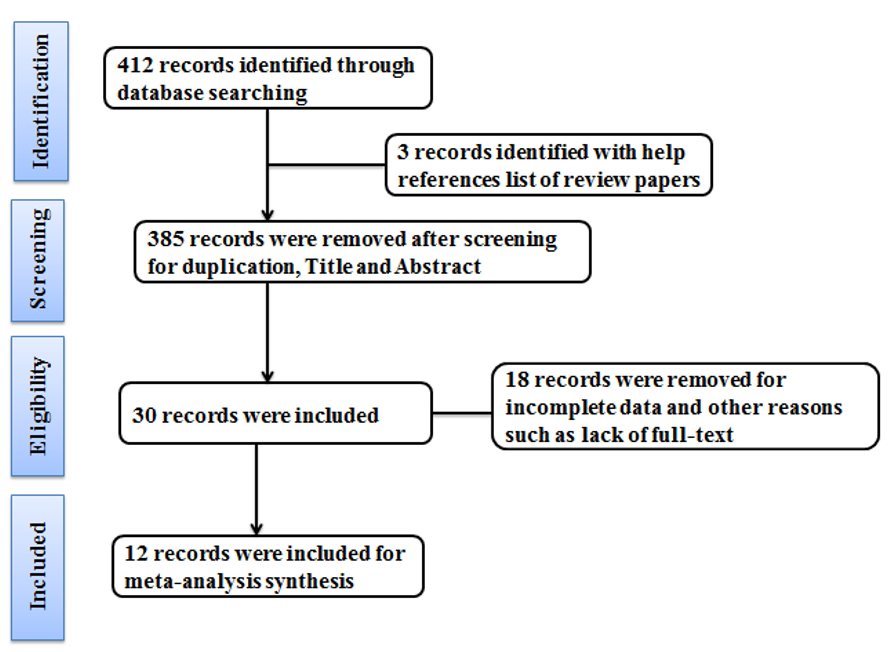
Figure 1. PRISMA flow diagram for included studies for the effects of exercises on BDNF
Findings
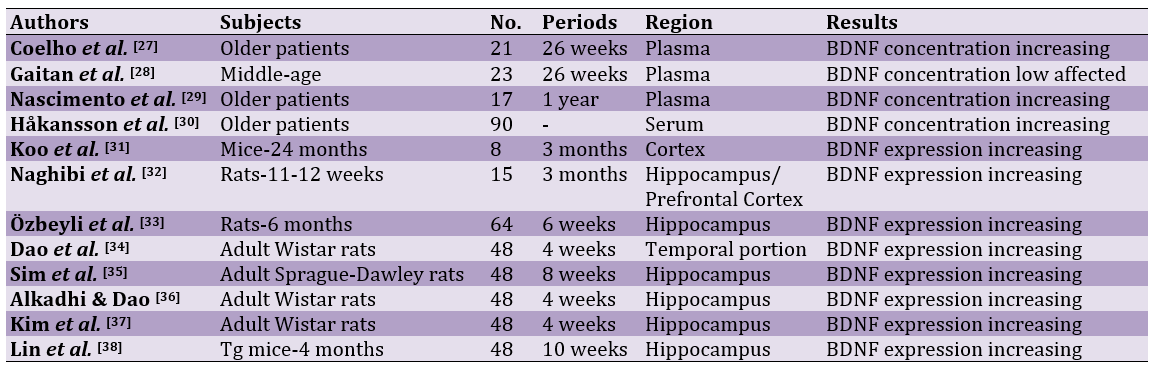
Twelve papers were reviewed, comprising 4 human and 8 animal studies. The periods for human studies lasted 26 to 52 weeks. Animal studies lasted 4 to 13 weeks. The samples were collected from plasma in human studies, while most animal studies were conducted on the expression of BDNF in the hippocampus (n=6). Out of 12 papers, 3 human papers and 8 animal studies showed that exercises significantly increased the concentration of the expression of BDNF (Table 1).
Table 1. Studies conducted on the effects of exercises on BDNF in subjects
Discussion
This systematic review assessed the effects of exercises on BDNF levels in subjects with Alzheimer's. Most human studies were conducted on middle-aged and elderly people. It is a common disease in elderly people. Alzheimer's disease in the elderly is a brain disorder that slowly destroys memory and thinking skills and, ultimately, the ability to do the simplest tasks. Recent estimates show that Alzheimer's disease is the third leading cause of death in the elderly after heart disease and cancer [39, 40].
Alzheimer's in the elderly is the most common cause of dementia among the elderly. Dementia is the loss of cognitive function-thinking, remembering, reasoning, and behavioral abilities to the extent that it interferes with a person's daily life and activities [41]. The severity of dementia ranges from the mildest stage, when it just begins to affect a person's functioning, to the most severe stage, when the person must be completely dependent on others for basic activities of daily living [42]. The damage occurs first in the hippocampus and entorhinal cortex, parts of the brain essential to forming memories. As more nerve cells die, other brain parts are affected and diminish. In the late stage of Alzheimer's in the elderly, the damage is extensive, and the brain tissue has significantly diminished [43].
Most studies on animal models were also conducted on elderly animals. Thus, animal models emphasize aged animals. The studies had differences for periods. Human studies were conducted for longer times, 26 weeks and longer. Since human studies were scarce, a relation between the period and efficiency of exercises can be stated. However, longer and shorter animal studies reported the positive effects. It can be stated that short-term exercises can increase BDNF in animal models. The results also showed that exercises influence the concentration of BDNF in the plasma. A study showed that exercises cannot positively affect the concentration plasma of BDNF [28]. The plasma concentration is not a good criterion for assessing BDNF and may not show the BDNF changes. However, most animal studies were conducted on the expression of BDNF. The expression of genes and changes in the hippocampus prove the effects of exercises on BDNF changes. Exercise could positively affect BDNF levels in the plasma and hippocampus. The exact mechanism that shows the effects exercises on the changes of the factor has not been determined. However, exercises may help improve this factor's concentration or its expression by increasing angiogenesis and reducing inflammation and oxidative stress [44, 45]. AD is accompanied with stress and inflammation [46, 47]. Several studies have reported anti-inflammatory and antioxidant properties of exercises [48-50].
Thus, exercises can be considered a supplementary treatment for patients with AD. We recommend clinical studies on humans with the help of assessing the expression of BDNF to elucidate the exercises on BDNF concentration.
Conclusion
Exercise has positive effects on improving and increasing the expression and concentrations of Brain-Derived Neurotrophic Factor.
Acknowledgments: Not applicable.
Ethical Permissions: Not applicable.
Conflicts of Interests: The authors declare no competing interests in this work.
Authors’ Contribution: Rostami Mehr S (First Author), Introduction Writer/Methodologist/ Statistical Analyst (20%); Hossein Gholizadeh Salmani R (Second Author), Methodologist/Statistical Analyst (10%); Abbasi-Maleki S (Third Author), Methodologist/Discussion Writer (10%); Rasheed S (Fourth Author), Methodologist/Statistical Analyst (15%); Lorenzo-Villegas DL (Fifth Author), Methodologist/Discussion Writer (15%); Haghipanah M (Sixth Author), Methodologist/Main or Assistant/Discussion Writer/Statistical Analyst (30%)
Funding/Support: Not applicable.
Alzheimer's disease (AD) is a type of brain dysfunction that gradually degrades the patient's mental abilities [1]. It is normal for people to become a little forgetful as they age, but memory disorder progresses gradually in AD [2]. Alzheimer's causes the death of nerve cells and loss of tissue throughout the brain [3]. With the severity of the disease, the brain tissue shrinks, and the areas containing cerebrospinal fluid become larger [4].
The damage caused by Alzheimer's affects the affected person's memory, speech, and perception. Memory problems are usually one of the first symptoms of Alzheimer's [5]. However, the initial symptoms of this disease vary from person to person. Complications such as impaired performance in other aspects of thinking, such as finding the right words while speaking, visual/spatial problems, and impaired reasoning or judgment can be another sign of the early stages of AD [6, 7]. Memory problems are usually one of the first symptoms of Alzheimer's [8]. However, the initial symptoms of this disease vary from person to person. Complications such as impaired performance in other aspects of thinking, such as finding the right words while speaking, visual/spatial problems, and impaired reasoning or judgment can be another sign of the early stages of Alzheimer's disease [9, 10].
Alzheimer's disease affects the secretion of many neurotrophins [11]. These are nerve growth factors and are a type of cytokine. Neurotrophins, including Brain-Derived Neurotrophic Factor (BDNF), are key in increasing sympathetic activity and blood pressure [12, 13]. Studies have shown that the level of BDNF decreases in AD, and the decrease in this factor is consistent with the decrease in hippocampal volume in this disease [14, 15]. BDNF affects the intracellular signaling pathway of the proliferation of hippocampus cells and thus interferes in the development of AD [16, 17].
Alzheimer's has no cure, and there is no way to slow down the rate of nerve damage that it causes in the brain [18]. However, some treatments seem to help maintain mental skills and reduce the effects of the disease. On the other hand, physical exercises can protect against deterioration [19]. Increasing physical activity is effective in different lifestyles and increases brain activity, especially in the hippocampus area (memory center and learning), thus decreasing AD's secondary effects [20, 21]. It seems that the aerobic exercise program can effectively improve the neuropsychological functions of these patients. Several studies have reported the efficiency of exercises on BDNF in AD [22-24], but there is no comprehensive review on the effects of exercise on BDNF in AD. Thus, this study aimed to evaluate the effects of exercises on Brain-Derived Neurotrophic Factor levels in patients with Alzheimer's.
Information and Methods
This study was conducted based on the Preferred Reporting Items for Systematic Reviews and Meta-Analyses (PRISMA) guidelines [25] in 2023. English papers on the effects of exercises on BDNF levels in subjects with Alzheimer's were included. Studies lacking complete data (e.g., lack of subjects, their numbers, periods, sample collection, and unclear results) were excluded. Unpublished papers, review papers, and studies with deficient information were not included. Papers were searched with keywords of “exercise” OR “BDNF” OR “neurotrophins” OR “rats” OR “mice” OR “humans”. The second strategy was to search reference lists in review articles for related articles. Articles were searched based on title and abstract. Duplicate papers were excluded, and potential papers were included. Searches were finalized on September 5th, 2023. Searches lasted for weeks to obtain final papers. Reviews and other mentioned non-related papers were excluded.
A standardized data coding form was prepared to extract the information from each study, including authors and publication year, study sample characteristics (number of subjects and their type), period of study, and results. Each study has only participated in the current research once [26]. In the current study, 12 articles were identified with the help of a database search and searching in a reference list. Keywords were searched in PubMed, Scopus, EuropePMC, Cochrane Central Database, Embase, and Web of Science databases (Figure 1). All the studies were managed with Endnote™ X9.2 (Thomson Reuters, Philadelphia, PA, USA) software. All the papers were read and investigated by two reviewers.
Figure 1. PRISMA flow diagram for included studies for the effects of exercises on BDNF
Findings
Twelve papers were reviewed, comprising 4 human and 8 animal studies. The periods for human studies lasted 26 to 52 weeks. Animal studies lasted 4 to 13 weeks. The samples were collected from plasma in human studies, while most animal studies were conducted on the expression of BDNF in the hippocampus (n=6). Out of 12 papers, 3 human papers and 8 animal studies showed that exercises significantly increased the concentration of the expression of BDNF (Table 1).
Table 1. Studies conducted on the effects of exercises on BDNF in subjects
Discussion
This systematic review assessed the effects of exercises on BDNF levels in subjects with Alzheimer's. Most human studies were conducted on middle-aged and elderly people. It is a common disease in elderly people. Alzheimer's disease in the elderly is a brain disorder that slowly destroys memory and thinking skills and, ultimately, the ability to do the simplest tasks. Recent estimates show that Alzheimer's disease is the third leading cause of death in the elderly after heart disease and cancer [39, 40].
Alzheimer's in the elderly is the most common cause of dementia among the elderly. Dementia is the loss of cognitive function-thinking, remembering, reasoning, and behavioral abilities to the extent that it interferes with a person's daily life and activities [41]. The severity of dementia ranges from the mildest stage, when it just begins to affect a person's functioning, to the most severe stage, when the person must be completely dependent on others for basic activities of daily living [42]. The damage occurs first in the hippocampus and entorhinal cortex, parts of the brain essential to forming memories. As more nerve cells die, other brain parts are affected and diminish. In the late stage of Alzheimer's in the elderly, the damage is extensive, and the brain tissue has significantly diminished [43].
Most studies on animal models were also conducted on elderly animals. Thus, animal models emphasize aged animals. The studies had differences for periods. Human studies were conducted for longer times, 26 weeks and longer. Since human studies were scarce, a relation between the period and efficiency of exercises can be stated. However, longer and shorter animal studies reported the positive effects. It can be stated that short-term exercises can increase BDNF in animal models. The results also showed that exercises influence the concentration of BDNF in the plasma. A study showed that exercises cannot positively affect the concentration plasma of BDNF [28]. The plasma concentration is not a good criterion for assessing BDNF and may not show the BDNF changes. However, most animal studies were conducted on the expression of BDNF. The expression of genes and changes in the hippocampus prove the effects of exercises on BDNF changes. Exercise could positively affect BDNF levels in the plasma and hippocampus. The exact mechanism that shows the effects exercises on the changes of the factor has not been determined. However, exercises may help improve this factor's concentration or its expression by increasing angiogenesis and reducing inflammation and oxidative stress [44, 45]. AD is accompanied with stress and inflammation [46, 47]. Several studies have reported anti-inflammatory and antioxidant properties of exercises [48-50].
Thus, exercises can be considered a supplementary treatment for patients with AD. We recommend clinical studies on humans with the help of assessing the expression of BDNF to elucidate the exercises on BDNF concentration.
Conclusion
Exercise has positive effects on improving and increasing the expression and concentrations of Brain-Derived Neurotrophic Factor.
Acknowledgments: Not applicable.
Ethical Permissions: Not applicable.
Conflicts of Interests: The authors declare no competing interests in this work.
Authors’ Contribution: Rostami Mehr S (First Author), Introduction Writer/Methodologist/ Statistical Analyst (20%); Hossein Gholizadeh Salmani R (Second Author), Methodologist/Statistical Analyst (10%); Abbasi-Maleki S (Third Author), Methodologist/Discussion Writer (10%); Rasheed S (Fourth Author), Methodologist/Statistical Analyst (15%); Lorenzo-Villegas DL (Fifth Author), Methodologist/Discussion Writer (15%); Haghipanah M (Sixth Author), Methodologist/Main or Assistant/Discussion Writer/Statistical Analyst (30%)
Funding/Support: Not applicable.
Article Type: Systematical Review/Meta-Analysis |
Subject:
Molecular Medicine
| Rights and permissions | |
 |
This work is licensed under a Creative Commons Attribution-NonCommercial 4.0 International License. |