Afarand Scholarly Publishing Institute
Publisher of open-access, peer-reviewed journals since 2003
5
Journals
CC BY-NC
Open access
10.58209
DOI prefix
Search Afarand journals
Volume -
3 , - : 769-775 |
Back to browse issues page


Download citation:
BibTeX | RIS | EndNote | Medlars | ProCite | Reference Manager | RefWorks
Send citation to:


BibTeX | RIS | EndNote | Medlars | ProCite | Reference Manager | RefWorks
Send citation to:
Predictors of Herbal Medicine Use Among Reproductive-Age Iranian Women Using a Socio-Ecological Model. 3 https://doi.org/10.58209/hehp.13.4.769
URL: http://daneshafarand.org/article-1-82859-en.html
URL: http://daneshafarand.org/article-1-82859-en.html
| Abstract (HTML) (986 Views)
Full-Text: (179 Views)
Introduction
Herbal medicine (HM), as one of the most common and popular complementary and alternative medicines, is increasing worldwide [1]. HM, which are widely used for both therapeutic and preventive purposes, encompass a range of elements such as herbs, herbal materials, herbal preparations, and finished herbal products, which may contain natural, organic, or inorganic active ingredients that are not derived from plants [2]. It is estimated that about 80% of the world’s population uses HM [3]. The findings of some studies in Iran reveal that HM products are used by 65.76% of Iranians [4].
HM is utilized to treat a variety of physical and mental disorders, including chronic pain management [5], psychiatric disorders [6], premenstrual syndrome [7], cancer treatment [8], cardiovascular complications of type II diabetes [9], reproductive health problems, such as reproductive ailments, venereal diseases, and infertility [10], digestive and sleep problems in newborns [11], and inflammation, and to boost the immune system [12]. Because HM does not have a specific dose like conventional drugs, using large amounts could be dangerous to the consumer’s health, and acute or chronic poisoning could occur [13]. The diagnosis and duration of the disease may also be delayed and prolonged by self-treatment with HM [14].
A number of factors have contributed to the use of HMs, including female gender, insufficient knowledge about HMs, history of chronic disease, social and cultural influences, socio-demographic characteristics, the perception that herbal products are safe and their availability, the high price of modern healthcare, and poor access to public health systems [15-17]. In addition, the belief that natural medicines are healthier and safer has led to an increase in the use of HM as a self-treatment method [3]. Studies have indicated that the source of information about HM is also important. Most consumers of HM are influenced by family members, friends and relatives, advertising, traditional doctors, the internet, and social networks. Nsibirwa et al. in Uganda showed that 76.2% of HM users are influenced by family members. Media, such as television, radio, and newspapers influence 52.5%, and other sources of information include their friends (23.8%), herbal practitioners (9.1%), and community elders (5.6%) [18]. Alqathama et al. also showed that most of the participants trust their family and friends (50.6%), social networks (23.7%), and the Internet (15.9%) when it came to self-medicating with herbs [19].
It is particularly important to identify the factors that influence people’s decisions to perform health-related behaviors. A comprehensive model that encompasses all the factors related to health behavior is required to examine these factors. The ecological model provides a useful framework for understanding factors across different levels—individual, interpersonal, organizational, and public health policy. The socio-ecological model (SEM) focuses on the interaction and interdependence of factors at all levels of a health problem. In some health studies, SEM has been recognized as a successful framework [20-22]. This model consists of five spheres of intervention, including individual, interpersonal, organizational, community, and public policy. Each of these levels interacts with the others and is independently effective in influencing behavior. Biopsychological factors like age, gender, personality, knowledge, and attitude are part of the intrapersonal sphere. An individual’s interactions with others (family, friends, relatives, and health staff) are also part of the interpersonal sphere. The organizational sphere (including institutional settings and affordances) has the potential to influence individuals through social institutions. The community and public policy spheres encompass parameters, such as social and cultural norms and values, and policies related to legal access to medicine and health-care policies at the macro level [20, 21, 23].
Factors that affect the consumption of HM have been investigated in some studies, but comprehensive behavioral models, like the ecological model have not been utilized widely. Women are the main consumers of HM according to the evidence, and reproductive age (15-49 years) is an important and effective period in women’s life cycle, which underpins healthy aging. Thus, the aim of this study was to investigate predictors of HM use among reproductive-age Iranian women using the SEM.
Instrument and Methods
This cross-sectional study included 190 reproductive-age women referred to Jahrom health centers in 2022. Inclusion criteria were being Iranian, literate (able to read and write), able to communicate effectively, living in Jahrom city, aged 15-49 years, and having no chronic diseases.
A random cluster sampling method was employed. Of the eight urban health centers in Jahrom, four centers were selected as clusters, and from each cluster a list of individuals meeting the inclusion criteria was extracted. Using a table of random numbers, 48 reproductive-age women were selected from each health center, for a total of 190 women included in the study. The sample size was calculated with a 95% confidence level (Zα=1.96), Zβ=0.84, d=0.1, and a standard deviation of 0.67 (obtained from a pilot study). This yielded a sample size of 172 participants; to increase the study power, 190 women were included in this study. The formula for calculating the sample size is as follows: n=Z2δ2/d2.
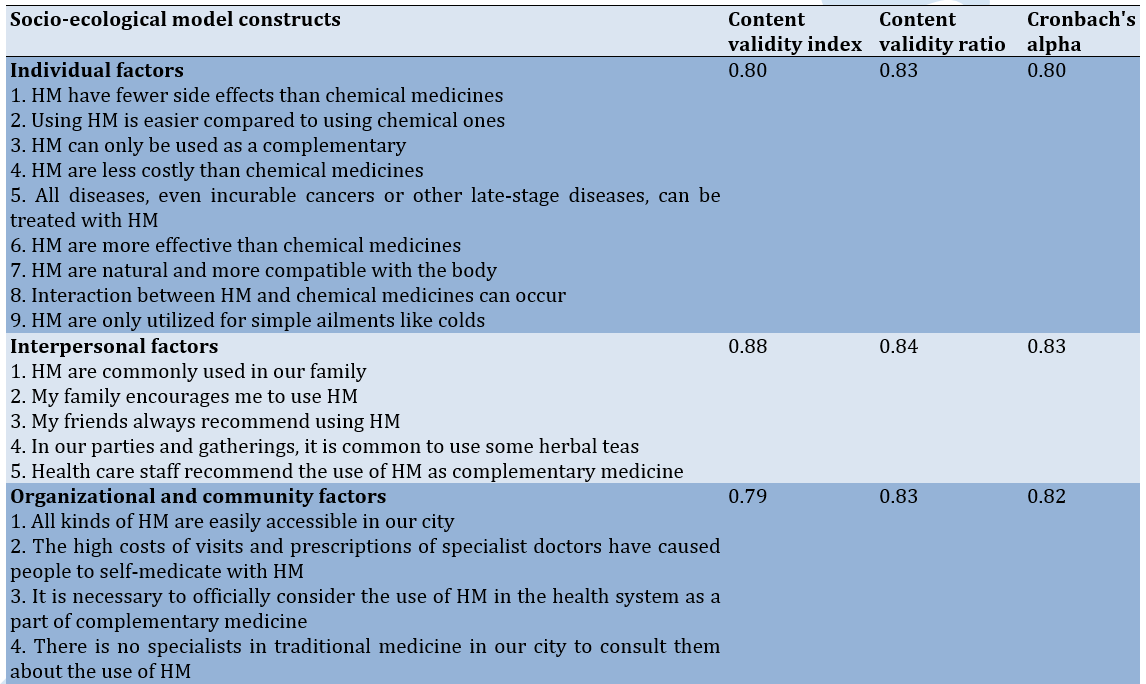
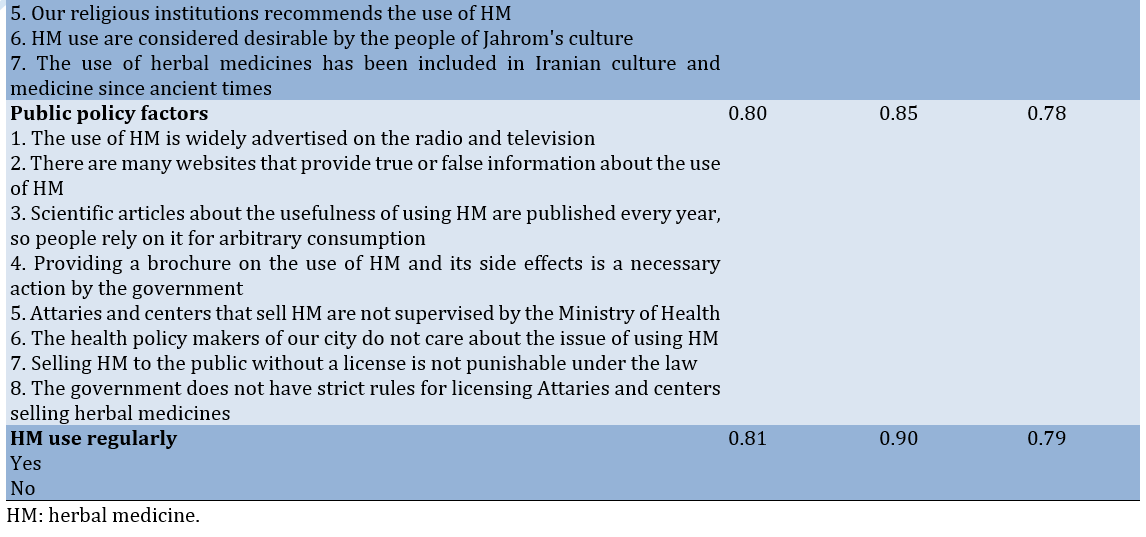
The data collection tool was a researcher-developed questionnaire comprising demographic information (6 items) and the constructs of the socio-ecological model, including individual factors (9 items), interpersonal factors (5 items), organizational and community factors (7 items), and public policy factors (8 items). A Likert scale was used to score all constructs, ranging from completely disagree (1) to completely agree (5); each item was scored 1–5. HM use was measured with a single item in which participants stated their HM use. The questionnaire’s validity was assessed by a panel of experts consisting of 10 health education experts using content validity methods, and the content validity ratio (CVR) and content validity index (CVI) were calculated. Cronbach’s alpha was used to assess reliability in a population similar to the target group (Table 1).
Table 1. Questionnaire items
A written informed consent was obtained from all participants. The study was performed in accordance with the Declaration of Helsinki.
Data analysis was performed using SPSS version 25. We applied odds ratios (ORs) and corresponding 95% confidence intervals (95% CIs) to examine univariate relationships between the assessed parameters and HM utilization. Parameters with p-values less than 0.20 in the univariate model were chosen for inclusion in the multivariate model. Adjusted ORs were estimated using backward multiple logistic regression to control for the effects of potential confounding parameters. The significance level was set at 0.05.
Findings
The mean age of participants was 33.84±9.66 years. In terms of education level, 15.8% had less than a diploma, 24.2% had a diploma, and 60% had an academic education. Of the total, 72.1% were housewives, 17.9% were employed, and 10% were self-employed. Additionally, 70% of women were married. The monthly family income for most women (66.3%) was reported as average, and 9.5% and 24.2% reported low and high economic status, respectively. Only 14.2% reported a history of underlying disease. 149 women (78.4%) reported using HM regularly.
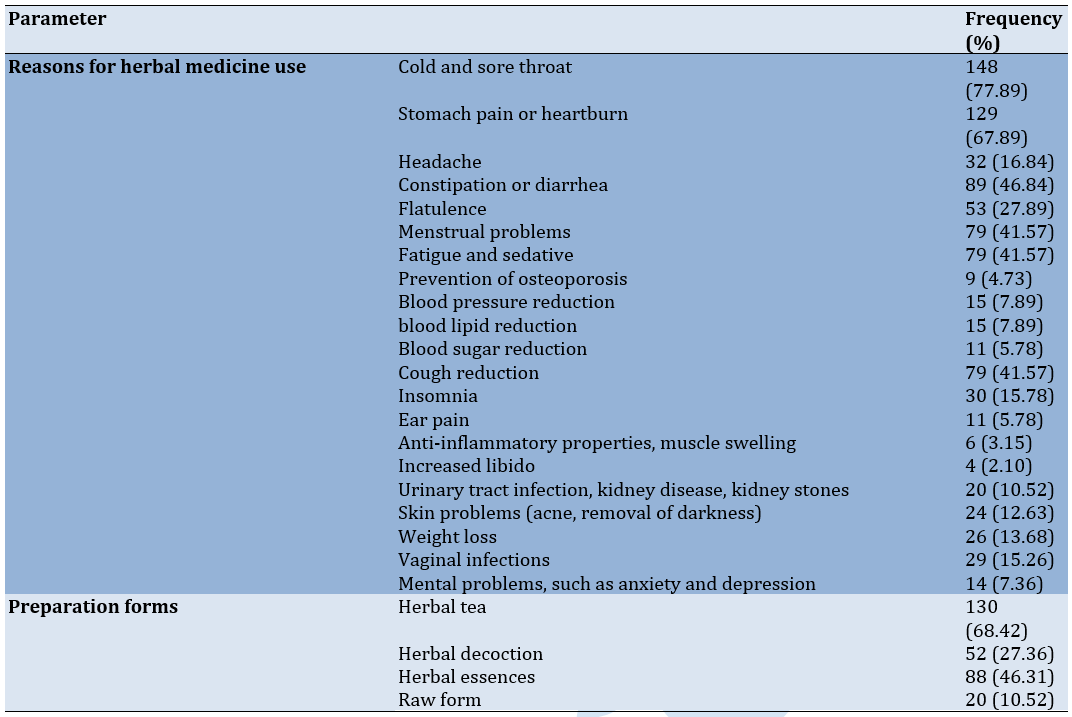
The most common reasons for using HM among women were cold and sore throat (n=148), stomach pain or heartburn (n=129), and constipation or diarrhea (n=89). Participants reported consuming HM primarily as herbal tea (n=130; Table 2).
Table 2. Reasons for herbal medicine use and preparation forms among participants (n=190)
There was a significant association between HM utilization and marital status, income level, and all SEM constructs (p<0.05). Age was not significantly associated with herbal medicine use (per-year increase: OR=0.98, 95% CI=0.95-1.02, p=0.40; Table 3).
Table 3. Univariate associations between independent parameters and herbal medicine use
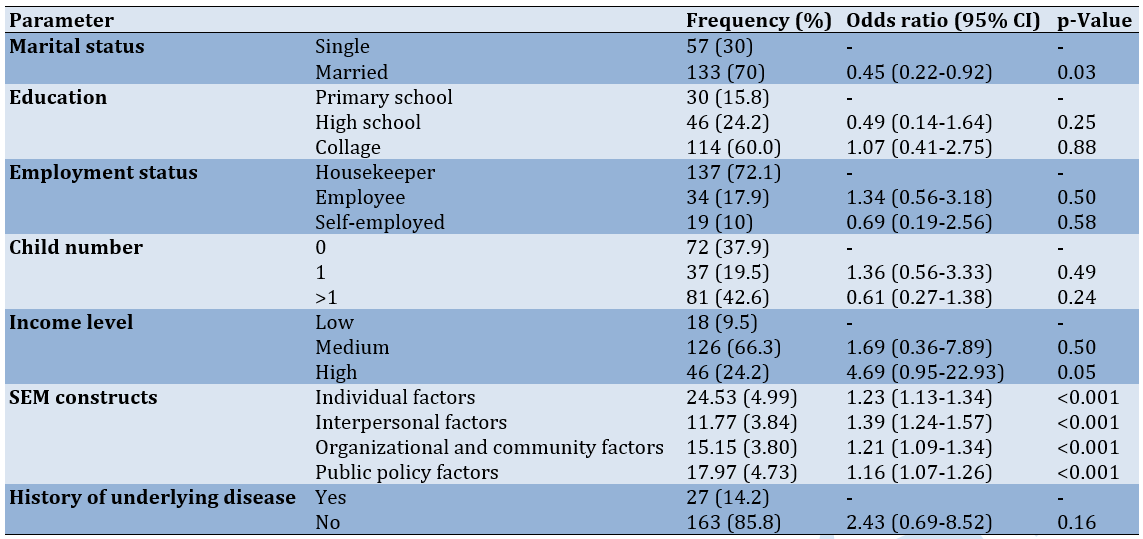
However, after adjustment using backward logistic regression, significant associations were only observed for the interpersonal and public policy constructs of the SEM (R2=0.382; Table 4).
Table 4. Multivariable-adjusted associations between the socio-ecological model (SEM) construct scores and herbal medicine use

Discussion
This study aimed to investigate predictors of HM use among reproductive-age Iranian women using the SEM. Interpersonal factors and public policy factors could explain 38% of the variance in HM use, with interpersonal factors identified as the strongest predictor. In some studies, behavioral theories and models have been used as appropriate frameworks for predicting complementary medicine use, such as HM. For example, Rochelle et al. applied the theory of planned behavior to explain the use of traditional Chinese medicine among Hong Kong Chinese in Britain and showed that gender, age, Chinese cultural attachment, subjective norms, and recent use of traditional medicine account for 25.3% of the variance explained in traditional Chinese medicine [24]. Furthermore, Afriyie & Kumi-Kyereme found that living in a district, being older than 20 years, believing that HMs work very well or at least somewhat, and believing that one could definitely or perhaps use HM with ease can predict HM use in the Ashanti Region of Ghana under the Health Belief Model [25]. Although individual factors, such as attitudes and beliefs are significant in the use of complementary medicine, the roles of other factors—such as social and structural factors and health policies—have been discussed in only a few studies. SEM can provide a more comprehensive framework for investigating HM use.
Interpersonal factors, as the strongest predictor among SEM constructs, had a positive and direct relationship with HM use. In some studies, it has been suggested that family, friends, and healthcare staff play a role in the decision to use or not use HM. Mountifield et al. showed that more than 50% of Australian patients’ family or friends use complementary and alternative treatment for any health purpose, and this factor predicts regular complementary and alternative therapy in inflammatory bowel disease [26]. Also, Karimian et al. stated that the use of HM among Iranian pregnant women is more likely to be used if family members and friends acknowledge it [27]. Bayisa et al. concluded that due to the lack of integration of traditional medicine in the Ethiopian health system, women obtain information about HMs from family and neighbors, which leads to an increase in self-treatment. According to their report, only 14.29% of women have received health advice from healthcare personnel, and this may indicate healthcare workers are not effectively consulted about alternative therapies or healthcare staff may be reluctant to give advice in such matters, or both [28]. Family members and friends play an important role in determining whether health-related behaviors are adopted; therefore, it is important to pay attention to these factors in educational interventions to reduce self-treatment with HMs among reproductive-age women. Healthcare workers should also be informed about the indications, limitations, and side effects of HM, to be able to advise reproductive-age women about appropriate HM therapy that does not conflict with modern medical prescriptions and is provided as complementary medicine.
Although individual factors had a statistically significant relationship with HM use, they could not predict HM use at the final stage. The use of HM has been investigated by examining individual factors such as knowledge, attitudes, or beliefs in some studies. Kristianto et al. showed that having knowledge about HM is positively linked to HM use and holistic health beliefs, and pro-complementary and alternative medicine attitudes are also found to be independently associated with HM use [29]. Some studies have shown that individual factors, such as female gender are related to increased HM use. Also, beliefs, such as that HMs can be used to promote health and treat diseases, are safe and can be used with conventional or allopathic medicines, have been reported as common beliefs among people [15]. Thus, health education strategies—such as holding educational workshops in health centers, providing tailored educational materials about how to use HM and its possible consequences, and creating group discussions about the reasons and motivations of reproductive-age women—can be suitable approaches to ensure that individual factors are taken into account in relation to appropriate HM use.
Public policy factors were also directly related to HM use and were another significant predictor in this study. According to the World Health Organization’s global survey, about 64% of member states (around 124 countries) report having laws or regulations regarding HM. Also, the registration system for HMs has been reported by approximately 65% of them [2]. However, in many countries, there are still no specific laws for the use of HM in the health system, or there is no necessary supervision for the people who sell these drugs. Demeke et al. [30] indicated that there are no defined policies, laws, or registration for HM in Ethiopia. They also report that traditional healers claim they are licensed by the health system to legally practice traditional HM, but no traditional healer is licensed by the Ethiopian Food and Drug Administration or the Ministry of Health. In Iran, traditional medicine has recently been officially integrated into the health system by the Ministry of Health. The purpose of this action is to use the knowledge of traditional medicine specialists and scientific resources in this field, along with modern medicine, to prevent disease. The increasing demand for HM, particularly in developing countries, and the consequences of their improper use, necessitated health policy makers to reasonably update their HM policies to protect the general community.
Although organizational and community factors (such as the costs of modern medicine, easy access to HM, and an encouraging culture in the community) were not among the predictors, they were significantly associated with HM, similar to other studies. Asare et al. state that doctors’ prescriptions, HM affordability, willingness to use HM, and the availability of HM are facilitators of HM use in Ghana [16]. On the other hand, Rochelle et al. report that respondents with strong attachment to Chinese culture are more likely to use traditional complementary medicine and express satisfaction with TCM services [24].
Using HM was higher in married women and in participants without a history of underlying disease, but it was not related to other socio-economic parameters. Demographic and socio-economic factors related to HM use have been studied in several studies. Kretchy et al. report that all sociodemographic characteristics (including age, religion, marital status, educational level, and employment status) except for sex are significantly associated with HM use among Ghanaian adults [31]. Zaidi et al. also show that a significantly higher number of chronic disease patients are using HM, whereas individuals with no medical problems are least likely to use HM. These differences can be due to a variety of factors, including sample size, geography, and socioeconomic status of the studied population. It is important that these parameters are also considered in interventions to improve reproductive-age women’s health.
The strength of this study is the use of a valid and reliable, researcher-made questionnaire with a comprehensive theoretical framework based on SEM, which is an appropriate model for identifying factors related to HM use in community members. One limitation of the study is the use of a self-report scale, and therefore, the participants’ responses may be subject to their personal interpretations. To address this problem, the instrument has been continuously reviewed by a panel of experts in order to develop a comprehensive questionnaire. In addition, participants in this study were selected from reproductive-age women in urban areas, and it is therefore recommended to replicate the study among people in rural or other cultural settings or age groups. It is necessary for health planners to consider comprehensive factors related to HM use in educational intervention programs based on a proper framework, such as SEM.
Conclusion
Herbal medicine use among reproductive-age women is related to psychological and demographic factors and interpersonal factors are the strongest predictor of herbal medicine use.
Acknowledgments: The authors thank all middle-aged women who participated in this study, as well as health managers and relevant health staff in health centers.
Ethical Permissions: The protocol of the study was approved by the ethics committee of Jahrom University of Medical Sciences (IR.JUMS.REC.1400.060).
Conflicts of Interests: The authors declared that they have no competing interests.
Authors' Contribution: Rahimi T (First Author), Introduction Writer/Methodologist/Main Researcher/Discussion Writer (40%); Mohammadi M (Second Author), Assistant Researcher/Discussion Writer (15%); Jowzi F (Third Author), Introduction Writer/Assistant Researcher (15%); Sarikhani Y (Fourth Author), Methodologist/Statistical Analyst (30%)
Funding/Support: This project was supported by the Jahrom University of Medical Sciences, Jahrom, Iran.
Herbal medicine (HM), as one of the most common and popular complementary and alternative medicines, is increasing worldwide [1]. HM, which are widely used for both therapeutic and preventive purposes, encompass a range of elements such as herbs, herbal materials, herbal preparations, and finished herbal products, which may contain natural, organic, or inorganic active ingredients that are not derived from plants [2]. It is estimated that about 80% of the world’s population uses HM [3]. The findings of some studies in Iran reveal that HM products are used by 65.76% of Iranians [4].
HM is utilized to treat a variety of physical and mental disorders, including chronic pain management [5], psychiatric disorders [6], premenstrual syndrome [7], cancer treatment [8], cardiovascular complications of type II diabetes [9], reproductive health problems, such as reproductive ailments, venereal diseases, and infertility [10], digestive and sleep problems in newborns [11], and inflammation, and to boost the immune system [12]. Because HM does not have a specific dose like conventional drugs, using large amounts could be dangerous to the consumer’s health, and acute or chronic poisoning could occur [13]. The diagnosis and duration of the disease may also be delayed and prolonged by self-treatment with HM [14].
A number of factors have contributed to the use of HMs, including female gender, insufficient knowledge about HMs, history of chronic disease, social and cultural influences, socio-demographic characteristics, the perception that herbal products are safe and their availability, the high price of modern healthcare, and poor access to public health systems [15-17]. In addition, the belief that natural medicines are healthier and safer has led to an increase in the use of HM as a self-treatment method [3]. Studies have indicated that the source of information about HM is also important. Most consumers of HM are influenced by family members, friends and relatives, advertising, traditional doctors, the internet, and social networks. Nsibirwa et al. in Uganda showed that 76.2% of HM users are influenced by family members. Media, such as television, radio, and newspapers influence 52.5%, and other sources of information include their friends (23.8%), herbal practitioners (9.1%), and community elders (5.6%) [18]. Alqathama et al. also showed that most of the participants trust their family and friends (50.6%), social networks (23.7%), and the Internet (15.9%) when it came to self-medicating with herbs [19].
It is particularly important to identify the factors that influence people’s decisions to perform health-related behaviors. A comprehensive model that encompasses all the factors related to health behavior is required to examine these factors. The ecological model provides a useful framework for understanding factors across different levels—individual, interpersonal, organizational, and public health policy. The socio-ecological model (SEM) focuses on the interaction and interdependence of factors at all levels of a health problem. In some health studies, SEM has been recognized as a successful framework [20-22]. This model consists of five spheres of intervention, including individual, interpersonal, organizational, community, and public policy. Each of these levels interacts with the others and is independently effective in influencing behavior. Biopsychological factors like age, gender, personality, knowledge, and attitude are part of the intrapersonal sphere. An individual’s interactions with others (family, friends, relatives, and health staff) are also part of the interpersonal sphere. The organizational sphere (including institutional settings and affordances) has the potential to influence individuals through social institutions. The community and public policy spheres encompass parameters, such as social and cultural norms and values, and policies related to legal access to medicine and health-care policies at the macro level [20, 21, 23].
Factors that affect the consumption of HM have been investigated in some studies, but comprehensive behavioral models, like the ecological model have not been utilized widely. Women are the main consumers of HM according to the evidence, and reproductive age (15-49 years) is an important and effective period in women’s life cycle, which underpins healthy aging. Thus, the aim of this study was to investigate predictors of HM use among reproductive-age Iranian women using the SEM.
Instrument and Methods
This cross-sectional study included 190 reproductive-age women referred to Jahrom health centers in 2022. Inclusion criteria were being Iranian, literate (able to read and write), able to communicate effectively, living in Jahrom city, aged 15-49 years, and having no chronic diseases.
A random cluster sampling method was employed. Of the eight urban health centers in Jahrom, four centers were selected as clusters, and from each cluster a list of individuals meeting the inclusion criteria was extracted. Using a table of random numbers, 48 reproductive-age women were selected from each health center, for a total of 190 women included in the study. The sample size was calculated with a 95% confidence level (Zα=1.96), Zβ=0.84, d=0.1, and a standard deviation of 0.67 (obtained from a pilot study). This yielded a sample size of 172 participants; to increase the study power, 190 women were included in this study. The formula for calculating the sample size is as follows: n=Z2δ2/d2.
The data collection tool was a researcher-developed questionnaire comprising demographic information (6 items) and the constructs of the socio-ecological model, including individual factors (9 items), interpersonal factors (5 items), organizational and community factors (7 items), and public policy factors (8 items). A Likert scale was used to score all constructs, ranging from completely disagree (1) to completely agree (5); each item was scored 1–5. HM use was measured with a single item in which participants stated their HM use. The questionnaire’s validity was assessed by a panel of experts consisting of 10 health education experts using content validity methods, and the content validity ratio (CVR) and content validity index (CVI) were calculated. Cronbach’s alpha was used to assess reliability in a population similar to the target group (Table 1).
Table 1. Questionnaire items
A written informed consent was obtained from all participants. The study was performed in accordance with the Declaration of Helsinki.
Data analysis was performed using SPSS version 25. We applied odds ratios (ORs) and corresponding 95% confidence intervals (95% CIs) to examine univariate relationships between the assessed parameters and HM utilization. Parameters with p-values less than 0.20 in the univariate model were chosen for inclusion in the multivariate model. Adjusted ORs were estimated using backward multiple logistic regression to control for the effects of potential confounding parameters. The significance level was set at 0.05.
Findings
The mean age of participants was 33.84±9.66 years. In terms of education level, 15.8% had less than a diploma, 24.2% had a diploma, and 60% had an academic education. Of the total, 72.1% were housewives, 17.9% were employed, and 10% were self-employed. Additionally, 70% of women were married. The monthly family income for most women (66.3%) was reported as average, and 9.5% and 24.2% reported low and high economic status, respectively. Only 14.2% reported a history of underlying disease. 149 women (78.4%) reported using HM regularly.
The most common reasons for using HM among women were cold and sore throat (n=148), stomach pain or heartburn (n=129), and constipation or diarrhea (n=89). Participants reported consuming HM primarily as herbal tea (n=130; Table 2).
Table 2. Reasons for herbal medicine use and preparation forms among participants (n=190)
There was a significant association between HM utilization and marital status, income level, and all SEM constructs (p<0.05). Age was not significantly associated with herbal medicine use (per-year increase: OR=0.98, 95% CI=0.95-1.02, p=0.40; Table 3).
Table 3. Univariate associations between independent parameters and herbal medicine use
However, after adjustment using backward logistic regression, significant associations were only observed for the interpersonal and public policy constructs of the SEM (R2=0.382; Table 4).
Table 4. Multivariable-adjusted associations between the socio-ecological model (SEM) construct scores and herbal medicine use
Discussion
This study aimed to investigate predictors of HM use among reproductive-age Iranian women using the SEM. Interpersonal factors and public policy factors could explain 38% of the variance in HM use, with interpersonal factors identified as the strongest predictor. In some studies, behavioral theories and models have been used as appropriate frameworks for predicting complementary medicine use, such as HM. For example, Rochelle et al. applied the theory of planned behavior to explain the use of traditional Chinese medicine among Hong Kong Chinese in Britain and showed that gender, age, Chinese cultural attachment, subjective norms, and recent use of traditional medicine account for 25.3% of the variance explained in traditional Chinese medicine [24]. Furthermore, Afriyie & Kumi-Kyereme found that living in a district, being older than 20 years, believing that HMs work very well or at least somewhat, and believing that one could definitely or perhaps use HM with ease can predict HM use in the Ashanti Region of Ghana under the Health Belief Model [25]. Although individual factors, such as attitudes and beliefs are significant in the use of complementary medicine, the roles of other factors—such as social and structural factors and health policies—have been discussed in only a few studies. SEM can provide a more comprehensive framework for investigating HM use.
Interpersonal factors, as the strongest predictor among SEM constructs, had a positive and direct relationship with HM use. In some studies, it has been suggested that family, friends, and healthcare staff play a role in the decision to use or not use HM. Mountifield et al. showed that more than 50% of Australian patients’ family or friends use complementary and alternative treatment for any health purpose, and this factor predicts regular complementary and alternative therapy in inflammatory bowel disease [26]. Also, Karimian et al. stated that the use of HM among Iranian pregnant women is more likely to be used if family members and friends acknowledge it [27]. Bayisa et al. concluded that due to the lack of integration of traditional medicine in the Ethiopian health system, women obtain information about HMs from family and neighbors, which leads to an increase in self-treatment. According to their report, only 14.29% of women have received health advice from healthcare personnel, and this may indicate healthcare workers are not effectively consulted about alternative therapies or healthcare staff may be reluctant to give advice in such matters, or both [28]. Family members and friends play an important role in determining whether health-related behaviors are adopted; therefore, it is important to pay attention to these factors in educational interventions to reduce self-treatment with HMs among reproductive-age women. Healthcare workers should also be informed about the indications, limitations, and side effects of HM, to be able to advise reproductive-age women about appropriate HM therapy that does not conflict with modern medical prescriptions and is provided as complementary medicine.
Although individual factors had a statistically significant relationship with HM use, they could not predict HM use at the final stage. The use of HM has been investigated by examining individual factors such as knowledge, attitudes, or beliefs in some studies. Kristianto et al. showed that having knowledge about HM is positively linked to HM use and holistic health beliefs, and pro-complementary and alternative medicine attitudes are also found to be independently associated with HM use [29]. Some studies have shown that individual factors, such as female gender are related to increased HM use. Also, beliefs, such as that HMs can be used to promote health and treat diseases, are safe and can be used with conventional or allopathic medicines, have been reported as common beliefs among people [15]. Thus, health education strategies—such as holding educational workshops in health centers, providing tailored educational materials about how to use HM and its possible consequences, and creating group discussions about the reasons and motivations of reproductive-age women—can be suitable approaches to ensure that individual factors are taken into account in relation to appropriate HM use.
Public policy factors were also directly related to HM use and were another significant predictor in this study. According to the World Health Organization’s global survey, about 64% of member states (around 124 countries) report having laws or regulations regarding HM. Also, the registration system for HMs has been reported by approximately 65% of them [2]. However, in many countries, there are still no specific laws for the use of HM in the health system, or there is no necessary supervision for the people who sell these drugs. Demeke et al. [30] indicated that there are no defined policies, laws, or registration for HM in Ethiopia. They also report that traditional healers claim they are licensed by the health system to legally practice traditional HM, but no traditional healer is licensed by the Ethiopian Food and Drug Administration or the Ministry of Health. In Iran, traditional medicine has recently been officially integrated into the health system by the Ministry of Health. The purpose of this action is to use the knowledge of traditional medicine specialists and scientific resources in this field, along with modern medicine, to prevent disease. The increasing demand for HM, particularly in developing countries, and the consequences of their improper use, necessitated health policy makers to reasonably update their HM policies to protect the general community.
Although organizational and community factors (such as the costs of modern medicine, easy access to HM, and an encouraging culture in the community) were not among the predictors, they were significantly associated with HM, similar to other studies. Asare et al. state that doctors’ prescriptions, HM affordability, willingness to use HM, and the availability of HM are facilitators of HM use in Ghana [16]. On the other hand, Rochelle et al. report that respondents with strong attachment to Chinese culture are more likely to use traditional complementary medicine and express satisfaction with TCM services [24].
Using HM was higher in married women and in participants without a history of underlying disease, but it was not related to other socio-economic parameters. Demographic and socio-economic factors related to HM use have been studied in several studies. Kretchy et al. report that all sociodemographic characteristics (including age, religion, marital status, educational level, and employment status) except for sex are significantly associated with HM use among Ghanaian adults [31]. Zaidi et al. also show that a significantly higher number of chronic disease patients are using HM, whereas individuals with no medical problems are least likely to use HM. These differences can be due to a variety of factors, including sample size, geography, and socioeconomic status of the studied population. It is important that these parameters are also considered in interventions to improve reproductive-age women’s health.
The strength of this study is the use of a valid and reliable, researcher-made questionnaire with a comprehensive theoretical framework based on SEM, which is an appropriate model for identifying factors related to HM use in community members. One limitation of the study is the use of a self-report scale, and therefore, the participants’ responses may be subject to their personal interpretations. To address this problem, the instrument has been continuously reviewed by a panel of experts in order to develop a comprehensive questionnaire. In addition, participants in this study were selected from reproductive-age women in urban areas, and it is therefore recommended to replicate the study among people in rural or other cultural settings or age groups. It is necessary for health planners to consider comprehensive factors related to HM use in educational intervention programs based on a proper framework, such as SEM.
Conclusion
Herbal medicine use among reproductive-age women is related to psychological and demographic factors and interpersonal factors are the strongest predictor of herbal medicine use.
Acknowledgments: The authors thank all middle-aged women who participated in this study, as well as health managers and relevant health staff in health centers.
Ethical Permissions: The protocol of the study was approved by the ethics committee of Jahrom University of Medical Sciences (IR.JUMS.REC.1400.060).
Conflicts of Interests: The authors declared that they have no competing interests.
Authors' Contribution: Rahimi T (First Author), Introduction Writer/Methodologist/Main Researcher/Discussion Writer (40%); Mohammadi M (Second Author), Assistant Researcher/Discussion Writer (15%); Jowzi F (Third Author), Introduction Writer/Assistant Researcher (15%); Sarikhani Y (Fourth Author), Methodologist/Statistical Analyst (30%)
Funding/Support: This project was supported by the Jahrom University of Medical Sciences, Jahrom, Iran.
Article Type: Descriptive & Survey |
| Rights and permissions | |
 |
This work is licensed under a Creative Commons Attribution-NonCommercial 4.0 International License. |