


Volume -
3 , - : 617-623 |
Back to browse issues page



Download citation:
BibTeX | RIS | EndNote | Medlars | ProCite | Reference Manager | RefWorks
Send citation to:


BibTeX | RIS | EndNote | Medlars | ProCite | Reference Manager | RefWorks
Send citation to:
Effective Determinant Factors on the Quality of Life in Hypertensive Wakatobi Patients, Indonesia. 3 https://doi.org/10.58209/hehp.13.4.617
URL: http://daneshafarand.org/article-1-82920-en.html
URL: http://daneshafarand.org/article-1-82920-en.html
| Abstract (HTML) (724 Views)
Full-Text: (38 Views)
Introduction
Hypertension is one of the major non-communicable diseases (NCDs) with a steadily increasing global prevalence [1, 2]. The World Health Organization (WHO) estimates that more than 1.28 billion adults are living with hypertension, two-thirds of whom reside in low- and middle-income countries [3]. Hypertension is widely recognized as a “silent killer” because it often presents without symptoms but can lead to serious complications, such as stroke, kidney failure, and coronary heart disease. Consequently, controlling hypertension has become a global and national health priority to reduce morbidity, mortality, and the economic burden caused by this disease [4, 5].
In Indonesia, hypertension remains a major public health problem. According to the 2018 Basic Health Research (Riskesdas), the prevalence of hypertension among individuals aged ≥18 years reached 34.1% [6]. One of the greatest challenges is the low level of adherence to antihypertensive medication. Many patients discontinue treatment on their own when they feel well, forget to take their medication, or face financial constraints. Poor adherence results in uncontrolled blood pressure, an increased risk of complications, and a reduced quality of life for hypertensive patients [7, 8].
Poor adherence is also evident in coastal communities, including Wakatobi District in Southeast Sulawesi. The region’s geographic characteristics as an archipelago, limited access to healthcare facilities, and relatively low educational and economic levels further exacerbate the situation [9]. Although healthcare services are available through primary health centers (Puskesmas) and integrated health posts (posyandu), many hypertensive patients still do not take their medications regularly. This reflects a gap between the availability of healthcare services and patients’ health behaviors in managing their conditions [10].
Previous studies have examined factors associated with the quality of life of hypertensive patients, including social support, knowledge, attitudes, perceptions, and motivation [11, 12]. However, most of these studies have focused only on the direct effects of these factors. Few have specifically examined medication adherence as a mediating factor that explains how determinant factors contribute to quality of life. Adherence is a key component in hypertension management that may strengthen the relationship between determinant factors and patients’ quality of life [13, 14].
This study is particularly important because coastal communities, such as those in Wakatobi District, have unique social, cultural, and geographic characteristics that may influence health behaviors. Poor adherence in such settings may worsen health outcomes and diminish the quality of life among hypertensive patients. By examining adherence as a mediator, interventions can be better targeted to improve hypertension management in coastal communities [15, 16].
The novelty of this research lies in the use of medication adherence as a mediating variable in the relationship between determinant factors (social support, perception, knowledge, attitude, and motivation) and the quality of life of hypertensive patients in coastal Wakatobi. We not only assessed direct relationships but also explored the mediation mechanisms through which these factors influence quality of life via adherence. Such an approach provides a more comprehensive understanding compared to previous studies.
The objective of this study was to analyze the relationship between determinant factors and the quality of life of hypertensive patients, with medication adherence as a mediating factor. Furthermore, we aimed to develop a conceptual model illustrating how social support, perception, knowledge, attitude, and motivation influence quality of life through adherence, specifically among coastal communities in Wakatobi District.
The study is expected to provide both theoretical and practical contributions. Theoretically, it enriches the literature on the role of medication adherence as a mediator in improving the quality of life of hypertensive patients, particularly in coastal contexts. Practically, the findings may serve as the basis for developing community-based educational interventions that are tailored to the geographic and sociocultural conditions of coastal communities. Thus, this research can assist healthcare workers, local governments, and stakeholders in designing strategies to enhance medication adherence and the quality of life of hypertensive patients in archipelagic areas.
Instrument and Methods
This observational analytic study using a cross-sectional quantitative approach was conducted among coastal communities in Wakatobi District, Southeast Sulawesi in 2025.
The location was selected due to its unique archipelagic setting, limited access to healthcare services, and distinctive behavioral patterns, making it a relevant context for examining factors influencing medication adherence and quality of life in hypertensive patients.
The sample consisted of all hypertensive patients aged 18 years and above residing in the coastal areas of Wakatobi District. A total of 200 respondents were recruited based on the inclusion criteria, including being ≥18 years of age, diagnosed with hypertension, residing in the study area for at least six months, and willing to participate by signing informed consent. Exclusion criteria included patients with severe cognitive impairment, those undergoing hospitalization, or those experiencing acute cardiovascular events during data collection.
A multistage cluster sampling technique was applied. Representative coastal villages/wards across selected subdistricts were first chosen, followed by the random selection of respondents from healthcare facility records until the sample quota for each cluster was met. Based on calculations using the Cochran formula with finite population correction, for a population of 350 individuals, a 95% confidence level (Z=1.96), a proportion (p)=0.5, and a margin of error of 5%, the required sample size was 182 respondents. This number is considered sufficient to represent the population with the desired level of accuracy. However, to anticipate potential issues, such as incomplete data or participant nonresponse, it is recommended to add approximately 10% as a buffer. Therefore, the ideal total sample size for this study is approximately 200 respondents, ensuring that the research results remain valid and representative of the target population.
The study examined the relationships among key constructs, including the quality of life of hypertensive patients (as the outcome), medication adherence (as the mediating factor), and several determinants such as social support, illness perception, knowledge, attitude toward treatment, and motivation. Quality of life was measured using the WHO Quality of Life Assessment Instrument (WHOQOL-BREF), which covers four domains (physical, psychological, social, and environmental) on a 5-point Likert scale [17]. Medication adherence was assessed using the validated Morisky Medication Adherence Scale (MMAS-8) [18]. Social support was measured using the Multidimensional Scale of Perceived Social Support (MSPSS) [19], illness perception was based on the Health Belief Model framework, knowledge was assessed with the Hypertension Knowledge Questionnaire, attitudes toward treatment were measured with Likert-scale items, and motivation was evaluated using the Medication Adherence Motivation Scale [20]. All tools were adapted, tested for validity and reliability, and categorized according to measurement standards.
Data were collected through face-to-face interviews using structured questionnaires administered by trained enumerators. Demographic and basic clinical data, such as age, sex, duration of hypertension, and type of medication used, were also recorded. Following data collection, responses were entered into a database, checked for completeness, and cleaned to prevent entry errors.
Bivariate analysis employed cross-tabulations and Chi-square tests to examine relationships between categorical factors, with a significance threshold of p<0.05. Multivariate analysis was conducted using SEM-PLS with SmartPLS version 3 software. Measurement model evaluation included tests of convergent validity, discriminant validity, and composite reliability, while the structural model was assessed using bootstrapping to determine path significance.
Preliminary data analyses were conducted using SPSS version 25. Mediation path analysis was performed with SmartPLS to obtain a comprehensive understanding of both direct and indirect relationships among the studied constructs.
Findings
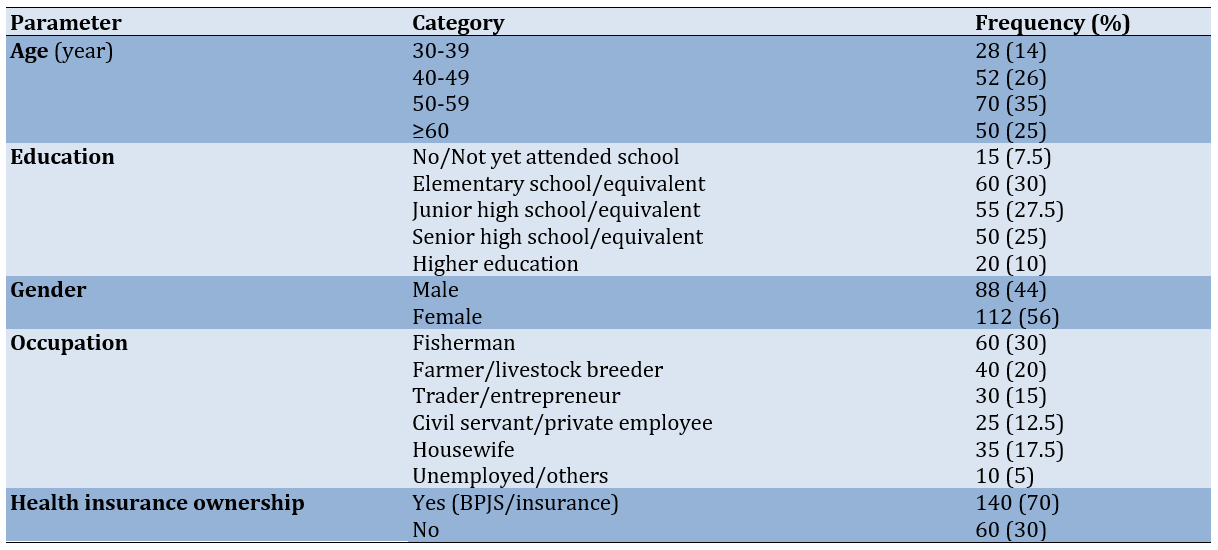
The majority of participants were in middle to older adulthood, with a relatively balanced gender distribution and varying educational and occupational backgrounds. Most respondents were covered by health insurance, reflecting access to basic healthcare services (Table 1).
Table 1. Characteristics of respondents
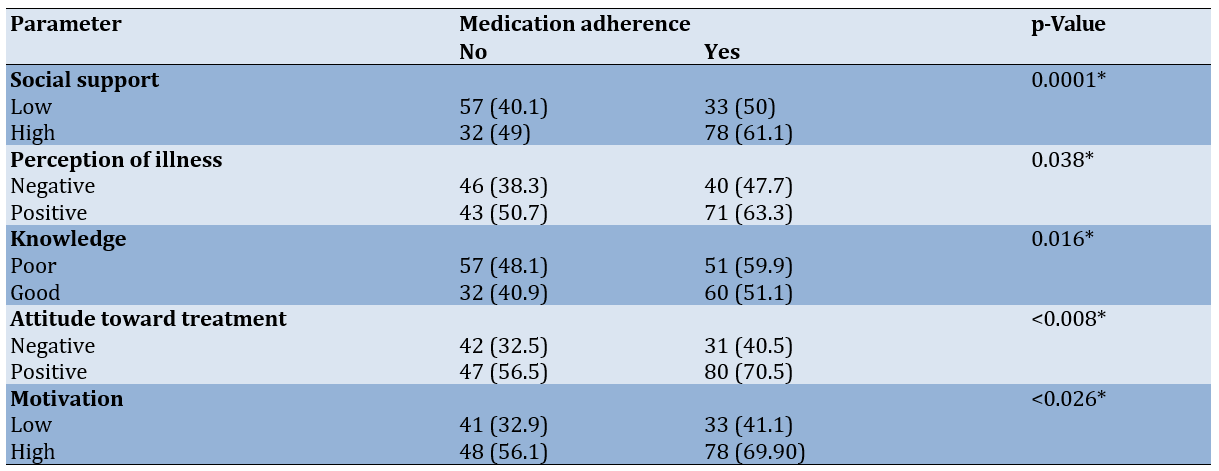
There were significant associations between all determinant factors—social support, illness perception, knowledge, attitude toward treatment, and motivation—and medication adherence (p<0.05). Respondents with higher levels of support, better understanding, and more positive attitudes and motivation tended to be more adherent to antihypertensive treatment. A significant positive association was found between medication adherence and quality of life (p=0.013). Patients who adhered to their medication regimen generally reported a better quality of life compared to those who were non-adherent (Table 2).
Table 2. Relationship between determinant factors and medication adherence among hypertensive patients in Wakatobi district
The obtained structural model using the SEM-PLS approach described how determinant factors, such as social support, illness perception, knowledge, attitude, and motivation influenced quality of life both directly and indirectly through medication adherence. All independent factors had a positive relationship with adherence, although the strength of their effects varies. Social support, knowledge, attitude, and motivation tended to contribute more significantly to adherence compared to illness perception. Meanwhile, the path from adherence to quality of life demonstrated a positive effect, indicating that higher medication adherence is associated with better quality of life in hypertension patients.
In addition, there were also direct paths from the independent factors to quality of life. Some factors, such as social support and motivation, although their direct effects were relatively smaller, still contributed to patients’ quality of life (Figure 1).
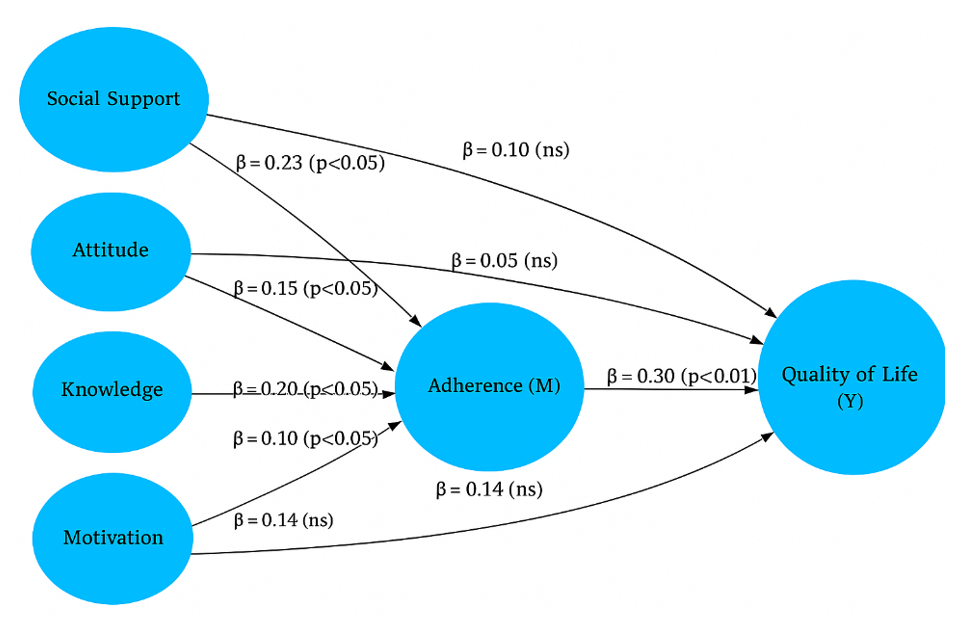
Figure 1. SEM-PLS path diagram.
Discussion
The primary objective of this study was to analyze the relationship between determinant factors (social support, illness perception, knowledge, attitude, and motivation) and the quality of life of hypertensive patients, with medication adherence serving as a mediating factor. All independent factors were found to have significant associations with medication adherence, while adherence itself was positively associated with quality of life. Path analysis using SEM-PLS further confirmed that adherence functioned as a key mediator, bridging the influence of determinant factors on patients’ quality of life.
Social support and motivation were critical determinants in improving the quality of life of patients with hypertension. Social support, whether from family, friends, or healthcare providers, plays a role in providing a sense of security, emotional encouragement, and practical assistance for patients in adhering to treatment. The internal motivation of patients was also found to influence their consistency in following prescribed therapeutic regimens. The combination of these two factors not only contributes to improved medication adherence but also directly enhances quality of life, as patients feel more in control and supported in managing their condition [21, 22].
In addition, knowledge, perception, and attitudes toward the illness are also found to have a significant relationship with medication adherence [23]. Adequate knowledge about hypertension and the importance of long-term therapy can increase patients’ awareness and prevent them from discontinuing treatment prematurely. A positive perception of the benefits of medication, along with a proactive attitude toward maintaining health, reinforces patients’ commitment to adhere to treatment regularly. Although the direct contributions of these three factors to quality of life are not as strong as those of social support and motivation, their roles remain essential as the foundation for establishing sustainable adherence behavior [24].
Furthermore, medication adherence was a key factor in determining the quality of life of hypertension patients, particularly in coastal areas of Wakatobi District, where access to healthcare services is limited. In this context, adherence is not only a matter of individual health but also serves as a strategic solution to reduce the risk of complications and improve community well-being. Therefore, education-based interventions, motivation enhancement, and the optimization of social support should be integrated into healthcare programs to ensure continuity of treatment and improve the quality of life for patients with hypertension in resource-limited settings [25, 26].
The results of this study are consistent with those of Morisky et al. [27], who demonstrate that medication adherence is the main predictor of successful blood pressure control and quality of life among hypertensive patients. Similarly, Wulandari et al. [28] in Indonesia reveal that family social support is significantly associated with medication adherence. In addition, Alhalaiqa et al. [29] emphasize that patients’ intrinsic motivation is the most influential factor in maintaining long-term adherence. However, this study adds further insight by positioning adherence as a mediator, a perspective that has rarely been explored in the context of coastal communities in Indonesia.
These findings are supported by the health belief model (HBM), which posits that health behavior is influenced by individuals’ perceptions of susceptibility, disease severity, perceived benefits, and perceived barriers. Social support, motivation, and knowledge can strengthen perceived benefits, thereby improving medication adherence. Furthermore, the self-management model also supports the evidence that patient engagement in managing chronic illness through treatment adherence is a key factor in improving quality of life [30].
Correlation analysis showed that social support was positively associated with adherence, meaning that the higher the support from family and community, the greater the likelihood of patients adhering to medication. Motivation and positive attitudes were also found to enhance adherence. Conversely, limited knowledge and negative perceptions of the disease were linked to lower adherence. Moreover, adherence was found to be directly associated with quality of life, although social support and motivation also exerted direct effects on quality of life independent of adherence. This indicates that quality of life is the outcome of a complex interaction of multiple factors [31].
This study makes an important contribution to the development of intervention strategies aimed at improving the quality of life for hypertensive patients. By establishing adherence as a mediator, the study highlights that efforts to strengthen knowledge, social support, attitudes, perceptions, and motivation must ultimately focus on improving medication adherence. The findings serve as the basis for the development of educational interventions, including pocketbooks and digital media, which were produced as outputs of this study. Additionally, healthcare providers in primary health centers and coastal communities may use these results to enhance the effectiveness of hypertension control programs.
This study has several limitations. First, the cross-sectional design does not allow for causal inferences; therefore, the interpretation of findings should be made cautiously. Second, the measurement of factors such as adherence and quality of life relied on self-reported questionnaires, which may be subject to social desirability and recall bias. Third, the study was conducted in coastal communities of Wakatobi District, which may limit the generalizability of the findings to populations with different socioeconomic and geographic contexts. Nevertheless, these limitations do not diminish the relevance and significance of the results within the context of the study.
We demonstrated that medication adherence played a crucial mediating role in the relationship between determinant factors and the quality of life of hypertensive patients in the coastal communities of Wakatobi District. In addition, social support and motivation not only influenced quality of life through adherence but also exerted direct effects. This underscores that the quality of life of hypertensive patients is shaped by a combination of internal and external factors that influence health behaviors. Therefore, interventions to improve the quality of life of hypertensive patients should focus on enhancing medication adherence by strengthening social support, improving knowledge, fostering positive attitudes, correcting illness perceptions, and increasing patient motivation.
Conclusion
Medication adherence plays a crucial mediating role in the relationship between determinant Factors and the quality of life of hypertensive patients in the coastal communities of Wakatobi District.
Acknowledgments: The authors would like to express their deepest gratitude and appreciation to the Institute for Research and Community Service (LPPM) of Halu Oleo University (UHO) for the institutional support and facilitation provided throughout the implementation of this research. Sincere appreciation is also extended to the Government of Wakatobi Regency for its support and cooperation, which enabled the research activities to be carried out successfully in the region.
Ethical Permissions: This study has received ethical approval from the Health Research Ethics Committee of the Faculty of Medicine at Halu Oleo University (UHO). All research procedures were conducted in accordance with the ethical principles for medical research involving human subjects. Prior to data collection, informed consent was obtained from all participants after they were provided with a clear explanation of the study objectives, procedures, potential risks, and benefits.
Conflicts of Interests: The authors declared no conflicts of interests.
Authors' Contribution: Alifariki LO (First Author), Introduction Writer/Methodologist/Main Researcher/Discussion Writer (50%); Salma WO (Second Author), Methodologist/Assistant Researcher/Discussion Writer/Statistical Analyst (25%); Sudayasa IP (Third Author), Introduction Writer/Assistant Researcher/Statistical Analyst (25%)
Funding/Support: This research was funded by the Directorate of Research and Community Service, Directorate General of Research and Development, Ministry of Higher Education, Science, and Technology, in accordance with the Contract for the Implementation of the BOPTN Research Program for the 2025 Fiscal Year, Contract Number: 068/C3/DT.05.00/PL/2025, dated May 28, 2025.
Hypertension is one of the major non-communicable diseases (NCDs) with a steadily increasing global prevalence [1, 2]. The World Health Organization (WHO) estimates that more than 1.28 billion adults are living with hypertension, two-thirds of whom reside in low- and middle-income countries [3]. Hypertension is widely recognized as a “silent killer” because it often presents without symptoms but can lead to serious complications, such as stroke, kidney failure, and coronary heart disease. Consequently, controlling hypertension has become a global and national health priority to reduce morbidity, mortality, and the economic burden caused by this disease [4, 5].
In Indonesia, hypertension remains a major public health problem. According to the 2018 Basic Health Research (Riskesdas), the prevalence of hypertension among individuals aged ≥18 years reached 34.1% [6]. One of the greatest challenges is the low level of adherence to antihypertensive medication. Many patients discontinue treatment on their own when they feel well, forget to take their medication, or face financial constraints. Poor adherence results in uncontrolled blood pressure, an increased risk of complications, and a reduced quality of life for hypertensive patients [7, 8].
Poor adherence is also evident in coastal communities, including Wakatobi District in Southeast Sulawesi. The region’s geographic characteristics as an archipelago, limited access to healthcare facilities, and relatively low educational and economic levels further exacerbate the situation [9]. Although healthcare services are available through primary health centers (Puskesmas) and integrated health posts (posyandu), many hypertensive patients still do not take their medications regularly. This reflects a gap between the availability of healthcare services and patients’ health behaviors in managing their conditions [10].
Previous studies have examined factors associated with the quality of life of hypertensive patients, including social support, knowledge, attitudes, perceptions, and motivation [11, 12]. However, most of these studies have focused only on the direct effects of these factors. Few have specifically examined medication adherence as a mediating factor that explains how determinant factors contribute to quality of life. Adherence is a key component in hypertension management that may strengthen the relationship between determinant factors and patients’ quality of life [13, 14].
This study is particularly important because coastal communities, such as those in Wakatobi District, have unique social, cultural, and geographic characteristics that may influence health behaviors. Poor adherence in such settings may worsen health outcomes and diminish the quality of life among hypertensive patients. By examining adherence as a mediator, interventions can be better targeted to improve hypertension management in coastal communities [15, 16].
The novelty of this research lies in the use of medication adherence as a mediating variable in the relationship between determinant factors (social support, perception, knowledge, attitude, and motivation) and the quality of life of hypertensive patients in coastal Wakatobi. We not only assessed direct relationships but also explored the mediation mechanisms through which these factors influence quality of life via adherence. Such an approach provides a more comprehensive understanding compared to previous studies.
The objective of this study was to analyze the relationship between determinant factors and the quality of life of hypertensive patients, with medication adherence as a mediating factor. Furthermore, we aimed to develop a conceptual model illustrating how social support, perception, knowledge, attitude, and motivation influence quality of life through adherence, specifically among coastal communities in Wakatobi District.
The study is expected to provide both theoretical and practical contributions. Theoretically, it enriches the literature on the role of medication adherence as a mediator in improving the quality of life of hypertensive patients, particularly in coastal contexts. Practically, the findings may serve as the basis for developing community-based educational interventions that are tailored to the geographic and sociocultural conditions of coastal communities. Thus, this research can assist healthcare workers, local governments, and stakeholders in designing strategies to enhance medication adherence and the quality of life of hypertensive patients in archipelagic areas.
Instrument and Methods
This observational analytic study using a cross-sectional quantitative approach was conducted among coastal communities in Wakatobi District, Southeast Sulawesi in 2025.
The location was selected due to its unique archipelagic setting, limited access to healthcare services, and distinctive behavioral patterns, making it a relevant context for examining factors influencing medication adherence and quality of life in hypertensive patients.
The sample consisted of all hypertensive patients aged 18 years and above residing in the coastal areas of Wakatobi District. A total of 200 respondents were recruited based on the inclusion criteria, including being ≥18 years of age, diagnosed with hypertension, residing in the study area for at least six months, and willing to participate by signing informed consent. Exclusion criteria included patients with severe cognitive impairment, those undergoing hospitalization, or those experiencing acute cardiovascular events during data collection.
A multistage cluster sampling technique was applied. Representative coastal villages/wards across selected subdistricts were first chosen, followed by the random selection of respondents from healthcare facility records until the sample quota for each cluster was met. Based on calculations using the Cochran formula with finite population correction, for a population of 350 individuals, a 95% confidence level (Z=1.96), a proportion (p)=0.5, and a margin of error of 5%, the required sample size was 182 respondents. This number is considered sufficient to represent the population with the desired level of accuracy. However, to anticipate potential issues, such as incomplete data or participant nonresponse, it is recommended to add approximately 10% as a buffer. Therefore, the ideal total sample size for this study is approximately 200 respondents, ensuring that the research results remain valid and representative of the target population.
The study examined the relationships among key constructs, including the quality of life of hypertensive patients (as the outcome), medication adherence (as the mediating factor), and several determinants such as social support, illness perception, knowledge, attitude toward treatment, and motivation. Quality of life was measured using the WHO Quality of Life Assessment Instrument (WHOQOL-BREF), which covers four domains (physical, psychological, social, and environmental) on a 5-point Likert scale [17]. Medication adherence was assessed using the validated Morisky Medication Adherence Scale (MMAS-8) [18]. Social support was measured using the Multidimensional Scale of Perceived Social Support (MSPSS) [19], illness perception was based on the Health Belief Model framework, knowledge was assessed with the Hypertension Knowledge Questionnaire, attitudes toward treatment were measured with Likert-scale items, and motivation was evaluated using the Medication Adherence Motivation Scale [20]. All tools were adapted, tested for validity and reliability, and categorized according to measurement standards.
Data were collected through face-to-face interviews using structured questionnaires administered by trained enumerators. Demographic and basic clinical data, such as age, sex, duration of hypertension, and type of medication used, were also recorded. Following data collection, responses were entered into a database, checked for completeness, and cleaned to prevent entry errors.
Bivariate analysis employed cross-tabulations and Chi-square tests to examine relationships between categorical factors, with a significance threshold of p<0.05. Multivariate analysis was conducted using SEM-PLS with SmartPLS version 3 software. Measurement model evaluation included tests of convergent validity, discriminant validity, and composite reliability, while the structural model was assessed using bootstrapping to determine path significance.
Preliminary data analyses were conducted using SPSS version 25. Mediation path analysis was performed with SmartPLS to obtain a comprehensive understanding of both direct and indirect relationships among the studied constructs.
Findings
The majority of participants were in middle to older adulthood, with a relatively balanced gender distribution and varying educational and occupational backgrounds. Most respondents were covered by health insurance, reflecting access to basic healthcare services (Table 1).
Table 1. Characteristics of respondents
There were significant associations between all determinant factors—social support, illness perception, knowledge, attitude toward treatment, and motivation—and medication adherence (p<0.05). Respondents with higher levels of support, better understanding, and more positive attitudes and motivation tended to be more adherent to antihypertensive treatment. A significant positive association was found between medication adherence and quality of life (p=0.013). Patients who adhered to their medication regimen generally reported a better quality of life compared to those who were non-adherent (Table 2).
Table 2. Relationship between determinant factors and medication adherence among hypertensive patients in Wakatobi district
The obtained structural model using the SEM-PLS approach described how determinant factors, such as social support, illness perception, knowledge, attitude, and motivation influenced quality of life both directly and indirectly through medication adherence. All independent factors had a positive relationship with adherence, although the strength of their effects varies. Social support, knowledge, attitude, and motivation tended to contribute more significantly to adherence compared to illness perception. Meanwhile, the path from adherence to quality of life demonstrated a positive effect, indicating that higher medication adherence is associated with better quality of life in hypertension patients.
In addition, there were also direct paths from the independent factors to quality of life. Some factors, such as social support and motivation, although their direct effects were relatively smaller, still contributed to patients’ quality of life (Figure 1).
Figure 1. SEM-PLS path diagram.
Discussion
The primary objective of this study was to analyze the relationship between determinant factors (social support, illness perception, knowledge, attitude, and motivation) and the quality of life of hypertensive patients, with medication adherence serving as a mediating factor. All independent factors were found to have significant associations with medication adherence, while adherence itself was positively associated with quality of life. Path analysis using SEM-PLS further confirmed that adherence functioned as a key mediator, bridging the influence of determinant factors on patients’ quality of life.
Social support and motivation were critical determinants in improving the quality of life of patients with hypertension. Social support, whether from family, friends, or healthcare providers, plays a role in providing a sense of security, emotional encouragement, and practical assistance for patients in adhering to treatment. The internal motivation of patients was also found to influence their consistency in following prescribed therapeutic regimens. The combination of these two factors not only contributes to improved medication adherence but also directly enhances quality of life, as patients feel more in control and supported in managing their condition [21, 22].
In addition, knowledge, perception, and attitudes toward the illness are also found to have a significant relationship with medication adherence [23]. Adequate knowledge about hypertension and the importance of long-term therapy can increase patients’ awareness and prevent them from discontinuing treatment prematurely. A positive perception of the benefits of medication, along with a proactive attitude toward maintaining health, reinforces patients’ commitment to adhere to treatment regularly. Although the direct contributions of these three factors to quality of life are not as strong as those of social support and motivation, their roles remain essential as the foundation for establishing sustainable adherence behavior [24].
Furthermore, medication adherence was a key factor in determining the quality of life of hypertension patients, particularly in coastal areas of Wakatobi District, where access to healthcare services is limited. In this context, adherence is not only a matter of individual health but also serves as a strategic solution to reduce the risk of complications and improve community well-being. Therefore, education-based interventions, motivation enhancement, and the optimization of social support should be integrated into healthcare programs to ensure continuity of treatment and improve the quality of life for patients with hypertension in resource-limited settings [25, 26].
The results of this study are consistent with those of Morisky et al. [27], who demonstrate that medication adherence is the main predictor of successful blood pressure control and quality of life among hypertensive patients. Similarly, Wulandari et al. [28] in Indonesia reveal that family social support is significantly associated with medication adherence. In addition, Alhalaiqa et al. [29] emphasize that patients’ intrinsic motivation is the most influential factor in maintaining long-term adherence. However, this study adds further insight by positioning adherence as a mediator, a perspective that has rarely been explored in the context of coastal communities in Indonesia.
These findings are supported by the health belief model (HBM), which posits that health behavior is influenced by individuals’ perceptions of susceptibility, disease severity, perceived benefits, and perceived barriers. Social support, motivation, and knowledge can strengthen perceived benefits, thereby improving medication adherence. Furthermore, the self-management model also supports the evidence that patient engagement in managing chronic illness through treatment adherence is a key factor in improving quality of life [30].
Correlation analysis showed that social support was positively associated with adherence, meaning that the higher the support from family and community, the greater the likelihood of patients adhering to medication. Motivation and positive attitudes were also found to enhance adherence. Conversely, limited knowledge and negative perceptions of the disease were linked to lower adherence. Moreover, adherence was found to be directly associated with quality of life, although social support and motivation also exerted direct effects on quality of life independent of adherence. This indicates that quality of life is the outcome of a complex interaction of multiple factors [31].
This study makes an important contribution to the development of intervention strategies aimed at improving the quality of life for hypertensive patients. By establishing adherence as a mediator, the study highlights that efforts to strengthen knowledge, social support, attitudes, perceptions, and motivation must ultimately focus on improving medication adherence. The findings serve as the basis for the development of educational interventions, including pocketbooks and digital media, which were produced as outputs of this study. Additionally, healthcare providers in primary health centers and coastal communities may use these results to enhance the effectiveness of hypertension control programs.
This study has several limitations. First, the cross-sectional design does not allow for causal inferences; therefore, the interpretation of findings should be made cautiously. Second, the measurement of factors such as adherence and quality of life relied on self-reported questionnaires, which may be subject to social desirability and recall bias. Third, the study was conducted in coastal communities of Wakatobi District, which may limit the generalizability of the findings to populations with different socioeconomic and geographic contexts. Nevertheless, these limitations do not diminish the relevance and significance of the results within the context of the study.
We demonstrated that medication adherence played a crucial mediating role in the relationship between determinant factors and the quality of life of hypertensive patients in the coastal communities of Wakatobi District. In addition, social support and motivation not only influenced quality of life through adherence but also exerted direct effects. This underscores that the quality of life of hypertensive patients is shaped by a combination of internal and external factors that influence health behaviors. Therefore, interventions to improve the quality of life of hypertensive patients should focus on enhancing medication adherence by strengthening social support, improving knowledge, fostering positive attitudes, correcting illness perceptions, and increasing patient motivation.
Conclusion
Medication adherence plays a crucial mediating role in the relationship between determinant Factors and the quality of life of hypertensive patients in the coastal communities of Wakatobi District.
Acknowledgments: The authors would like to express their deepest gratitude and appreciation to the Institute for Research and Community Service (LPPM) of Halu Oleo University (UHO) for the institutional support and facilitation provided throughout the implementation of this research. Sincere appreciation is also extended to the Government of Wakatobi Regency for its support and cooperation, which enabled the research activities to be carried out successfully in the region.
Ethical Permissions: This study has received ethical approval from the Health Research Ethics Committee of the Faculty of Medicine at Halu Oleo University (UHO). All research procedures were conducted in accordance with the ethical principles for medical research involving human subjects. Prior to data collection, informed consent was obtained from all participants after they were provided with a clear explanation of the study objectives, procedures, potential risks, and benefits.
Conflicts of Interests: The authors declared no conflicts of interests.
Authors' Contribution: Alifariki LO (First Author), Introduction Writer/Methodologist/Main Researcher/Discussion Writer (50%); Salma WO (Second Author), Methodologist/Assistant Researcher/Discussion Writer/Statistical Analyst (25%); Sudayasa IP (Third Author), Introduction Writer/Assistant Researcher/Statistical Analyst (25%)
Funding/Support: This research was funded by the Directorate of Research and Community Service, Directorate General of Research and Development, Ministry of Higher Education, Science, and Technology, in accordance with the Contract for the Implementation of the BOPTN Research Program for the 2025 Fiscal Year, Contract Number: 068/C3/DT.05.00/PL/2025, dated May 28, 2025.
| Rights and permissions | |
 |
This work is licensed under a Creative Commons Attribution-NonCommercial 4.0 International License. |