


Volume -
3 , - : 669-677 |
Back to browse issues page



Download citation:
BibTeX | RIS | EndNote | Medlars | ProCite | Reference Manager | RefWorks
Send citation to:


BibTeX | RIS | EndNote | Medlars | ProCite | Reference Manager | RefWorks
Send citation to:
Psychoeducation Model for Mothers of Children with Stunting. 3 https://doi.org/10.58209/hehp.13.4.669
URL: http://daneshafarand.org/article-1-82957-en.html
URL: http://daneshafarand.org/article-1-82957-en.html
| Abstract (HTML) (692 Views)
Full-Text: (28 Views)
Introduction
Psychoeducation, particularly through prevention efforts based on the infant and young child feeding model (IYCFM), has become a strategic approach in preventing child growth and development disorders such as stunting. This model-based approach has been shown to enhance patient satisfaction with mental health care and medication adherence, as well as improve function and quality of life [1]. Additionally, psychoeducation appears to be quite effective in reducing emotional distress [2]. The IYCFM concept aims to minimize the occurrence of stunting in a timely and precise manner, making it a key element in reducing the incidence of stunting [3].
Stunting is a persistent nutritional condition caused by inadequate nutrient intake over time, which negatively impacts children’s growth. It is one of the reasons for shorter height among children compared to their peers [4]. The primary contributing factor to stunting is insufficient dietary intake during the child’s growth phase. Many individuals are unaware that a child’s short stature may be a symptom of ongoing dietary issues [5]. The WHO considers a country to have a stunting problem when the prevalence exceeds 20%. In Indonesia, according to Ministry of Health statistics from 2021, the rate of stunted toddlers is 24.4%; consequently, it is an issue that requires urgent resolution [6].
Stunting is a national priority program, and the incidence in Magetan Regency remains high, although it shows a decreasing trend: 18.8% in 2018, 10.8% in 2019, 10.29% in 2020, 10.53% in 2021, and 10.15% in 2022. From 2021 to 2024, Magetan is designated as a Stunting Locus (Focus Location) area. In this area, there were 15 stunting locus villages in 2021 and 19 villages in 2022. Serious interventions are required to realize stunting reduction and achieve a zero-stunting area. The impact of stunting extends beyond child growth to include child development. Physical interventions with specific nutritional support and sensitive nutritional interventions alone are insufficient; psychosocial interventions are also critically needed but are still rarely implemented for child development [7].
Evidence shows the benefits of family psychoeducation for patients and families within a diverse Indonesian population [8]. Psychoeducation for mothers, using the IYCFM-based stunting prevention model, includes numerous indicators that play a critical role in addressing child growth and development disorders. These indicators encompass maternal characteristics, exclusive breastfeeding, husband’s support, and, most importantly, enhancing maternal awareness of stunting prevention. This increased awareness helps mothers who often face challenges in managing coordination, comprehensiveness, and collaboration with those around them in a cross-sectoral context [9].
With prevention efforts based on the IYCFM, mothers are encouraged to identify the availability of programs related to stunting prevention by understanding feeding conditions [10]. Interventions can be concentrated in areas with a high prevalence of stunting, ensuring that mothers receive education on the importance of exclusive breastfeeding and appropriate childcare practices [11].
Psychoeducation enhances caregivers’ knowledge, coping strategies, and situational evaluation [12]. Theory-based psychoeducational programs, along with the integration of technology and interactive delivery methods, remain underexplored [13]. Another aspect of integrating prevention efforts based on the IYCFM in public health is reflected in the increased awareness among mothers to participate in stunting prevention and engage actively in child nutrition programs, as well as in assessing child growth and development indicators [14].
A prospective study will evaluate the effect of a systematic short psychoeducational intervention on various drug use disorders in patient care plans. This will foster awareness among mothers regarding stunting prevention through child nutrition, emphasizing a collaborative effort among parents, families, and the community. This collaboration leads to greater emotional presence, higher empathy, and improved self-regulation [15].
The quality of prevention efforts based on psychoeducation, particularly through the IYCFM, can be enhanced by increasing maternal awareness of nutrition in stunting prevention. This approach focuses on mothers as a crucial component in supporting stunting prevention through feeding programs. Within the framework of this prevention model, maternal involvement fosters awareness of child nutrition [16].
Psychoeducational prevention based on the IYCFM in public health serves as a form of prevention and health promotion. This is demonstrated by the increase in maternal awareness, which facilitates self-reflection, enhances understanding of personal and professional boundaries, and nurtures the ability to recognize and identify coordinated, comprehensive, and collaborative intervention approaches early on [17].
Psychoeducation for mothers through the IYCFM is closely linked to the family system and the support of husbands in child nutrition programs aimed at preventing stunting [13]. Additionally, the implementation of the IYCFM-based stunting prevention program in health service institutions must be supported by maternal knowledge, environmental sanitation, supportive policies, ongoing training, and the development of a culture of maternal awareness regarding prevention [14].
The success of prevention efforts in public health services depends not only on individual capacity but also on the organization’s commitment to integrating these efforts into a comprehensive prevention system [15]. Positive outcomes of IYCFM-based stunting prevention in the community can be observed through the psychosocial dimension. These changes are correlated with mothers’ abilities to manage stress, reduce reactivity to negative stimuli, and enhance cognitive flexibility in implementing prevention strategies [11].
Furthermore, IYCFM-based stunting prevention plays a crucial role in reducing internalized stigma among patient families and within the community, while also increasing maternal awareness for preventing stunting through balanced nutrition. The IYCFM approach can enhance maternal awareness, facilitating early identification efforts and fostering acceptance of the mother’s condition [16].
Psychoeducation effectively reduces negative psychological effects and enhances coping abilities in caregivers of children [18]. Psychoeducation for mothers through the IYCFM requires a systematic, evidence-based educational approach focused on feeding and nutrition programs. An effective training and education curriculum should include a theoretical understanding of stunting prevention, as well as feeding education and mentoring by experienced facilitators [19].
Success in program evaluation can be measured by assessing psychological indicators, such as work stress, anxiety, awareness, and life satisfaction, alongside clinical performance indicators like documentation quality, inter-team communication, and compliance with stunting prevention standards related to feeding and nutrition. These are reflected in maternal characteristics, stunting prevention efforts, health, exclusive breastfeeding, environmental sanitation, and husband support [20]. The IYCFM also fosters opportunities for cross-disciplinary collaboration among nurses, psychologists, psychiatrists, and occupational therapists. This interdisciplinary approach allows each profession to contribute coaching based on their competencies, emphasizing the principle of awareness.
Such collaboration strengthens team unity in implementing IYCFM-based stunting prevention, as each member complements the others’ efforts. Awareness serves as a common language that connects stunting prevention initiatives within a biopsychosocial framework [21]. This study developed not only the physiological dimensions but also the psychological and biopsychosocial dimensions. Therefore, children’s growth and development become synergistic and balanced, addressing both physiological and psychosocial aspects.
In this research, members with expertise in environmental health were involved, ensuring that they could contribute knowledge to prevent and address stunting stemming from the home environment. A poor home environment is a significant cause of stunting, and demand for psychoeducational programs can help caregivers improve their mental and emotional health in various ways. However, the effects on caregivers’ self-efficacy, anxiety, burden, and quality of life have been inconsistent [22].
Evidence-based psychoeducational interventions have significantly enhanced knowledge, self-efficacy, and attitudes, and these trends continued throughout the follow-up period [23]. In the long term, the IYCFM not only increases awareness but also fosters reflective thinking, identity, and a sense of responsibility among mothers, making them more self-aware and resilient in preventing stunting, with a focus on improving feeding and nutrition.
This study aimed to evaluate growth and development deviations, specifically examining the role of mothers in psychoeducation through the IYCFM. Additionally, it sought to identify maternal characteristics, stunting prevention, health, exclusive breastfeeding, environmental sanitation, and husband support as indicators within this model. This study is expected to provide both theoretical and practical contributions to the development of a more humanistic and evidence-based prevention model.
Instrument and Methods
Study design and data source
The present observational cross-sectional research was done on mothers of toddlers the Lokus Stunting area, located across 19 villages in Magetan Regency from May to July 2024 selected cluster sampling. Participants were selected based on inclusion criteria, which included age, education, and socioeconomic status.
The sample size was determined using structural equation modeling (SEM) adhered to the Rule of Thumb, which suggests that the number of samples involved should be 5 to 10 times the number of parameters A total of 231 subjects were pre-screened by data from Primary Health Care. Four patients were excluded: one due to poor health and three who refused to participate. Subsequently, 227 patients were selected through simple random sampling, of whom two were excluded, one due to time conflicts and one for unknown reasons. Ultimately, 225 subjects were analyzed. Maternal characteristics encompassed 10 parameters, knowledge comprised 4 parameters, health included 4 parameters, nutritional status had 4 parameters, exclusive breastfeeding featured 3 parameters, environmental sanitation accounted for 4 parameters, and husband’s support for stunting included 2 parameters, along with 7 arrow directions or correlations. This results in a total of 38 parameters multiplied by 6, leading to a final sample size of 231. Furthermore, the sampling approach employed multiple rounds of random sampling, starting with categorizing the collection based on the community’s area or location, followed by stratification and selection through a systematic random sampling technique. This process involved choosing six public health centers within the 19 villages identified as Stunting Loci in Magetan Regency in 2022. We examined maternal characteristics, child’s physical health, exclusive breastfeeding, husband’s support, and home environment, with data analysis conducted using SEM-PLS.
Instrument
The research utilized a questionnaire based on the IYCFM to assess stunting prevention. The survey employed closed questions using a Likert scale ranging from 1 (strongly disagree) to 5 (strongly agree). Approximately 95% accuracy, sensitivity, and specificity were achieved through criterion-related validity testing, indicating robust measurement quality. Demographic variables collected included age, education, and employment status.
To ensure the questionnaire’s reliability and validity, assessments were conducted using Cronbach’s alpha for reliability and factor analysis for construct validity. The instrument had previously been evaluated for accuracy and suitability. Specific criteria were applied to select Stunting Locus locations in Magetan Regency in 2024, categorizing public health facilities by their nature, operational location, and patient demographics.
The assessment of stunting prevention included indicators, such as maternal characteristics, knowledge, physical health, nutritional status, exclusive breastfeeding, environmental sanitation, and spousal support. The questionnaire demonstrated discriminant validity, while structural validity was confirmed through a single-factor unidimensional model with a factor score of 0.973. Inter-rater reliability (Krippendorff’s alpha=0.851) and internal consistency (Cronbach’s alpha=0.837; Spearman-Brown coefficient=0.925; Guttman split-half coefficient=0.929) showed excellent results.
Data collection
The researchers distributed the questionnaire as an online survey created using Google Forms to mothers. The deliberate selection of Stunting Locus regions in Magetan Regency in 2024 influenced the investigation’s validity, as the outcomes were more readily applicable to areas with similar characteristics. Data collection was facilitated through an online survey created using Google Forms, targeting mothers to obtain primary data effectively.
Data analysis
The SEM-PLS was used to analyze the correlations for research and establish a model based on psychoeducational prevention derived from the IYCFM. To generate accurate data related to questionnaire indicators, regression analyses were performed using a Likert scale. SEM was implemented to examine the interactions among indicators, primarily in evaluating the arrangement of causal connections that existed between dependent and independent parameters.
Findings
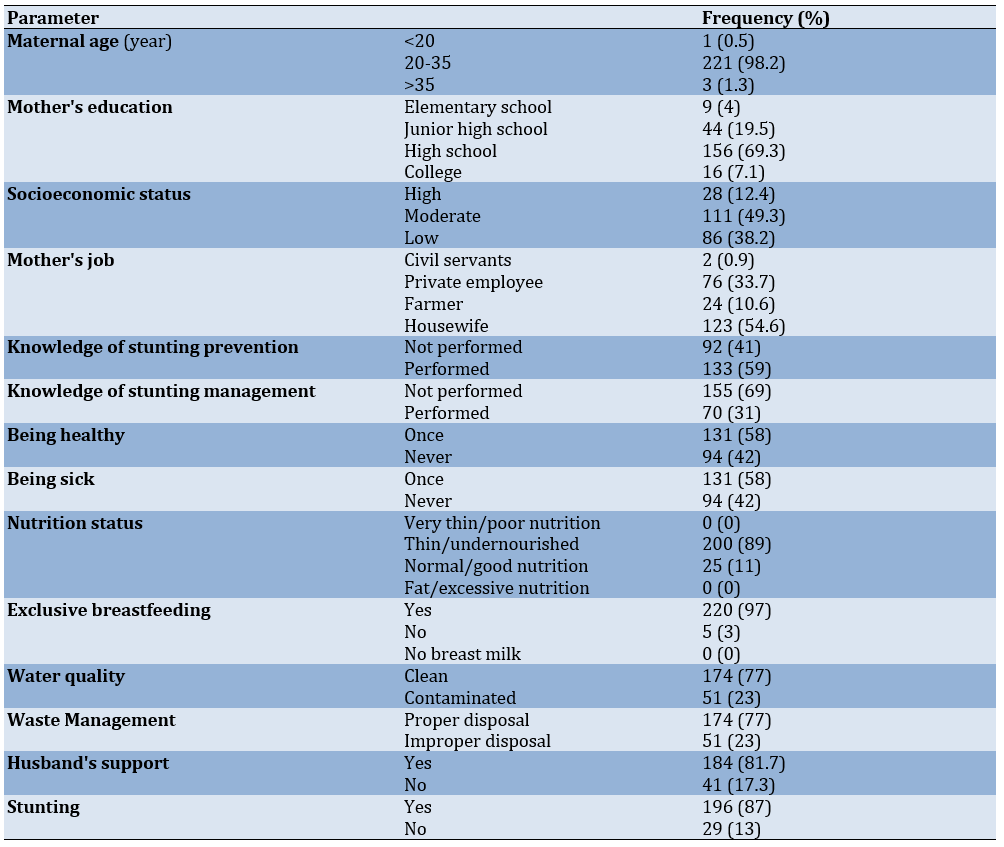
The characteristics of mothers in this study demonstrated a high tendency towards age within the 20-35 years group (98.2%), which fell within the productive age range (Table 1). Regarding maternal education, most mothers had a high school academic background (69.3%), indicating that the majority of participating mothers had acquired foundational knowledge about feeding and nutrition for children, enabling them to adopt more appropriate and balanced practices. Although nearly half of the mothers were in the moderate socioeconomic group (49.3%), indicating that their financial ability to provide for their children’s nutrition was potentially more sufficient, the majority were housewives (54.6%). Most mothers were actively engaged in some form of behavior related to this (59%). However, in terms of knowledge application, most mothers did not take any action (69%). Regarding health indicators, both healthy and sick children were reported to have been affected (58%). A majority of children were categorized as thin/undernourished (89%). In terms of environmental sanitation, both clean water and waste disposal were primarily deemed clean (77%). Most husbands were reported to be supportive (81.7%), and regarding stunting prevention, a significant portion was actively involved (87%).
Table 1. Participants’ characteristics
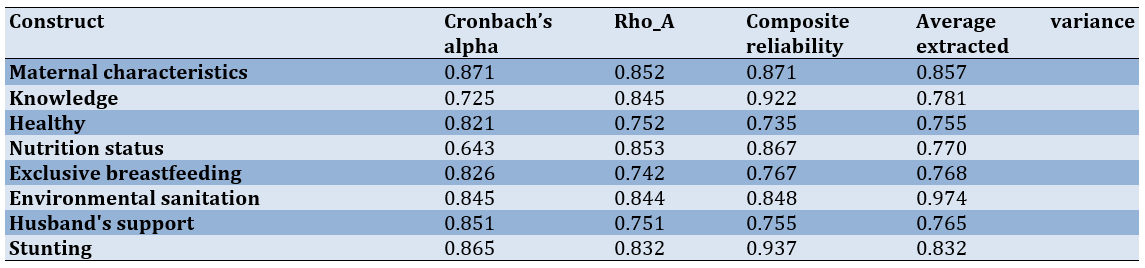
The internal consistency of each construct fell within the very adequate category. The composite reliability results showed high values across all constructs. Additionally, internal consistency and supported the accuracy of the reliability estimates used in the PLS-SEM approach were approved. The indicators utilized demonstrated the ability to consistently measure important dimensions in psychoeducational prevention based on the IYCFM. All constructs also exhibited average variance extracted (AVE) values above the minimum threshold of 0.50. Thus, the convergent validity of all constructs was adequately achieved. The instrument used in this study was reliable for measuring stunting prevention based on psychoeducational methods related to the IYCFM (Table 2).
Table 2. Results of composite reliability and Cronbach’s alpha examination
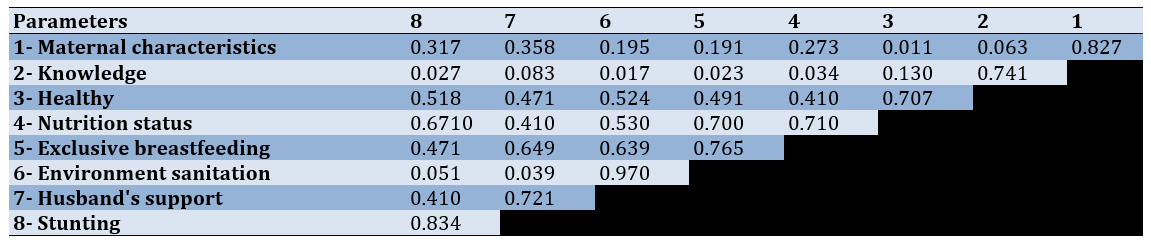
According to the Fornell-Larcker criterion, the square root of the AVE for each latent construct needed to be larger than the correlation coefficients involving that construct and others. Strong evidence of discriminant validity was presented in, which demonstrated that the diagonal elements (square roots of AVEs) were larger than the off-diagonal inter-construct correlations (Table 3).
Table 3. Hasil Fornell-Larcker criterion values for discriminant validity
The estimated model had a fair fit, with a lower standardized root mean residual (0.102) compared to the saturated model (0.144). However, chi-square values were high, and normed fit index (NFI) indicated a good fit, which is typical in SEM with large datasets (Table 4).
Table 4. Model fit and reliability

The fixed model had the parameters of maternal characteristics, knowledge, health, nutritional status, exclusive breastfeeding, environmental sanitation, husband’s support, and stunting in measuring stunting prevention based on psychoeducational strategies related to the IYCFM (Figure 1).
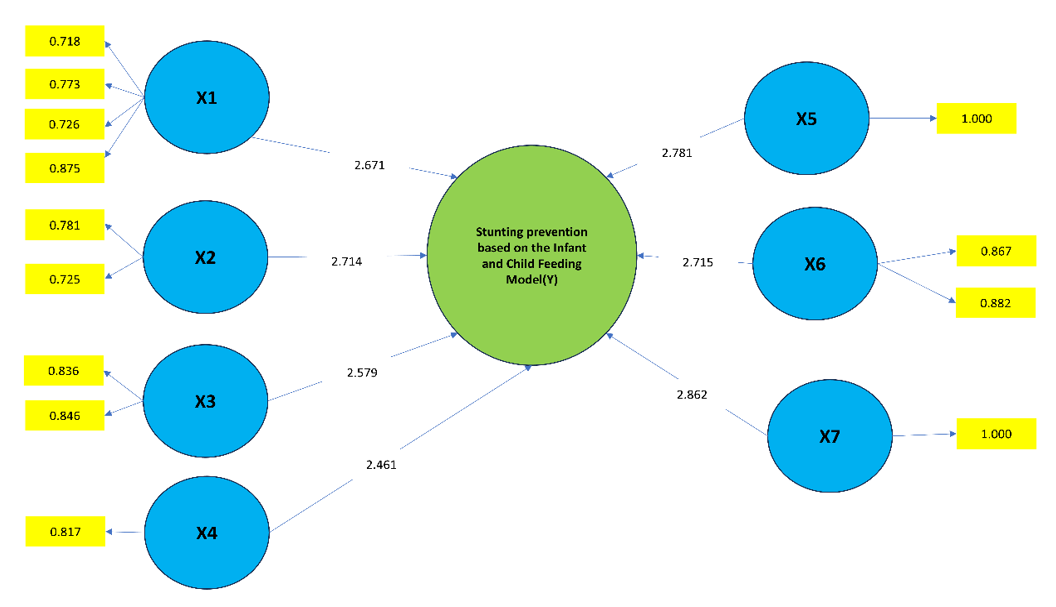
Figure 1. Psychoeducation prevention based on the psychoeducation prevention based on the infant and child feeding model
All indicators of stunting prevention had a significant correlation with preventing maternal stunting. All dimensions of prevention, specifically maternal characteristics (β=0.589; p=0.022), knowledge (β=0.741; p=0.034), health (β=0.716; p=0.033), nutritional status (β=0.591; p=0.016), exclusive breastfeeding (β=0.769; p=0.037), environmental sanitation (β=0.651; p=0.018), and husband’s support (β=0.691; p=0.027), were significantly related to the outcomes. Furthermore, the effect size (f²) was calculated to be 0.758, indicating moderate to strong practical significance (Table 5).
Table 5. Correlation results of indicators for stunting prevention based on the infant and child feeding model

Discussion
This study aimed to evaluate growth and development deviations, specifically examining the role of mothers in psychoeducation through the IYCFM. Most mothers giving birth were high school graduates. This indicates that a mother’s education level influences her attitude toward choosing exclusive breastfeeding as the child’s food during the first six months of age. Higher education is expected to facilitate the acceptance of positive practices and to foster good attitudes toward improving children’s health, growth, and development [24]. In comparison, research in Russia indicates that linguistic, cognitive, emotional, sociocultural, and relational changes enhance family coping and recovery abilities, with implications for the cultural adaptation of family psychoeducation for Russian-speaking immigrants [25].
Furthermore, other studies have reinforced this finding, showing that after completing psychoeducation, the average scores for functional and emotional symptoms decreased drastically. This aligns with the notion that a person’s health status is influenced by their educational level, which determines the quality of care. Low maternal education and poor parenting practices, along with insufficient mental stimulation, remain common, leading to developmental delays in toddlers [26]. Additionally, 2.1% of toddlers are suspected of experiencing developmental delays due to their mothers’ low educational levels. The education level of parents, particularly that of the mother, significantly influences a child’s development. Low maternal education can serve as a risk factor for developmental delays, as mothers with lower education are less likely to understand how to stimulate their children’s development compared to those with higher education [27].
Psychoeducation enhances self-efficacy, social support, and reduces depression in first-time mothers [28]. Sufficient maternal knowledge equips mothers with a solid understanding of their child’s growth and development, motivating them to prevent or minimize developmental deviations or stunting in their child, both psychologically and physically. Understanding nutrition is one of the crucial factors that mothers of toddlers need, as they play a significant role in preparing family meals [29]. Low maternal knowledge is not solely attributed to a lack of education; it is also influenced by the mother’s low socio-economic status [30].
In contrast, research in Turkey found that psychoeducation reduces the caregiving burden experienced by mothers of children [31]. Mothers of older age, stable employment, good socio-economic status, and sufficient education tend to have adequate knowledge regarding child growth and development. This knowledge can be acquired through both formal and informal means, including online media (gadgets, radio, TV, internet) and printed materials, such as newspapers and magazines. Furthermore, mothers with higher education typically possess a good understanding of how to stimulate their children’s growth and development, encompassing both physical and psychological aspects. This enables them to detect irregularities in growth and development early and to address them promptly [32].
Furthermore, the characteristics of a healthy child include well-balanced growth and developmental levels appropriate for their age and stage. Meanwhile, the results of the Bordeaux trial demonstrated that family psychoeducational intervention significantly decreases the likelihood of relapse, with notable effects identified at the twelve-month follow-up [33]. This contrasts with previous research, which has shown encouraging results for psychoeducation in terms of the adoption and implementation of micro-interventions. However, the few efficacy trials have not revealed substantial improvements in parental outcomes. More research is needed to determine the differential significance of micro-interventions based on parents’ needs and their appropriate integration into larger intervention programs [34].
Additionally, the findings of a subsequent study contribute to previous randomized controlled trials (RCTs), indicating that nutrition psychoeducation interventions delivered separately result in modest weight loss effects after 12 months, with 5% and 17% of participants maintaining a 5% weight loss, respectively. However, it remains uncertain whether using motivational interviewing (MI) in primary care for weight reduction is more cost-efficient than simply providing dietary psychoeducation [35]. An intriguing finding from the breastfeeding trial is that participants in the solution-focused psychoeducation group received significantly lower midwife support scores than those in the SFP, which are deemed safe and effective techniques for enhancing mothers’ motivation to breastfeed while alleviating concerns about low breast milk supply [36].
Other studies have found that implementing hygiene practices and excellent dietary habits is critical for children’s physical development and intellectual achievement, as well as for reducing health concerns. The importance of hygiene and a healthy diet through psychoeducation has implications for students, teachers, and parents, as personal hygiene, environmental cleanliness, and healthy eating habits are highly effective ways to reduce the risk of diseases that impede children’s growth and development [37].
The husband’s involvement in ensuring effective marital functioning is equally crucial, supported by a therapeutic rationale based on psychoeducational, cognitive-behavioral, and self-help concepts [38]. Comparative research findings indicate that a husband’s support influences the incidence of stunting. The characteristics of family size, whether large or small, significantly impact child care; children in larger families tend to receive less individual attention, which can affect the incidence of stunting, especially when considered from the perspective of economic status based on family income [39].
Based on the studies mentioned above, it is evident that the husband’s support is very important and contributes significantly to the occurrence of stunting in children. This support is crucial, as it enhances the mother’s commitment to addressing growth issues in their children. Optimal family support improves toddlers’ nutritional status, thereby reducing the incidence of stunting. Increasing the role of the family can be achieved by providing information and understanding how the family can effectively care for toddlers, particularly in terms of offering a variety of foods, fruits, and vegetables, and encouraging frequent small portion meals.
Mother as psychoeducation convincingly demonstrates that stunting prevention based on the psychoeducation prevention aligned with the IYCFM produces a significant correlation. Findings from SEM confirm that all dimensions of stunting prevention based on this psychoeducational approach are interconnected. The high coefficient of determination indicates that this model is not only valid but also possesses strong predictive power in comprehensively explaining the transformation of stunting prevention, particularly in the areas of feeding and nutrition.
Conclusion
The IYCFM demonstrates strong predictive power and validity in explaining the psychoeducational model.
Acknowledgments: The author would like to thank the Primary Health Service of East Java for allowing the authors to analyze the data presented in this article.
Ethical Permissions: This research received ethical approval from Poltekkes Surabaya, with the number: No.EA/3982/KEPK-Poltekkes_Sby/V/2024.
Conflicts of Interests: The authors declared no conflicts of interests.
Authors' Contribution: Saadah N (First Author), Assistant Researcher/Discussion Writer/Statistical Analyst (25%); Suhron M (Second Author), Statistical Analyst (15%); Yulianto B (Third Author), Introduction Writer/Methodologist/Main Researcher (20%); Puji Rahayu T (Fourth Author), Discussion Writer (20%); Khasanah U (Fifth Author), Assistant Researcher (20%)
Funding/Support: Funding was provided by the DIPA (Budget Implementation List) of the Surabaya Ministry of Health Polytechnic.
Psychoeducation, particularly through prevention efforts based on the infant and young child feeding model (IYCFM), has become a strategic approach in preventing child growth and development disorders such as stunting. This model-based approach has been shown to enhance patient satisfaction with mental health care and medication adherence, as well as improve function and quality of life [1]. Additionally, psychoeducation appears to be quite effective in reducing emotional distress [2]. The IYCFM concept aims to minimize the occurrence of stunting in a timely and precise manner, making it a key element in reducing the incidence of stunting [3].
Stunting is a persistent nutritional condition caused by inadequate nutrient intake over time, which negatively impacts children’s growth. It is one of the reasons for shorter height among children compared to their peers [4]. The primary contributing factor to stunting is insufficient dietary intake during the child’s growth phase. Many individuals are unaware that a child’s short stature may be a symptom of ongoing dietary issues [5]. The WHO considers a country to have a stunting problem when the prevalence exceeds 20%. In Indonesia, according to Ministry of Health statistics from 2021, the rate of stunted toddlers is 24.4%; consequently, it is an issue that requires urgent resolution [6].
Stunting is a national priority program, and the incidence in Magetan Regency remains high, although it shows a decreasing trend: 18.8% in 2018, 10.8% in 2019, 10.29% in 2020, 10.53% in 2021, and 10.15% in 2022. From 2021 to 2024, Magetan is designated as a Stunting Locus (Focus Location) area. In this area, there were 15 stunting locus villages in 2021 and 19 villages in 2022. Serious interventions are required to realize stunting reduction and achieve a zero-stunting area. The impact of stunting extends beyond child growth to include child development. Physical interventions with specific nutritional support and sensitive nutritional interventions alone are insufficient; psychosocial interventions are also critically needed but are still rarely implemented for child development [7].
Evidence shows the benefits of family psychoeducation for patients and families within a diverse Indonesian population [8]. Psychoeducation for mothers, using the IYCFM-based stunting prevention model, includes numerous indicators that play a critical role in addressing child growth and development disorders. These indicators encompass maternal characteristics, exclusive breastfeeding, husband’s support, and, most importantly, enhancing maternal awareness of stunting prevention. This increased awareness helps mothers who often face challenges in managing coordination, comprehensiveness, and collaboration with those around them in a cross-sectoral context [9].
With prevention efforts based on the IYCFM, mothers are encouraged to identify the availability of programs related to stunting prevention by understanding feeding conditions [10]. Interventions can be concentrated in areas with a high prevalence of stunting, ensuring that mothers receive education on the importance of exclusive breastfeeding and appropriate childcare practices [11].
Psychoeducation enhances caregivers’ knowledge, coping strategies, and situational evaluation [12]. Theory-based psychoeducational programs, along with the integration of technology and interactive delivery methods, remain underexplored [13]. Another aspect of integrating prevention efforts based on the IYCFM in public health is reflected in the increased awareness among mothers to participate in stunting prevention and engage actively in child nutrition programs, as well as in assessing child growth and development indicators [14].
A prospective study will evaluate the effect of a systematic short psychoeducational intervention on various drug use disorders in patient care plans. This will foster awareness among mothers regarding stunting prevention through child nutrition, emphasizing a collaborative effort among parents, families, and the community. This collaboration leads to greater emotional presence, higher empathy, and improved self-regulation [15].
The quality of prevention efforts based on psychoeducation, particularly through the IYCFM, can be enhanced by increasing maternal awareness of nutrition in stunting prevention. This approach focuses on mothers as a crucial component in supporting stunting prevention through feeding programs. Within the framework of this prevention model, maternal involvement fosters awareness of child nutrition [16].
Psychoeducational prevention based on the IYCFM in public health serves as a form of prevention and health promotion. This is demonstrated by the increase in maternal awareness, which facilitates self-reflection, enhances understanding of personal and professional boundaries, and nurtures the ability to recognize and identify coordinated, comprehensive, and collaborative intervention approaches early on [17].
Psychoeducation for mothers through the IYCFM is closely linked to the family system and the support of husbands in child nutrition programs aimed at preventing stunting [13]. Additionally, the implementation of the IYCFM-based stunting prevention program in health service institutions must be supported by maternal knowledge, environmental sanitation, supportive policies, ongoing training, and the development of a culture of maternal awareness regarding prevention [14].
The success of prevention efforts in public health services depends not only on individual capacity but also on the organization’s commitment to integrating these efforts into a comprehensive prevention system [15]. Positive outcomes of IYCFM-based stunting prevention in the community can be observed through the psychosocial dimension. These changes are correlated with mothers’ abilities to manage stress, reduce reactivity to negative stimuli, and enhance cognitive flexibility in implementing prevention strategies [11].
Furthermore, IYCFM-based stunting prevention plays a crucial role in reducing internalized stigma among patient families and within the community, while also increasing maternal awareness for preventing stunting through balanced nutrition. The IYCFM approach can enhance maternal awareness, facilitating early identification efforts and fostering acceptance of the mother’s condition [16].
Psychoeducation effectively reduces negative psychological effects and enhances coping abilities in caregivers of children [18]. Psychoeducation for mothers through the IYCFM requires a systematic, evidence-based educational approach focused on feeding and nutrition programs. An effective training and education curriculum should include a theoretical understanding of stunting prevention, as well as feeding education and mentoring by experienced facilitators [19].
Success in program evaluation can be measured by assessing psychological indicators, such as work stress, anxiety, awareness, and life satisfaction, alongside clinical performance indicators like documentation quality, inter-team communication, and compliance with stunting prevention standards related to feeding and nutrition. These are reflected in maternal characteristics, stunting prevention efforts, health, exclusive breastfeeding, environmental sanitation, and husband support [20]. The IYCFM also fosters opportunities for cross-disciplinary collaboration among nurses, psychologists, psychiatrists, and occupational therapists. This interdisciplinary approach allows each profession to contribute coaching based on their competencies, emphasizing the principle of awareness.
Such collaboration strengthens team unity in implementing IYCFM-based stunting prevention, as each member complements the others’ efforts. Awareness serves as a common language that connects stunting prevention initiatives within a biopsychosocial framework [21]. This study developed not only the physiological dimensions but also the psychological and biopsychosocial dimensions. Therefore, children’s growth and development become synergistic and balanced, addressing both physiological and psychosocial aspects.
In this research, members with expertise in environmental health were involved, ensuring that they could contribute knowledge to prevent and address stunting stemming from the home environment. A poor home environment is a significant cause of stunting, and demand for psychoeducational programs can help caregivers improve their mental and emotional health in various ways. However, the effects on caregivers’ self-efficacy, anxiety, burden, and quality of life have been inconsistent [22].
Evidence-based psychoeducational interventions have significantly enhanced knowledge, self-efficacy, and attitudes, and these trends continued throughout the follow-up period [23]. In the long term, the IYCFM not only increases awareness but also fosters reflective thinking, identity, and a sense of responsibility among mothers, making them more self-aware and resilient in preventing stunting, with a focus on improving feeding and nutrition.
This study aimed to evaluate growth and development deviations, specifically examining the role of mothers in psychoeducation through the IYCFM. Additionally, it sought to identify maternal characteristics, stunting prevention, health, exclusive breastfeeding, environmental sanitation, and husband support as indicators within this model. This study is expected to provide both theoretical and practical contributions to the development of a more humanistic and evidence-based prevention model.
Instrument and Methods
Study design and data source
The present observational cross-sectional research was done on mothers of toddlers the Lokus Stunting area, located across 19 villages in Magetan Regency from May to July 2024 selected cluster sampling. Participants were selected based on inclusion criteria, which included age, education, and socioeconomic status.
The sample size was determined using structural equation modeling (SEM) adhered to the Rule of Thumb, which suggests that the number of samples involved should be 5 to 10 times the number of parameters A total of 231 subjects were pre-screened by data from Primary Health Care. Four patients were excluded: one due to poor health and three who refused to participate. Subsequently, 227 patients were selected through simple random sampling, of whom two were excluded, one due to time conflicts and one for unknown reasons. Ultimately, 225 subjects were analyzed. Maternal characteristics encompassed 10 parameters, knowledge comprised 4 parameters, health included 4 parameters, nutritional status had 4 parameters, exclusive breastfeeding featured 3 parameters, environmental sanitation accounted for 4 parameters, and husband’s support for stunting included 2 parameters, along with 7 arrow directions or correlations. This results in a total of 38 parameters multiplied by 6, leading to a final sample size of 231. Furthermore, the sampling approach employed multiple rounds of random sampling, starting with categorizing the collection based on the community’s area or location, followed by stratification and selection through a systematic random sampling technique. This process involved choosing six public health centers within the 19 villages identified as Stunting Loci in Magetan Regency in 2022. We examined maternal characteristics, child’s physical health, exclusive breastfeeding, husband’s support, and home environment, with data analysis conducted using SEM-PLS.
Instrument
The research utilized a questionnaire based on the IYCFM to assess stunting prevention. The survey employed closed questions using a Likert scale ranging from 1 (strongly disagree) to 5 (strongly agree). Approximately 95% accuracy, sensitivity, and specificity were achieved through criterion-related validity testing, indicating robust measurement quality. Demographic variables collected included age, education, and employment status.
To ensure the questionnaire’s reliability and validity, assessments were conducted using Cronbach’s alpha for reliability and factor analysis for construct validity. The instrument had previously been evaluated for accuracy and suitability. Specific criteria were applied to select Stunting Locus locations in Magetan Regency in 2024, categorizing public health facilities by their nature, operational location, and patient demographics.
The assessment of stunting prevention included indicators, such as maternal characteristics, knowledge, physical health, nutritional status, exclusive breastfeeding, environmental sanitation, and spousal support. The questionnaire demonstrated discriminant validity, while structural validity was confirmed through a single-factor unidimensional model with a factor score of 0.973. Inter-rater reliability (Krippendorff’s alpha=0.851) and internal consistency (Cronbach’s alpha=0.837; Spearman-Brown coefficient=0.925; Guttman split-half coefficient=0.929) showed excellent results.
Data collection
The researchers distributed the questionnaire as an online survey created using Google Forms to mothers. The deliberate selection of Stunting Locus regions in Magetan Regency in 2024 influenced the investigation’s validity, as the outcomes were more readily applicable to areas with similar characteristics. Data collection was facilitated through an online survey created using Google Forms, targeting mothers to obtain primary data effectively.
Data analysis
The SEM-PLS was used to analyze the correlations for research and establish a model based on psychoeducational prevention derived from the IYCFM. To generate accurate data related to questionnaire indicators, regression analyses were performed using a Likert scale. SEM was implemented to examine the interactions among indicators, primarily in evaluating the arrangement of causal connections that existed between dependent and independent parameters.
Findings
The characteristics of mothers in this study demonstrated a high tendency towards age within the 20-35 years group (98.2%), which fell within the productive age range (Table 1). Regarding maternal education, most mothers had a high school academic background (69.3%), indicating that the majority of participating mothers had acquired foundational knowledge about feeding and nutrition for children, enabling them to adopt more appropriate and balanced practices. Although nearly half of the mothers were in the moderate socioeconomic group (49.3%), indicating that their financial ability to provide for their children’s nutrition was potentially more sufficient, the majority were housewives (54.6%). Most mothers were actively engaged in some form of behavior related to this (59%). However, in terms of knowledge application, most mothers did not take any action (69%). Regarding health indicators, both healthy and sick children were reported to have been affected (58%). A majority of children were categorized as thin/undernourished (89%). In terms of environmental sanitation, both clean water and waste disposal were primarily deemed clean (77%). Most husbands were reported to be supportive (81.7%), and regarding stunting prevention, a significant portion was actively involved (87%).
Table 1. Participants’ characteristics
The internal consistency of each construct fell within the very adequate category. The composite reliability results showed high values across all constructs. Additionally, internal consistency and supported the accuracy of the reliability estimates used in the PLS-SEM approach were approved. The indicators utilized demonstrated the ability to consistently measure important dimensions in psychoeducational prevention based on the IYCFM. All constructs also exhibited average variance extracted (AVE) values above the minimum threshold of 0.50. Thus, the convergent validity of all constructs was adequately achieved. The instrument used in this study was reliable for measuring stunting prevention based on psychoeducational methods related to the IYCFM (Table 2).
Table 2. Results of composite reliability and Cronbach’s alpha examination
According to the Fornell-Larcker criterion, the square root of the AVE for each latent construct needed to be larger than the correlation coefficients involving that construct and others. Strong evidence of discriminant validity was presented in, which demonstrated that the diagonal elements (square roots of AVEs) were larger than the off-diagonal inter-construct correlations (Table 3).
Table 3. Hasil Fornell-Larcker criterion values for discriminant validity
The estimated model had a fair fit, with a lower standardized root mean residual (0.102) compared to the saturated model (0.144). However, chi-square values were high, and normed fit index (NFI) indicated a good fit, which is typical in SEM with large datasets (Table 4).
Table 4. Model fit and reliability
The fixed model had the parameters of maternal characteristics, knowledge, health, nutritional status, exclusive breastfeeding, environmental sanitation, husband’s support, and stunting in measuring stunting prevention based on psychoeducational strategies related to the IYCFM (Figure 1).
Figure 1. Psychoeducation prevention based on the psychoeducation prevention based on the infant and child feeding model
All indicators of stunting prevention had a significant correlation with preventing maternal stunting. All dimensions of prevention, specifically maternal characteristics (β=0.589; p=0.022), knowledge (β=0.741; p=0.034), health (β=0.716; p=0.033), nutritional status (β=0.591; p=0.016), exclusive breastfeeding (β=0.769; p=0.037), environmental sanitation (β=0.651; p=0.018), and husband’s support (β=0.691; p=0.027), were significantly related to the outcomes. Furthermore, the effect size (f²) was calculated to be 0.758, indicating moderate to strong practical significance (Table 5).
Table 5. Correlation results of indicators for stunting prevention based on the infant and child feeding model
Discussion
This study aimed to evaluate growth and development deviations, specifically examining the role of mothers in psychoeducation through the IYCFM. Most mothers giving birth were high school graduates. This indicates that a mother’s education level influences her attitude toward choosing exclusive breastfeeding as the child’s food during the first six months of age. Higher education is expected to facilitate the acceptance of positive practices and to foster good attitudes toward improving children’s health, growth, and development [24]. In comparison, research in Russia indicates that linguistic, cognitive, emotional, sociocultural, and relational changes enhance family coping and recovery abilities, with implications for the cultural adaptation of family psychoeducation for Russian-speaking immigrants [25].
Furthermore, other studies have reinforced this finding, showing that after completing psychoeducation, the average scores for functional and emotional symptoms decreased drastically. This aligns with the notion that a person’s health status is influenced by their educational level, which determines the quality of care. Low maternal education and poor parenting practices, along with insufficient mental stimulation, remain common, leading to developmental delays in toddlers [26]. Additionally, 2.1% of toddlers are suspected of experiencing developmental delays due to their mothers’ low educational levels. The education level of parents, particularly that of the mother, significantly influences a child’s development. Low maternal education can serve as a risk factor for developmental delays, as mothers with lower education are less likely to understand how to stimulate their children’s development compared to those with higher education [27].
Psychoeducation enhances self-efficacy, social support, and reduces depression in first-time mothers [28]. Sufficient maternal knowledge equips mothers with a solid understanding of their child’s growth and development, motivating them to prevent or minimize developmental deviations or stunting in their child, both psychologically and physically. Understanding nutrition is one of the crucial factors that mothers of toddlers need, as they play a significant role in preparing family meals [29]. Low maternal knowledge is not solely attributed to a lack of education; it is also influenced by the mother’s low socio-economic status [30].
In contrast, research in Turkey found that psychoeducation reduces the caregiving burden experienced by mothers of children [31]. Mothers of older age, stable employment, good socio-economic status, and sufficient education tend to have adequate knowledge regarding child growth and development. This knowledge can be acquired through both formal and informal means, including online media (gadgets, radio, TV, internet) and printed materials, such as newspapers and magazines. Furthermore, mothers with higher education typically possess a good understanding of how to stimulate their children’s growth and development, encompassing both physical and psychological aspects. This enables them to detect irregularities in growth and development early and to address them promptly [32].
Furthermore, the characteristics of a healthy child include well-balanced growth and developmental levels appropriate for their age and stage. Meanwhile, the results of the Bordeaux trial demonstrated that family psychoeducational intervention significantly decreases the likelihood of relapse, with notable effects identified at the twelve-month follow-up [33]. This contrasts with previous research, which has shown encouraging results for psychoeducation in terms of the adoption and implementation of micro-interventions. However, the few efficacy trials have not revealed substantial improvements in parental outcomes. More research is needed to determine the differential significance of micro-interventions based on parents’ needs and their appropriate integration into larger intervention programs [34].
Additionally, the findings of a subsequent study contribute to previous randomized controlled trials (RCTs), indicating that nutrition psychoeducation interventions delivered separately result in modest weight loss effects after 12 months, with 5% and 17% of participants maintaining a 5% weight loss, respectively. However, it remains uncertain whether using motivational interviewing (MI) in primary care for weight reduction is more cost-efficient than simply providing dietary psychoeducation [35]. An intriguing finding from the breastfeeding trial is that participants in the solution-focused psychoeducation group received significantly lower midwife support scores than those in the SFP, which are deemed safe and effective techniques for enhancing mothers’ motivation to breastfeed while alleviating concerns about low breast milk supply [36].
Other studies have found that implementing hygiene practices and excellent dietary habits is critical for children’s physical development and intellectual achievement, as well as for reducing health concerns. The importance of hygiene and a healthy diet through psychoeducation has implications for students, teachers, and parents, as personal hygiene, environmental cleanliness, and healthy eating habits are highly effective ways to reduce the risk of diseases that impede children’s growth and development [37].
The husband’s involvement in ensuring effective marital functioning is equally crucial, supported by a therapeutic rationale based on psychoeducational, cognitive-behavioral, and self-help concepts [38]. Comparative research findings indicate that a husband’s support influences the incidence of stunting. The characteristics of family size, whether large or small, significantly impact child care; children in larger families tend to receive less individual attention, which can affect the incidence of stunting, especially when considered from the perspective of economic status based on family income [39].
Based on the studies mentioned above, it is evident that the husband’s support is very important and contributes significantly to the occurrence of stunting in children. This support is crucial, as it enhances the mother’s commitment to addressing growth issues in their children. Optimal family support improves toddlers’ nutritional status, thereby reducing the incidence of stunting. Increasing the role of the family can be achieved by providing information and understanding how the family can effectively care for toddlers, particularly in terms of offering a variety of foods, fruits, and vegetables, and encouraging frequent small portion meals.
Mother as psychoeducation convincingly demonstrates that stunting prevention based on the psychoeducation prevention aligned with the IYCFM produces a significant correlation. Findings from SEM confirm that all dimensions of stunting prevention based on this psychoeducational approach are interconnected. The high coefficient of determination indicates that this model is not only valid but also possesses strong predictive power in comprehensively explaining the transformation of stunting prevention, particularly in the areas of feeding and nutrition.
Conclusion
The IYCFM demonstrates strong predictive power and validity in explaining the psychoeducational model.
Acknowledgments: The author would like to thank the Primary Health Service of East Java for allowing the authors to analyze the data presented in this article.
Ethical Permissions: This research received ethical approval from Poltekkes Surabaya, with the number: No.EA/3982/KEPK-Poltekkes_Sby/V/2024.
Conflicts of Interests: The authors declared no conflicts of interests.
Authors' Contribution: Saadah N (First Author), Assistant Researcher/Discussion Writer/Statistical Analyst (25%); Suhron M (Second Author), Statistical Analyst (15%); Yulianto B (Third Author), Introduction Writer/Methodologist/Main Researcher (20%); Puji Rahayu T (Fourth Author), Discussion Writer (20%); Khasanah U (Fifth Author), Assistant Researcher (20%)
Funding/Support: Funding was provided by the DIPA (Budget Implementation List) of the Surabaya Ministry of Health Polytechnic.
| Rights and permissions | |
 |
This work is licensed under a Creative Commons Attribution-NonCommercial 4.0 International License. |