


Volume -
3 , - : 711-719 |
Back to browse issues page



Download citation:
BibTeX | RIS | EndNote | Medlars | ProCite | Reference Manager | RefWorks
Send citation to:


BibTeX | RIS | EndNote | Medlars | ProCite | Reference Manager | RefWorks
Send citation to:
Antecedents of Patient Satisfaction in Prenatal Care Quality in Rural Areas. 3 https://doi.org/10.58209/hehp.13.4.711
URL: http://daneshafarand.org/article-1-82962-en.html
URL: http://daneshafarand.org/article-1-82962-en.html
| Abstract (HTML) (775 Views)
Full-Text: (31 Views)
Introduction
Maternal and child health represents a key priority in international health agendas. In alignment with Sustainable Development Goal 3.1, countries are expected to reduce maternal mortality worldwide, targeting fewer than 70 maternal deaths per 100,000 live births by the year 2030 [1]. Notwithstanding significant advancements in service coverage, almost 80% of maternal fatalities globally remain preventable with high-quality and timely prenatal care [2]. Since 1990, Indonesia’s maternal mortality has declined with better obstetric and prenatal access, yet it remains higher than most Southeast Asian countries. Persistent gaps between urban and rural areas in facilities, referral systems, and workforce show that expanding antenatal coverage is not enough; improving prenatal care quality, especially in rural and underserved regions, is essential for safer pregnancies and better maternal outcomes [3].
This need is underscored by Indonesia’s maternal mortality ratio, which remained at 249 per 100,000 live births in 2020, representing only a 45% reduction since 1990 [3]. Additionally, significant regional disparities are apparent: provinces beyond Java–Bali exhibit maternal mortality rates that exceed the national average by more than twofold [3]. Currently, the provision of comprehensive antenatal services is not keeping pace with the metrics of their utilization. For instance, the data indicate that merely 64.25% of pregnant women in rural West Java attended antenatal care (ANC) visits that met the recommended thresholds, in contrast to 79.81% in urban regions [4]. The data indicate that although a significant number of women seek care, the thoroughness and quality of these services are often inconsistent and inequitable, especially in rural areas. Together, these figures point to a coverage-quality gap.
Against this backdrop, national programs have increased antenatal care visits among Indonesian women, though studies continue to show variability in the quality and content of care delivered. Many expectant mothers receive routine clinical examinations but report inadequate counseling, limited explanations of pregnancy-related risks, and shortened consultation times. Research analyzing the Quality of Prenatal Care Questionnaire (QPCQ) has demonstrated that the interpersonal dimensions of care—encompassing information dissemination, anticipatory guidance, and provider support—frequently receive lower ratings than the technical service elements [5]. Addressing these limitations requires understanding how specific elements of care quality influence women’s satisfaction and their future care-seeking behaviors, particularly in rural hospitals where resource constraints may exacerbate these issues.
Grounded in Donabedian’s structure-process-outcome model, the QPCQ captures six process domains: information sharing, anticipatory guidance, sufficient time, approachability, availability, and support/respect, which shape women’s evaluations of prenatal care [5]. Evidence shows that clear communication, consistent counseling, and empathic support improve understanding and reduce anxiety, whereas rushed or inconsistent encounters depress satisfaction [6, 7]. In Indonesia and comparable settings, responsiveness, assurance, and staff empathy are strong predictors of satisfaction [8, 9]. Building on this evidence, it is expected that each of the six QPCQ domains will demonstrate a positive association with overall patient satisfaction, reflecting their central role in shaping women’s care experiences.
Patient satisfaction, the alignment of expectations with experienced interpersonal and technical care, functions as a proximal outcome and a driver of subsequent behavior. Higher satisfaction strengthens perceptions of hospital credibility, professionalism, and trustworthiness, thereby building institutional reputation that influences provider choice and word-of-mouth [10, 11]. In Indonesian settings, satisfaction consistently predicts loyalty behaviors, including willingness to return, with assurance, responsiveness, and empathy as salient antecedents [12, 13]. Patients who view a hospital as reputable report stronger intentions to revisit even after accounting for other factors, indicating that reputational capital translates perceived quality into concrete utilization decisions [11, 14]. Accordingly, our conceptual model anticipates positive relationships between satisfaction and hospital reputation, between satisfaction and intention to revisit, and between hospital reputation and intention to revisit, including the possibility that reputation may strengthen or channel the satisfaction-revisit relationship.
To test this model in a resource-constrained setting, we conducted a cross-sectional study in a rural maternal and child hospital in Indonesia, using the QPCQ to measure the six care-quality domains and separate scales for satisfaction, hospital reputation, and intention to revisit. Partial least squares-structural equation modeling (PLS-SEM) was applied to evaluate the measurement properties and the proposed relational paths, providing evidence to guide improvements in antenatal care quality and patient-centered outcomes in rural services.
Instrument and Methods
Research design and sample
This quantitative, cross-sectional was conducted in 2025 on 181 pregnant women undergoing antenatal treatment at the maternal-child hospital in Tabanan, Bali, Indonesia.
Participants were systematically recruited from the hospital’s outpatient obstetric clinics for a two-week data collection period. The eligibility criteria included being currently pregnant and attending antenatal care at the hospital for a minimum of two visits, the age of ≥18 years, being proficient in reading and comprehension of Bahasa Indonesia, and willingness to provide informed consent. Women experiencing obstetric problems necessitating tertiary referral or possessing cognitive or psychological impairments that would hinder questionnaire understanding were excluded.
Following the statistical power guidelines proposed by Cohen et al., the required sample size was calculated using G*Power version 3.1.9.7. Using a medium effect size (f²=0.15), a significance level of 0.05, a power level of 0.90, and up to eight predictor constructs, at least 136 respondents were needed [15]. Moreover, Kock and Hadaya state that the minimum sample size necessary for research using PLS-SEM can be approximated by the inverse square root and gamma-exponential techniques [16]. Their Monte Carlo simulation trials showed that these methods provide estimates with a statistical power of at least 0.80 at the 0.05 significance level. The study suggests a minimum sample size of about 160 respondents as a general rule of thumb for PLS-SEM analyses when the requisite power cannot be known beforehand.
Instrument
Data were gathered using a structured questionnaire with closed-ended items and predetermined response options. The instrument covered six QPCQ domains, including information sharing (IS1-IS4), anticipatory guidance (AG1-AG4), sufficient time (ST1-ST4), approachability (AP1-AP4), availability (AV1-AV4), and support and respect (SR1-SR4), adapted from Heaman et al. [5]. Overall patient satisfaction was measured with four items (PS1-PS4) adapted from Hibusu et al. [17]. The hospital reputation was assessed with three items (HR1-HR3) adapted from Gaspersz et al. [11], and intention to revisit was assessed with three items (IRV1-IRV3) adapted from Kasena & Antonio [18]. All items employed a five-point Likert scale from 1 (strongly disagree) to 5 (strongly agree).
Participants selected the response options that best represented their perceptions or experiences with the antenatal services they received.
Procedure
Recruitment was carried out with assistance from midwives and clinic staff, who identified eligible women and invited them to participate after their visits. Each respondent received a brief explanation of the study purpose and completed the self-administered questionnaire in a designated private area of the clinic. Participation was anonymous and voluntary, and informed consent was obtained prior to data collection.
Data analysis
The dataset was analyzed using the PLS-SEM approach with SmartPLS version 4.0 [19]. This technique is suitable because it handles complex predictive frameworks with numerous latent constructs and indicators, and it performs well with moderate sample sizes and data that may deviate from a normal distribution. The analysis adhered to the standard two-stage procedure, which includes assessing the measurement (outer) model followed by evaluating the structural (inner) model [20, 21].
The assessment of the reflective measurement model focused on ensuring that the constructs met the required reliability and validity standards. Items were retained only if they showed factor loadings greater than 0.70, indicating that each indicator contributed adequately to its construct. The consistency of the constructs was then examined using Cronbach’s alpha and composite reliability (CR), with both metrics needing to exceed 0.70 to be deemed reliable. Evidence of convergent validity was established when the average variance extracted (AVE) for each construct was above 0.50. To determine whether the constructs were empirically distinct, discriminant validity was checked using the Heterotrait–Monotrait (HTMT) criterion; values under 0.85 confirmed that the constructs did not overlap excessively [20, 21].
To investigate the proposed relationships among the model constructs, the structural component of the model was analyzed. Potential multicollinearity was assessed through the variance inflation factor (VIF); all VIF values were below 5.0, indicating that the predictors did not exhibit problematic overlap [21]. The statistical significance of each proposed path was then evaluated using a bootstrapping resampling technique, which produced the standardized path estimates (β), along with their t-statistics and p-values [22].
The overall explanatory capacity of the model was judged using the R² statistic. According to commonly accepted guidelines, R² values around 0.25, 0.50, and 0.75 denote low, moderate, and high levels of explained variance, respectively [20]. To understand how much each predictor contributed to its outcome construct, effect sizes (f²) were computed—categorized as small (0.02-0.15), medium (0.15-0.35), and large (greater than 0.35) impacts [15]. Furthermore, predictive relevance of the endogenous constructs was examined through the Stone–Geisser Q² statistic obtained via the blindfolding procedure.
Importance-performance map analysis (IPMA) enhances the interpretation of PLS-SEM results by examining not only how strongly each predictor influences the target construct (its total effect) but also how well each construct performs based on its average latent variable scores [23]. This analysis provides actionable insights by identifying the characteristics of prenatal care quality that most significantly influence patient satisfaction and the intention to revisit, thus offering practical guidance for hospital administrators aiming to enhance service quality [24].
Findings
A total of 181 respondents participated in this study, all of whom were pregnant women receiving antenatal care at a maternal and child hospital in Tabanan, Bali. The outer model demonstrated dependable indicator loadings across all constructs (Figure 1).
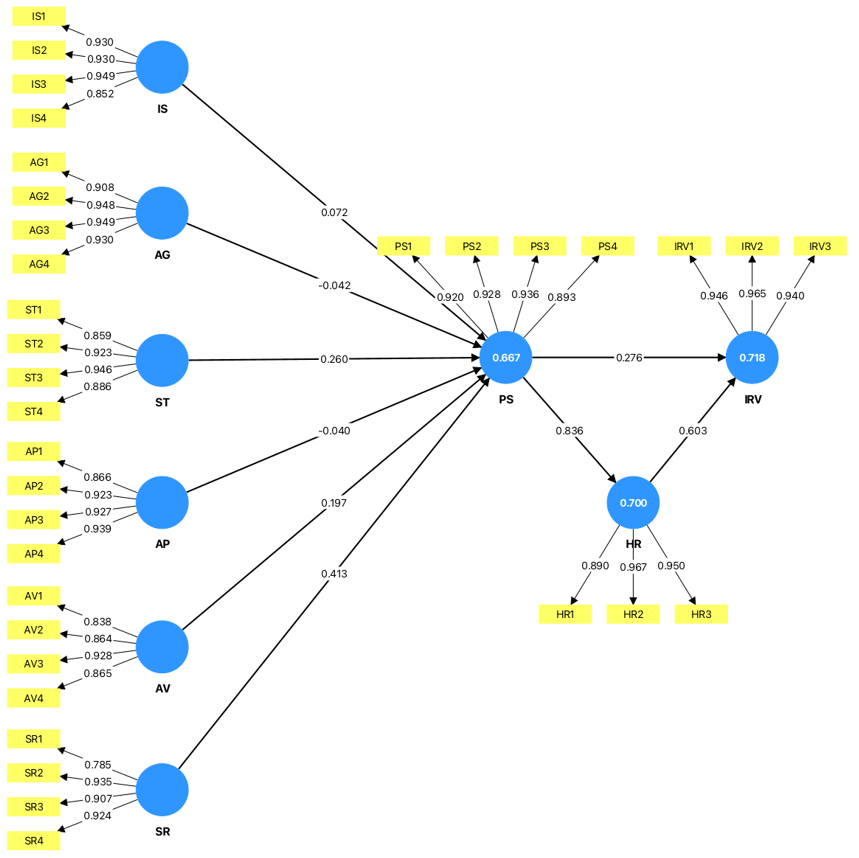
Figure 1. The outer model.
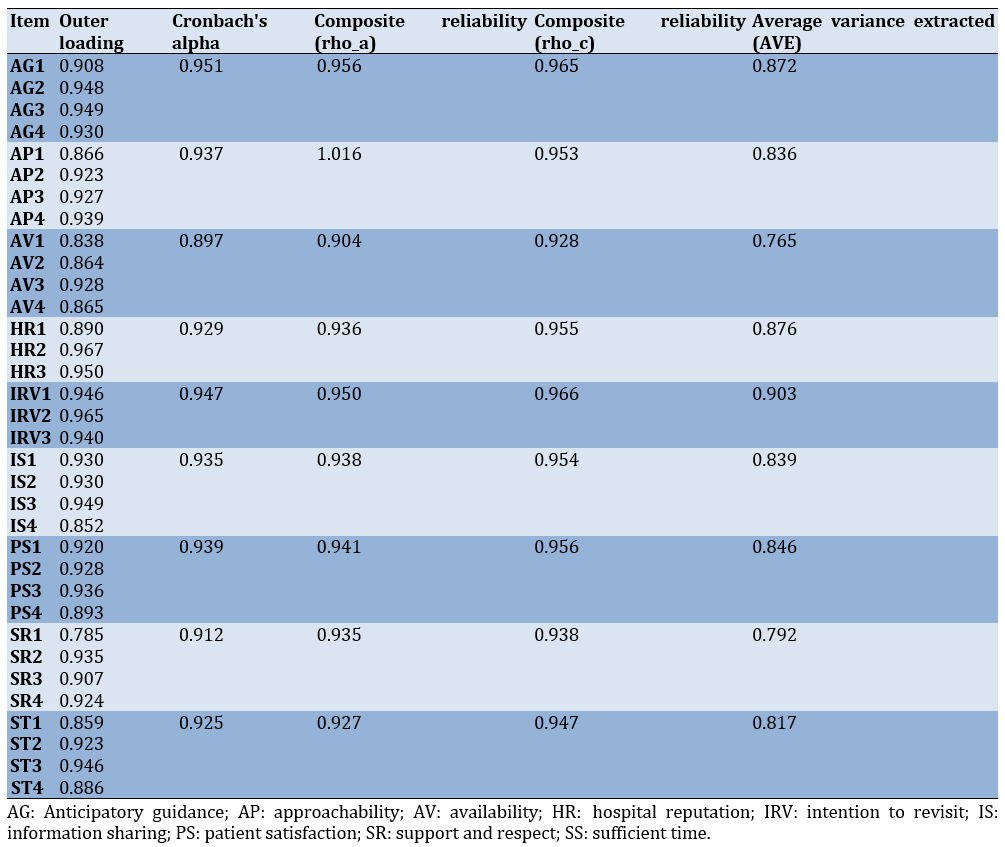
Every item achieved an outer loading above 0.70, indicating acceptable item reliability. All items also recorded Cronbach’s alpha and CR values greater than 0.70, supporting internal consistency. Moreover, each item’s AVE exceeded the 0.50 benchmark, confirming adequate convergent validity (Table 1).
Table 1. Outer loadings and construct reliability and validity (n=181)
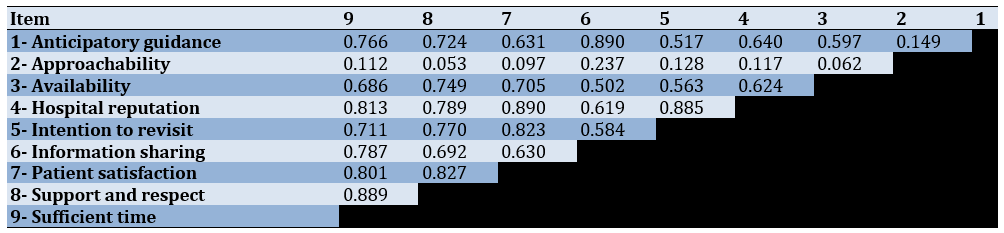
In addition, the HTMT values reported were all lower than the recommended cutoff of 0.90, confirming that the constructs were sufficiently distinct from one another. The measurement model met the required standards of reliability and validity, allowing for subsequent analysis of the structural links among prenatal care quality, patient satisfaction, hospital reputation, and revisit intention (Table 2).
Table 2. Discriminant validity assessment using the Heterotrait-Monotrait (HTMT) criterion
For the patient-satisfaction equation, VIF values were as follows: approachability=1.075; availability=2.008; anticipatory guidance=4.059; information sharing=4.144; support and respect=3.699; and sufficient time=4.023. When examining predictors of hospital reputation, patient satisfaction showed a VIF of 1.000, indicating negligible collinearity in that equation. For the intention-to-revisit equation, both hospital reputation and patient satisfaction recorded VIFs of 3.329. All reported VIFs were below the conservative threshold of 5.0, confirming that multicollinearity did not materially bias the estimation of the structural paths.
The R² results indicated strong explanatory capacity for all endogenous constructs. The R² for patient satisfaction was 0.667 (adjusted 0.655), for hospital reputation 0.700 (adjusted 0.698), and for intention to revisit 0.718 (adjusted 0.715), demonstrating substantial predictive accuracy across the model. In addition, the Stone-Geisser Q² values were 0.610 for patient satisfaction, 0.554 for hospital reputation, and 0.499 for intention to revisit, all of which exceed zero, confirming that each construct possesses meaningful predictive relevance within the model. These findings underscore the model’s strong capacity to account for both structural relationships and predictive performance in this maternal healthcare context (Figure 2).
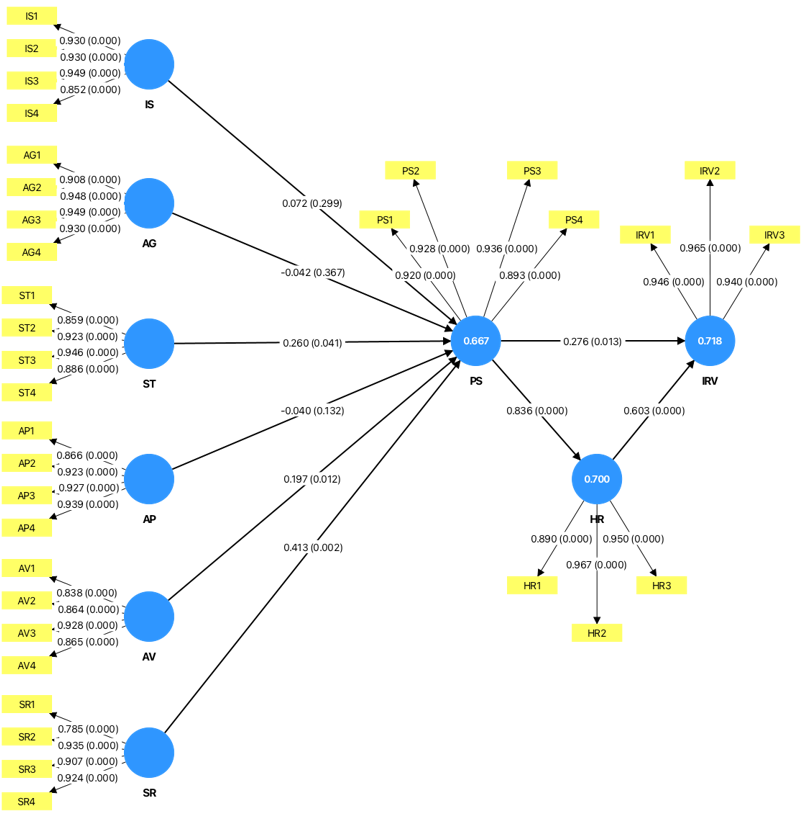
Figure 2. The inner model.
According to structural analysis using one-tailed bootstrapping, sufficient time had a significant association with patient satisfaction (β=0.260, t=1.743, p=0.041, f²=0.050), accompanied by availability (β=0.197, t=2.260, p=0.012, f²=0.058) and support and respect (β=0.413, t=2.920, p=0.002, f²=0.138). Information sharing (β=0.072, t=0.526, p=0.299, f²=0.004), anticipatory guidance (β=-0.042, t=0.339, p=0.367, f²=0.001), and approachability (β=-0.040, t=1.119, p=0.132, f²=0.005) were not statistically significant. Accordingly, within the studied rural hospital context, sufficient consultation time, accessibility of services, and respectful, supportive interactions were the primary drivers of patient satisfaction, whereas communication-related dimensions played a comparatively lesser role.
For the downstream relationships, patient satisfaction strongly predicted hospital reputation (β=0.836, t=29.156, p<0.001, f²=2.329), and also showed a moderate association with intention to revisit (β=0.276, t=2.238, p=0.013, f²=0.081). Hospital reputation further demonstrated a substantial positive effect on intention to revisit (β=0.603, t=5.207, p<0.001, f²=0.388). Overall, the pattern of effects highlighted the primacy of time adequacy, service availability, and respectful care in shaping satisfaction, and the central role of satisfaction and reputation in influencing revisit behavior.
Thus, patient satisfaction was an important mediating factor connecting prenatal care quality to both hospital reputation and patient loyalty. The high R² and Q² values further reinforced the model’s robust explanatory and predictive performance in understanding satisfaction and revisit intentions among maternal healthcare users.
The IPMA identified which constructs most strongly influenced patients’ intention to revisit while evaluating their performance levels. The mean importance value across constructs was 0.256, while the mean performance value was 77.66. Constructs situated above these mean values were deemed to possess enhanced strategic significance for enhancing hospital service quality (Figure 3).
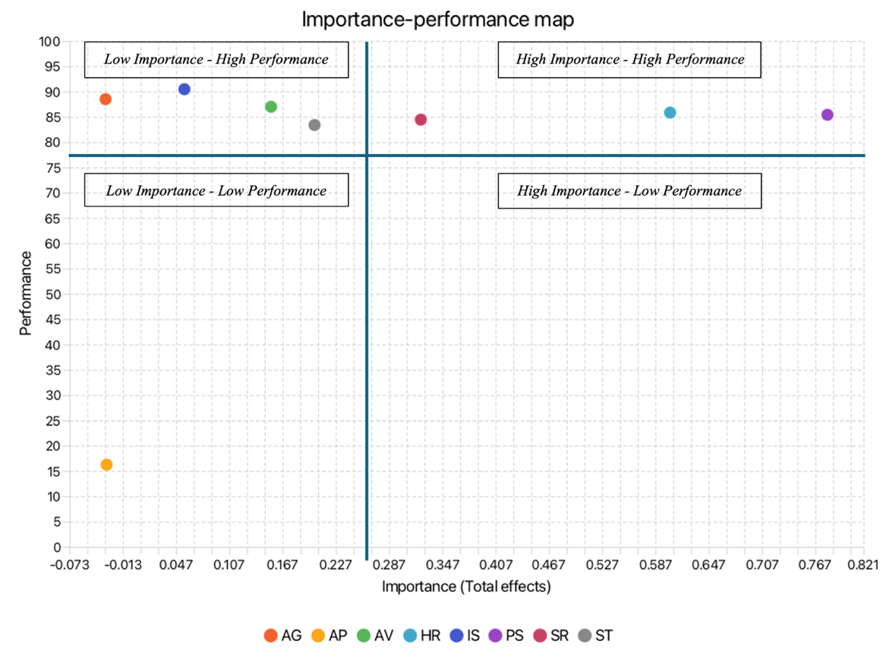
Figure 3. Importance-performance map analysis (IPMA) at the construct level, each point represents a latent construct.
None of the constructs were situated in the high-importance, low-performance quadrant, signifying that all predictors exhibit satisfactory performance levels. Patient satisfaction (importance=0.780; performance=85.41), hospital reputation (importance=0.603; performance=85.84), and support and respect (importance=0.322; performance=84.45) were positioned within the high-importance, high-performance quadrant, thereby affirming their essential contribution to maintaining patient loyalty. Meanwhile, anticipatory guidance, information sharing, availability, and sufficient time were in the low-importance, high-performance quadrant, reflecting that these aspects were already performing well but contributed less significantly to patient loyalty outcomes. Lastly, approachability was positioned within the low-importance, low-performance quadrant, indicating that although it currently had limited influence, its relatively lower performance suggested an area that could still benefit from improvement.
At the indicator level, the average importance score was 0.072, and the average performance score was 76.34. Indicators above these mean values were key contributors to revisit intention, whereas those below may required managerial attention (Figure 4).
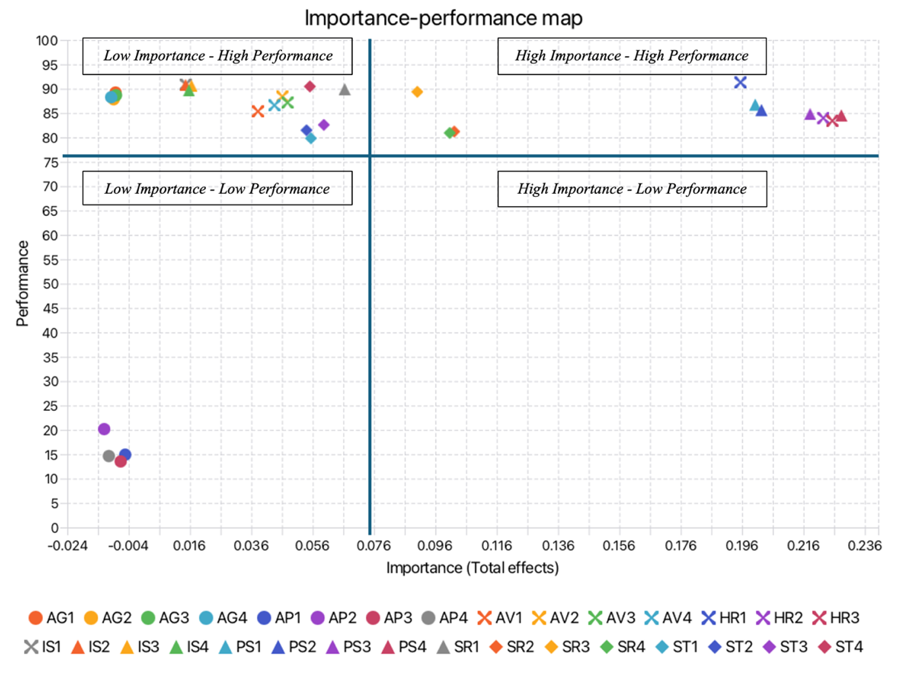
Figure 4. Importance-performance map analysis (IPMA) at the indicator level, each point represents a questionnaire indicator/item.
Discussion
This study examined the effect of prenatal care quality on patient satisfaction and its subsequent effects on hospital reputation and intention to revisit among women receiving antenatal services in rural Indonesia. In a rural Indonesian hospital context, antenatal satisfaction was shaped most strongly by sufficient time, service availability, and supportive-respectful care, whereas information sharing, anticipatory guidance, and approachability carried less weight in determining satisfaction. Satisfaction, in turn, affected the hospital’s reputation and the intention to return through a significant indirect path via reputation.
Our findings align with recent evidence from Indonesia and low- and middle-income countries (LMICs) emphasizing the centrality of time and access in antenatal experience. A 2025 cross-sectional study from Bantul, Indonesia, found that waiting time and consultation duration are positively associated with integrated ANC quality, reinforcing that unhurried encounters and reduced bottlenecks are perceived as higher quality by pregnant women [25]. Beyond Indonesia, new analyses continue to report wide variation in ANC satisfaction across countries, with time and access dimensions frequently implicated in low ratings [26]. Comparable signals appear in East Africa, where facility and district surveys in Ethiopia report timeliness and service organization as persistent pain points that closely track overall ANC satisfaction [27, 28]. In terms of the support and respect pathway, recent facility studies in Ethiopia and Zanzibar demonstrate that polite communication, privacy, and being treated with dignity are independently associated with increased ANC satisfaction, after controlling for structural factors [26, 29]. A systematic review of LMICs in 2023 also reports dignity, privacy, and compassionate communication as key drivers of a positive experience, and recent facility surveys likewise links respectful interactions to higher overall satisfaction [30, 31]. Thus, when women can get in, be seen quickly, and spend enough time with their providers, the overall quality of ANC improves—even if other areas are doing well [28, 32, 33].
The absence of independent effects for information sharing and anticipatory guidance should not be interpreted as clinical unimportance. Two non-exclusive explanations fit recent observations. First, communication items often show ceiling effects once basic counseling protocols are in place, shrinking their statistical leverage relative to time and access. This pattern is echoed in facility surveys that report high mean scores on counseling content alongside lower scores for waiting time and flow, indicating limited discriminative power for communication once minimum standards are met [26, 27, 32]. Second, in resource-constrained settings, patients appear to weigh tangible enablers (time to talk, ability to reach staff) more heavily than standardized counseling when forming satisfaction judgments. Additional ANC studies echo this pattern. A 2022 review reports waiting time under sixty minutes as a consistent correlate of higher ANC satisfaction, highlighting the salience of service flow over didactic content when women summarize their experience [27]. A 2025 Ethiopian study [33] likewise links respect, provider knowledge, and waiting time to satisfaction, and a 2024 facility survey [32] reports very high overall satisfaction but lower ratings for waiting time and receiving test result information, consistent with ceiling effects on communication items and a heavier weighting of tangible enablers. Contemporary Indonesian ANC studies underline this pattern: Even where coverage is improving, service organization factors (waits, reachability, coordination) dominate women’s assessments [25].
Downstream, the sizeable satisfaction-reputation-revisit pathway reflects broader hospital loyalty evidence. New hospital-based analyses confirm that satisfaction improves revisit intention directly and through institution-level perceptions (reputation/credibility) [32, 33]. Studies in Asian hospital systems indicate that satisfaction enhances revisit intention directly and indirectly through institutional image or reputation and related trust perceptions, suggesting that improvements in day-to-day ANC processes can compound into reputational capital that sustains future utilization [11, 12, 14]. Similar ANC-specific findings from Nigeria also indicate that a higher perceived quality of ANC services correlates with a willingness to return to the same facility, thereby reinforcing the satisfaction-reputation-loyalty chain identified in this context [34].
This study is not without limitations. The investigation took place in only one maternal and child hospital situated in a rural region of Bali, which may limit the applicability of the results to other institutions or more urban populations. In addition, the study relied on participants’ self-reported experiences, which may be affected by factors such as recall inaccuracies or a tendency to respond in socially desirable ways. Future studies should incorporate a broader range of hospitals across various geographic areas to allow comparisons and enhance the generalizability of the findings. Longitudinal or mixed-method approaches are also recommended to capture changes in patient satisfaction over time and to explore deeper qualitative insights into women’s prenatal care experiences.
Conclusion
Ensuring adequate consultation time, accessible services, and respectful, supportive care substantially improves satisfaction, strengthens hospital reputation, and fosters patient loyalty in rural maternal healthcare.
Acknowledgments: The authors extend their heartfelt thanks to the management and team of Cahaya Bunda Maternal and Child Hospital in Tabanan, Bali, for their assistance during the data collection process, as well as to all the pregnant women who willingly took part in this research. Appreciation is also given to Universitas Pelita Harapan for providing academic support and facilitating the completion of this study.
Ethical Permissions: This study was approved by the Research Ethics Committee of Universitas Pelita Harapan, Indonesia (Reference Number: 047/MARS/EC/X/2025).
Conflicts of Interests: Nothing to be reported.
Authors' Contribution: Soetomo CT (First Author), Introduction Writer/Main Researcher/Discussion Writer/Statistical Analyst (40%); Achmadi H (Second Author), Methodologist/Assistant Researcher/Discussion Writer (30%); Gunawan MFB (Third Author), Methodologist/Assistant Researcher/Discussion Writer/Statistical Analyst (30%)
Funding/Support: Nothing to be reported.
Maternal and child health represents a key priority in international health agendas. In alignment with Sustainable Development Goal 3.1, countries are expected to reduce maternal mortality worldwide, targeting fewer than 70 maternal deaths per 100,000 live births by the year 2030 [1]. Notwithstanding significant advancements in service coverage, almost 80% of maternal fatalities globally remain preventable with high-quality and timely prenatal care [2]. Since 1990, Indonesia’s maternal mortality has declined with better obstetric and prenatal access, yet it remains higher than most Southeast Asian countries. Persistent gaps between urban and rural areas in facilities, referral systems, and workforce show that expanding antenatal coverage is not enough; improving prenatal care quality, especially in rural and underserved regions, is essential for safer pregnancies and better maternal outcomes [3].
This need is underscored by Indonesia’s maternal mortality ratio, which remained at 249 per 100,000 live births in 2020, representing only a 45% reduction since 1990 [3]. Additionally, significant regional disparities are apparent: provinces beyond Java–Bali exhibit maternal mortality rates that exceed the national average by more than twofold [3]. Currently, the provision of comprehensive antenatal services is not keeping pace with the metrics of their utilization. For instance, the data indicate that merely 64.25% of pregnant women in rural West Java attended antenatal care (ANC) visits that met the recommended thresholds, in contrast to 79.81% in urban regions [4]. The data indicate that although a significant number of women seek care, the thoroughness and quality of these services are often inconsistent and inequitable, especially in rural areas. Together, these figures point to a coverage-quality gap.
Against this backdrop, national programs have increased antenatal care visits among Indonesian women, though studies continue to show variability in the quality and content of care delivered. Many expectant mothers receive routine clinical examinations but report inadequate counseling, limited explanations of pregnancy-related risks, and shortened consultation times. Research analyzing the Quality of Prenatal Care Questionnaire (QPCQ) has demonstrated that the interpersonal dimensions of care—encompassing information dissemination, anticipatory guidance, and provider support—frequently receive lower ratings than the technical service elements [5]. Addressing these limitations requires understanding how specific elements of care quality influence women’s satisfaction and their future care-seeking behaviors, particularly in rural hospitals where resource constraints may exacerbate these issues.
Grounded in Donabedian’s structure-process-outcome model, the QPCQ captures six process domains: information sharing, anticipatory guidance, sufficient time, approachability, availability, and support/respect, which shape women’s evaluations of prenatal care [5]. Evidence shows that clear communication, consistent counseling, and empathic support improve understanding and reduce anxiety, whereas rushed or inconsistent encounters depress satisfaction [6, 7]. In Indonesia and comparable settings, responsiveness, assurance, and staff empathy are strong predictors of satisfaction [8, 9]. Building on this evidence, it is expected that each of the six QPCQ domains will demonstrate a positive association with overall patient satisfaction, reflecting their central role in shaping women’s care experiences.
Patient satisfaction, the alignment of expectations with experienced interpersonal and technical care, functions as a proximal outcome and a driver of subsequent behavior. Higher satisfaction strengthens perceptions of hospital credibility, professionalism, and trustworthiness, thereby building institutional reputation that influences provider choice and word-of-mouth [10, 11]. In Indonesian settings, satisfaction consistently predicts loyalty behaviors, including willingness to return, with assurance, responsiveness, and empathy as salient antecedents [12, 13]. Patients who view a hospital as reputable report stronger intentions to revisit even after accounting for other factors, indicating that reputational capital translates perceived quality into concrete utilization decisions [11, 14]. Accordingly, our conceptual model anticipates positive relationships between satisfaction and hospital reputation, between satisfaction and intention to revisit, and between hospital reputation and intention to revisit, including the possibility that reputation may strengthen or channel the satisfaction-revisit relationship.
To test this model in a resource-constrained setting, we conducted a cross-sectional study in a rural maternal and child hospital in Indonesia, using the QPCQ to measure the six care-quality domains and separate scales for satisfaction, hospital reputation, and intention to revisit. Partial least squares-structural equation modeling (PLS-SEM) was applied to evaluate the measurement properties and the proposed relational paths, providing evidence to guide improvements in antenatal care quality and patient-centered outcomes in rural services.
Instrument and Methods
Research design and sample
This quantitative, cross-sectional was conducted in 2025 on 181 pregnant women undergoing antenatal treatment at the maternal-child hospital in Tabanan, Bali, Indonesia.
Participants were systematically recruited from the hospital’s outpatient obstetric clinics for a two-week data collection period. The eligibility criteria included being currently pregnant and attending antenatal care at the hospital for a minimum of two visits, the age of ≥18 years, being proficient in reading and comprehension of Bahasa Indonesia, and willingness to provide informed consent. Women experiencing obstetric problems necessitating tertiary referral or possessing cognitive or psychological impairments that would hinder questionnaire understanding were excluded.
Following the statistical power guidelines proposed by Cohen et al., the required sample size was calculated using G*Power version 3.1.9.7. Using a medium effect size (f²=0.15), a significance level of 0.05, a power level of 0.90, and up to eight predictor constructs, at least 136 respondents were needed [15]. Moreover, Kock and Hadaya state that the minimum sample size necessary for research using PLS-SEM can be approximated by the inverse square root and gamma-exponential techniques [16]. Their Monte Carlo simulation trials showed that these methods provide estimates with a statistical power of at least 0.80 at the 0.05 significance level. The study suggests a minimum sample size of about 160 respondents as a general rule of thumb for PLS-SEM analyses when the requisite power cannot be known beforehand.
Instrument
Data were gathered using a structured questionnaire with closed-ended items and predetermined response options. The instrument covered six QPCQ domains, including information sharing (IS1-IS4), anticipatory guidance (AG1-AG4), sufficient time (ST1-ST4), approachability (AP1-AP4), availability (AV1-AV4), and support and respect (SR1-SR4), adapted from Heaman et al. [5]. Overall patient satisfaction was measured with four items (PS1-PS4) adapted from Hibusu et al. [17]. The hospital reputation was assessed with three items (HR1-HR3) adapted from Gaspersz et al. [11], and intention to revisit was assessed with three items (IRV1-IRV3) adapted from Kasena & Antonio [18]. All items employed a five-point Likert scale from 1 (strongly disagree) to 5 (strongly agree).
Participants selected the response options that best represented their perceptions or experiences with the antenatal services they received.
Procedure
Recruitment was carried out with assistance from midwives and clinic staff, who identified eligible women and invited them to participate after their visits. Each respondent received a brief explanation of the study purpose and completed the self-administered questionnaire in a designated private area of the clinic. Participation was anonymous and voluntary, and informed consent was obtained prior to data collection.
Data analysis
The dataset was analyzed using the PLS-SEM approach with SmartPLS version 4.0 [19]. This technique is suitable because it handles complex predictive frameworks with numerous latent constructs and indicators, and it performs well with moderate sample sizes and data that may deviate from a normal distribution. The analysis adhered to the standard two-stage procedure, which includes assessing the measurement (outer) model followed by evaluating the structural (inner) model [20, 21].
The assessment of the reflective measurement model focused on ensuring that the constructs met the required reliability and validity standards. Items were retained only if they showed factor loadings greater than 0.70, indicating that each indicator contributed adequately to its construct. The consistency of the constructs was then examined using Cronbach’s alpha and composite reliability (CR), with both metrics needing to exceed 0.70 to be deemed reliable. Evidence of convergent validity was established when the average variance extracted (AVE) for each construct was above 0.50. To determine whether the constructs were empirically distinct, discriminant validity was checked using the Heterotrait–Monotrait (HTMT) criterion; values under 0.85 confirmed that the constructs did not overlap excessively [20, 21].
To investigate the proposed relationships among the model constructs, the structural component of the model was analyzed. Potential multicollinearity was assessed through the variance inflation factor (VIF); all VIF values were below 5.0, indicating that the predictors did not exhibit problematic overlap [21]. The statistical significance of each proposed path was then evaluated using a bootstrapping resampling technique, which produced the standardized path estimates (β), along with their t-statistics and p-values [22].
The overall explanatory capacity of the model was judged using the R² statistic. According to commonly accepted guidelines, R² values around 0.25, 0.50, and 0.75 denote low, moderate, and high levels of explained variance, respectively [20]. To understand how much each predictor contributed to its outcome construct, effect sizes (f²) were computed—categorized as small (0.02-0.15), medium (0.15-0.35), and large (greater than 0.35) impacts [15]. Furthermore, predictive relevance of the endogenous constructs was examined through the Stone–Geisser Q² statistic obtained via the blindfolding procedure.
Importance-performance map analysis (IPMA) enhances the interpretation of PLS-SEM results by examining not only how strongly each predictor influences the target construct (its total effect) but also how well each construct performs based on its average latent variable scores [23]. This analysis provides actionable insights by identifying the characteristics of prenatal care quality that most significantly influence patient satisfaction and the intention to revisit, thus offering practical guidance for hospital administrators aiming to enhance service quality [24].
Findings
A total of 181 respondents participated in this study, all of whom were pregnant women receiving antenatal care at a maternal and child hospital in Tabanan, Bali. The outer model demonstrated dependable indicator loadings across all constructs (Figure 1).
Figure 1. The outer model.
Every item achieved an outer loading above 0.70, indicating acceptable item reliability. All items also recorded Cronbach’s alpha and CR values greater than 0.70, supporting internal consistency. Moreover, each item’s AVE exceeded the 0.50 benchmark, confirming adequate convergent validity (Table 1).
Table 1. Outer loadings and construct reliability and validity (n=181)
In addition, the HTMT values reported were all lower than the recommended cutoff of 0.90, confirming that the constructs were sufficiently distinct from one another. The measurement model met the required standards of reliability and validity, allowing for subsequent analysis of the structural links among prenatal care quality, patient satisfaction, hospital reputation, and revisit intention (Table 2).
Table 2. Discriminant validity assessment using the Heterotrait-Monotrait (HTMT) criterion
For the patient-satisfaction equation, VIF values were as follows: approachability=1.075; availability=2.008; anticipatory guidance=4.059; information sharing=4.144; support and respect=3.699; and sufficient time=4.023. When examining predictors of hospital reputation, patient satisfaction showed a VIF of 1.000, indicating negligible collinearity in that equation. For the intention-to-revisit equation, both hospital reputation and patient satisfaction recorded VIFs of 3.329. All reported VIFs were below the conservative threshold of 5.0, confirming that multicollinearity did not materially bias the estimation of the structural paths.
The R² results indicated strong explanatory capacity for all endogenous constructs. The R² for patient satisfaction was 0.667 (adjusted 0.655), for hospital reputation 0.700 (adjusted 0.698), and for intention to revisit 0.718 (adjusted 0.715), demonstrating substantial predictive accuracy across the model. In addition, the Stone-Geisser Q² values were 0.610 for patient satisfaction, 0.554 for hospital reputation, and 0.499 for intention to revisit, all of which exceed zero, confirming that each construct possesses meaningful predictive relevance within the model. These findings underscore the model’s strong capacity to account for both structural relationships and predictive performance in this maternal healthcare context (Figure 2).
Figure 2. The inner model.
According to structural analysis using one-tailed bootstrapping, sufficient time had a significant association with patient satisfaction (β=0.260, t=1.743, p=0.041, f²=0.050), accompanied by availability (β=0.197, t=2.260, p=0.012, f²=0.058) and support and respect (β=0.413, t=2.920, p=0.002, f²=0.138). Information sharing (β=0.072, t=0.526, p=0.299, f²=0.004), anticipatory guidance (β=-0.042, t=0.339, p=0.367, f²=0.001), and approachability (β=-0.040, t=1.119, p=0.132, f²=0.005) were not statistically significant. Accordingly, within the studied rural hospital context, sufficient consultation time, accessibility of services, and respectful, supportive interactions were the primary drivers of patient satisfaction, whereas communication-related dimensions played a comparatively lesser role.
For the downstream relationships, patient satisfaction strongly predicted hospital reputation (β=0.836, t=29.156, p<0.001, f²=2.329), and also showed a moderate association with intention to revisit (β=0.276, t=2.238, p=0.013, f²=0.081). Hospital reputation further demonstrated a substantial positive effect on intention to revisit (β=0.603, t=5.207, p<0.001, f²=0.388). Overall, the pattern of effects highlighted the primacy of time adequacy, service availability, and respectful care in shaping satisfaction, and the central role of satisfaction and reputation in influencing revisit behavior.
Thus, patient satisfaction was an important mediating factor connecting prenatal care quality to both hospital reputation and patient loyalty. The high R² and Q² values further reinforced the model’s robust explanatory and predictive performance in understanding satisfaction and revisit intentions among maternal healthcare users.
The IPMA identified which constructs most strongly influenced patients’ intention to revisit while evaluating their performance levels. The mean importance value across constructs was 0.256, while the mean performance value was 77.66. Constructs situated above these mean values were deemed to possess enhanced strategic significance for enhancing hospital service quality (Figure 3).
Figure 3. Importance-performance map analysis (IPMA) at the construct level, each point represents a latent construct.
None of the constructs were situated in the high-importance, low-performance quadrant, signifying that all predictors exhibit satisfactory performance levels. Patient satisfaction (importance=0.780; performance=85.41), hospital reputation (importance=0.603; performance=85.84), and support and respect (importance=0.322; performance=84.45) were positioned within the high-importance, high-performance quadrant, thereby affirming their essential contribution to maintaining patient loyalty. Meanwhile, anticipatory guidance, information sharing, availability, and sufficient time were in the low-importance, high-performance quadrant, reflecting that these aspects were already performing well but contributed less significantly to patient loyalty outcomes. Lastly, approachability was positioned within the low-importance, low-performance quadrant, indicating that although it currently had limited influence, its relatively lower performance suggested an area that could still benefit from improvement.
At the indicator level, the average importance score was 0.072, and the average performance score was 76.34. Indicators above these mean values were key contributors to revisit intention, whereas those below may required managerial attention (Figure 4).
Figure 4. Importance-performance map analysis (IPMA) at the indicator level, each point represents a questionnaire indicator/item.
Discussion
This study examined the effect of prenatal care quality on patient satisfaction and its subsequent effects on hospital reputation and intention to revisit among women receiving antenatal services in rural Indonesia. In a rural Indonesian hospital context, antenatal satisfaction was shaped most strongly by sufficient time, service availability, and supportive-respectful care, whereas information sharing, anticipatory guidance, and approachability carried less weight in determining satisfaction. Satisfaction, in turn, affected the hospital’s reputation and the intention to return through a significant indirect path via reputation.
Our findings align with recent evidence from Indonesia and low- and middle-income countries (LMICs) emphasizing the centrality of time and access in antenatal experience. A 2025 cross-sectional study from Bantul, Indonesia, found that waiting time and consultation duration are positively associated with integrated ANC quality, reinforcing that unhurried encounters and reduced bottlenecks are perceived as higher quality by pregnant women [25]. Beyond Indonesia, new analyses continue to report wide variation in ANC satisfaction across countries, with time and access dimensions frequently implicated in low ratings [26]. Comparable signals appear in East Africa, where facility and district surveys in Ethiopia report timeliness and service organization as persistent pain points that closely track overall ANC satisfaction [27, 28]. In terms of the support and respect pathway, recent facility studies in Ethiopia and Zanzibar demonstrate that polite communication, privacy, and being treated with dignity are independently associated with increased ANC satisfaction, after controlling for structural factors [26, 29]. A systematic review of LMICs in 2023 also reports dignity, privacy, and compassionate communication as key drivers of a positive experience, and recent facility surveys likewise links respectful interactions to higher overall satisfaction [30, 31]. Thus, when women can get in, be seen quickly, and spend enough time with their providers, the overall quality of ANC improves—even if other areas are doing well [28, 32, 33].
The absence of independent effects for information sharing and anticipatory guidance should not be interpreted as clinical unimportance. Two non-exclusive explanations fit recent observations. First, communication items often show ceiling effects once basic counseling protocols are in place, shrinking their statistical leverage relative to time and access. This pattern is echoed in facility surveys that report high mean scores on counseling content alongside lower scores for waiting time and flow, indicating limited discriminative power for communication once minimum standards are met [26, 27, 32]. Second, in resource-constrained settings, patients appear to weigh tangible enablers (time to talk, ability to reach staff) more heavily than standardized counseling when forming satisfaction judgments. Additional ANC studies echo this pattern. A 2022 review reports waiting time under sixty minutes as a consistent correlate of higher ANC satisfaction, highlighting the salience of service flow over didactic content when women summarize their experience [27]. A 2025 Ethiopian study [33] likewise links respect, provider knowledge, and waiting time to satisfaction, and a 2024 facility survey [32] reports very high overall satisfaction but lower ratings for waiting time and receiving test result information, consistent with ceiling effects on communication items and a heavier weighting of tangible enablers. Contemporary Indonesian ANC studies underline this pattern: Even where coverage is improving, service organization factors (waits, reachability, coordination) dominate women’s assessments [25].
Downstream, the sizeable satisfaction-reputation-revisit pathway reflects broader hospital loyalty evidence. New hospital-based analyses confirm that satisfaction improves revisit intention directly and through institution-level perceptions (reputation/credibility) [32, 33]. Studies in Asian hospital systems indicate that satisfaction enhances revisit intention directly and indirectly through institutional image or reputation and related trust perceptions, suggesting that improvements in day-to-day ANC processes can compound into reputational capital that sustains future utilization [11, 12, 14]. Similar ANC-specific findings from Nigeria also indicate that a higher perceived quality of ANC services correlates with a willingness to return to the same facility, thereby reinforcing the satisfaction-reputation-loyalty chain identified in this context [34].
This study is not without limitations. The investigation took place in only one maternal and child hospital situated in a rural region of Bali, which may limit the applicability of the results to other institutions or more urban populations. In addition, the study relied on participants’ self-reported experiences, which may be affected by factors such as recall inaccuracies or a tendency to respond in socially desirable ways. Future studies should incorporate a broader range of hospitals across various geographic areas to allow comparisons and enhance the generalizability of the findings. Longitudinal or mixed-method approaches are also recommended to capture changes in patient satisfaction over time and to explore deeper qualitative insights into women’s prenatal care experiences.
Conclusion
Ensuring adequate consultation time, accessible services, and respectful, supportive care substantially improves satisfaction, strengthens hospital reputation, and fosters patient loyalty in rural maternal healthcare.
Acknowledgments: The authors extend their heartfelt thanks to the management and team of Cahaya Bunda Maternal and Child Hospital in Tabanan, Bali, for their assistance during the data collection process, as well as to all the pregnant women who willingly took part in this research. Appreciation is also given to Universitas Pelita Harapan for providing academic support and facilitating the completion of this study.
Ethical Permissions: This study was approved by the Research Ethics Committee of Universitas Pelita Harapan, Indonesia (Reference Number: 047/MARS/EC/X/2025).
Conflicts of Interests: Nothing to be reported.
Authors' Contribution: Soetomo CT (First Author), Introduction Writer/Main Researcher/Discussion Writer/Statistical Analyst (40%); Achmadi H (Second Author), Methodologist/Assistant Researcher/Discussion Writer (30%); Gunawan MFB (Third Author), Methodologist/Assistant Researcher/Discussion Writer/Statistical Analyst (30%)
Funding/Support: Nothing to be reported.
Article Type: Descriptive & Survey |
| Rights and permissions | |
 |
This work is licensed under a Creative Commons Attribution-NonCommercial 4.0 International License. |