


Volume -
3 , - : 721-726 |
Back to browse issues page



Download citation:
BibTeX | RIS | EndNote | Medlars | ProCite | Reference Manager | RefWorks
Send citation to:


BibTeX | RIS | EndNote | Medlars | ProCite | Reference Manager | RefWorks
Send citation to:
Role of Perceived Social Support in the University to Work Transition in Health Graduates. 3 https://doi.org/10.58209/hehp.13.4.721
URL: http://daneshafarand.org/article-1-83024-en.html
URL: http://daneshafarand.org/article-1-83024-en.html
| Abstract (HTML) (513 Views)
Full-Text: (25 Views)
Introduction
According to the results of the Labor Force Survey conducted by the Statistical Center of Iran in 2023, the unemployment rate among university graduates was reported to be approximately 40.8% [1], and considering the growth rate of the graduate population over the past two decades, it can be regarded as the most significant social and economic challenge of the future [2]. Transitions are periods of change and mobility during which individuals move between different life stages, such as from childhood to adulthood and from working life to retirement [3]. One of the transitions that students face as they approach graduation is the transition from university to work, which often involves starting their first job [3, 4]. This transition period is fraught with challenges because new graduates grapple with issues such as unemployment and financial pressure [5]. A successful university-to-work transition (UWT) is an important milestone in students’ lives, a significant, complex, and challenging step in their career path, and entering the labor market is considered a fundamental developmental task during young adulthood [6]. In this sense, success or failure in the transition affects other dimensions of graduates’ lives [7]. During this transition period, students face difficult tasks such as leaving university and searching for employment [8]. Moreover, while leaving the familiar, secure, and structured educational environment, they must enter the insecure and unstable world of work. They must find a job that, ideally, not only matches their education but is also compatible with their values [6, 9].
In this regard, Wendlandt & Rochlen identify three fundamental challenges as reasons for the difficulty of the UWT, including the existence of different cultures governing the university and the world of employment, and students’ and graduates’ lack of awareness of these differences, graduates’ lack of experience and skills required in the world of employment, such as weaknesses in job-search skills, verbal and written communication skills, effective communication skills, time management, teamwork, and problem-solving, and students’ unrealistic expectations of the world of work [10]. A lack of preparedness for this type of transition may be associated with ambiguity, confusion, stress, depression, unemployment, financial dependence, and employment in fields that do not align with their field of study [11, 12]. Super believes that the concept of transition—the successful passage from one stage to another—indicates understanding and readiness for change, which is recognized as a transition, and this transition is a process, not an event; therefore, it can be planned and predicted [13].
The transition period is defined as a broad change in role, position, and relationships, concerns and curiosity for acquiring necessary academic skills, completing educational and skill training courses for employment, curiosity about suitable job options, increased self-confidence to participate in job interviews, and learning assertiveness and job search skills [14, 15]. It has four dimensions under the title of career transition competence, which include concern for the UWT, meaning having a future time perspective or having a plan for the future, control over the UWT, meaning having awareness and a sense of management regarding the path one wants to follow in the future, curiosity about the UWT, meaning searching for various options and job opportunities, and confidence in the UWT, meaning having self-efficacy and a sense of confidence to take charge of career path goals [16, 17]. These four transition competencies are derived from career adaptability, which refers to an individual’s readiness to undertake developmental tasks, face career path transitions and the psychological shocks resulting from them, and provide appropriate responses to the challenges they encounter [8]. Increasing career transition competencies among job seekers enables individuals to have greater preparedness to face upcoming events, such as being assessed and participating in job interviews or finding a suitable job position, and to experience emotions, such as anxiety and reduced self-efficacy [5, 7]. The transition from university to the workforce can also negatively affect the well-being and mental health of new graduates. There is growing evidence indicating that new graduates in the labor market can experience mental health issues such as anxiety, depression, and stress while searching for employment after graduation [15]. One of the important psychological resources for career adaptability is perceived social support, which focuses on an individual’s cognitive appraisal of their environment and their level of confidence that help and support will be available if needed. If the student population in society, who are involved in the transition issue, are left without support and backing, they cannot be expected to participate, be creative, and be productive in their work environment and field of study [18]. Perceived social support has significant effects on individuals’ physical and psychological status, life satisfaction, and various aspects of quality of life, and is recognized as an effective moderating factor in coping with and adapting to stressful life conditions, such as the concept of UWT [19].
In Sweeney’s study, challenges related to the UWT are attributed to the lack of internal and external social support, the presence of stress and anxiety during the transition, and the lack of support from professors, mentors, and supervisors [20]. Indeed, social support is one of the most important forms of social relationships, and benefiting from it, perceiving it, and needing it can vary according to age, gender, personality, and even culture. On the other hand, at each stage of life, certain aspects of support may gain importance and have greater effects than others [21]. Therefore, the presence of social support can be associated with high positive affect, life satisfaction, and low psychological distress [19].
Considering that students, as an efficient and future-building stratum of society, annually account for a significant portion of each country’s planning and budget [22], to accomplish this task and successfully pass through this transition, they must obtain appropriate support for searching and finding employment. The present study aimed at determining the role of perceived social support and the level of readiness for the UWT among graduating students of the School of Health at Qazvin University of Medical Sciences.
Instrument and Methods
Design and participants
This descriptive-analytical cross-sectional study included all bachelor’s graduates in public health, environmental health, occupational health, and health services management from the School of Health between 2023 and 2025. Of 238 graduates during this period, 228 (selected through census) participated in the study (a dropout of 10 individuals due to refusal or non-response). Inclusion criteria were having completed a bachelor’s degree in one of the specified fields and at least one month since graduation; the exclusion criterion was unwillingness to participate.
Instrument
The questionnaire comprised three sections. First, demographic and academic parameters, including age, gender, field of study, marital status, employment status, parental education, family financial status, and satisfaction with the field of study were recorded.
Perceived social support was assessed using the Multidimensional Scale of Perceived Social Support (MSPSS). It is a 12-item instrument developed by Zimet et al. in 1988 [23], measuring perceived support from family, friends, and significant others on a seven-point Likert scale (1=strongly disagree to 7=strongly agree). Items 1, 2, 5, and 10 relate to significant others (e.g., “there is a special person who is around when I am in need.”); items 3, 4, 8, and 11 relate to family (e.g., “my family is willing to help me make decisions.”); and items 6, 7, 9, and 12 relate to friends (e.g., “my friends really try to help me”). Scores range from 12 to 84, with higher scores indicating greater perceived social support. In Iran, this scale was translated and validated by Besharat, with psychometric properties α=0.91, r=0.86 [24]. In this study, the reliability of the questionnaire was evaluated based on internal consistency (Cronbach's alpha) in a sample of 30 cases, and the total reliability coefficient for the MSPSS and UWTS subscales was 0.88 and 0.82, respectively.
UWTS was evaluated using the University-to-Work Transition Scale (UWTS). It is a 32-item measure assessing the four competencies: concern (items 1-8), control (items 9-16), curiosity (items 17-26), and confidence (items 27-32). Developed by Sadeghi et al. in 2017 [8], items are rated on a five-point Likert scale (1=strongly disagree to 5=strongly agree), with total scores ranging from 32 to 160. The scale’s psychometric properties were confirmed (α=0.86, r=0.83).
Data collection
Participants entered the study with written consent and were assured that participation was voluntary and that they could withdraw from the study at any time if they wished. Moreover, the questionnaires were coded and designed without mentioning names, assuring participants that all information would be used solely for research purposes and would remain confidential. After obtaining the necessary permissions, the research team explained the study’s methods and objectives in separate groups for each discipline, then distributed the online Porsline questionnaire link via the students’ contact numbers.
Data analysis
Data analysis was performed using SPSS version 25. Appropriate statistical tests were used, including the Kolmogorov-Smirnov test to assess data normality, independent t-tests, Pearson correlation coefficients, ANOVA, and multivariate regression.
Findings
Of 228 participants, the mean age was 22.89±1.04 years. 172 (75.4%) were female and 56 (24.6%) were male, and 45.6% reported being relatively satisfied with their field of study. UWT was significantly associated with father’s education, field of study, satisfaction with the field, and family financial status (p<0.05). PSS was significantly associated with field of study, gender, and family financial status (p<0.05; Table 1).
Table 1. Relationship between demographic characteristics of participants, UWTC dimensions, and PSS (n=228)
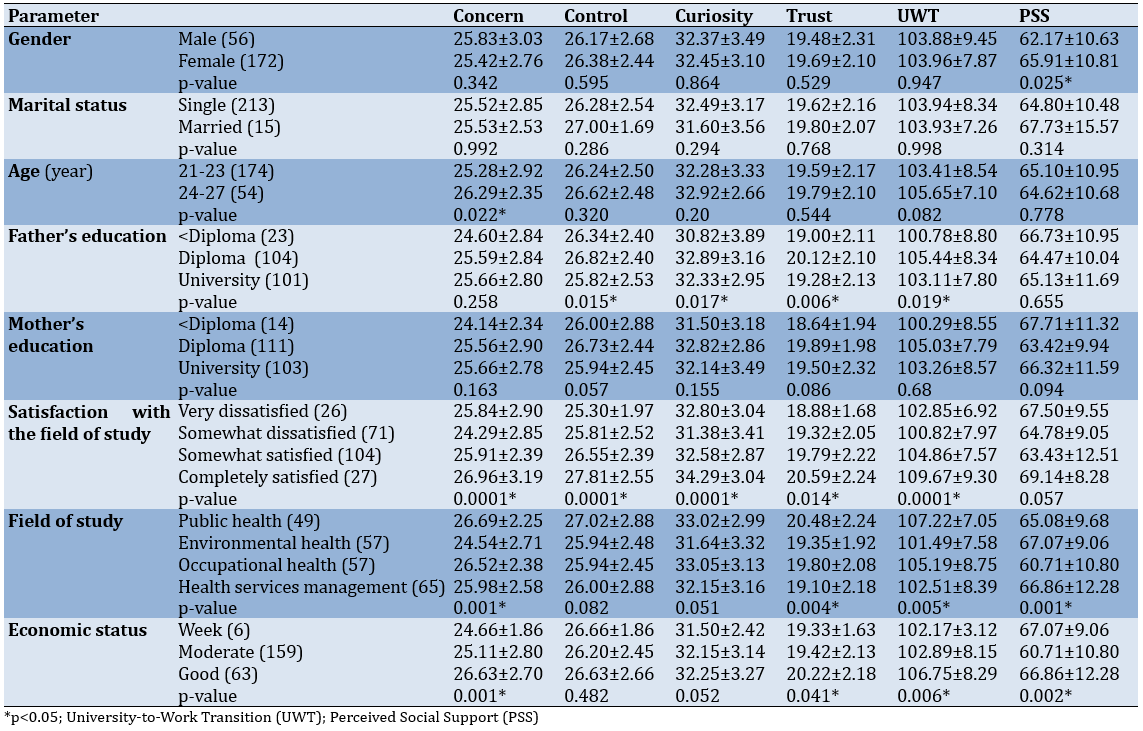
Pearson correlation analysis revealed significant positive associations between UWT and concern (r=0.77, p=0.0001), curiosity (r=0.80, p=0.0001), confidence (r=0.74, p=0.0001), control (r=0.75, p=0.0001), and perceived social support from significant others (r=0.13, p=0.037; Table 2).
Table 2. Pearson correlation matrix of UWTC dimensions and PSS
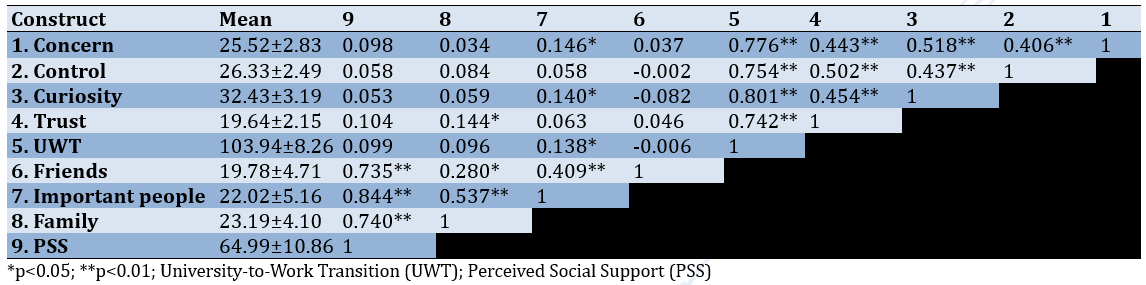
Multiple regression showed that field of study, satisfaction with the field, family financial status, and perceived support from significant others accounted for 15% of the variance in UWT scores. A one standard deviation increase in significant others’ support was associated with a 0.14 standard deviation increase in UWT (Adjusted R2=0.143; R2=0.153; R=0.398; Table 3).
Table 3. Regression analysis findings for predicting university-to-work transition

Discussion
The aim of this study was to examine the role of perceived social support in the UWT among graduates of the School of Health at Qazvin University of Medical Sciences, Iran. Before entering the new century and undergoing extensive changes in the world of work, students believed that after graduation they would obtain lifelong employment. However, with the emergence of fundamental transformations in the world of work in the new century and changes in the rules of selection, recruitment, and full-time entry into the job market, this process has become associated with specific concerns [24]. There was a significant and positive correlation between UWT and the four career adaptability competencies of concern, control, curiosity, and confidence. This result is consistent with the findings of Zhang et al. [8], Schettino et al. [25], and Neureiter & Traut-Mattausch [26], who have demonstrated that students’ abilities in these four competencies play an important role in their success in transitioning and entering the labor market. Accordingly, having future-oriented career-planning attitudes and readiness to face career-related challenges are considered important factors in achieving a successful transition. As Skorikov states, when individuals possess high levels of career adaptability (concern, control, curiosity, and confidence), it leads to greater success in mastering their career transitions [27]. Likewise, in the study by Eslamie et al., the dimensions of career adaptability have a direct effect on students’ successful transition from university to work [1].
Therefore, students who exhibit career concern tend to plan for their professional futures, and such attitudes help them better prepare for employment opportunities. The control dimension involves a sense of responsibility for constructing one’s career path and actively engaging in career development tasks and stages. This characteristic enables students to feel capable of managing their career trajectories and participating assertively in career-related changes. Curiosity involves cognitive exploration through discovering new opportunities. This dimension helps students remain receptive to new learning and experiences, which can create additional employment opportunities for them. Career confidence arises from a sense of self-efficacy and belief in one’s ability to make appropriate academic and career decisions, enabling students to feel capable of achieving their career goals through informed choices. However, these characteristics alone are not sufficient; success in transitioning to the labor market is influenced by multiple factors, including economic conditions, the structure of the labor market, the quality of practical experiences (such as internships), individual skill levels, and social support.
The “significant others” dimension of perceived social support had a significant and positive correlation with UWT, such that a one-standard-deviation increase in this dimension was associated with a 0.14-standard-deviation increase in UWT scores. This is consistent with the results of Pasha et al. [28], who highlight the role of environmental support in two general categories, including interpersonal support (family, faculty members) and organizational support (university). Financial and emotional support from the family, as well as faculty support through engaging students in work-related projects and organizing specialized workshops, familiarize students with job opportunities, enhance their skills, increase their awareness, and facilitate career planning, helping to reduce transition-related stress. The university, as a reputable and recognized institution, acts as an intermediary between students and employment opportunities in society and can play an important role in creating appropriate conditions for introducing and supporting students in the labor market.
In Sweeney’s study, the absence of internal and external social support, as well as the lack of support from faculty, mentors, and supervisors, is identified as a major challenge during the transition stage [20]. Considering that human life is inherently interconnected with others, perceived social support is regarded as an important contextual resource for career adaptability and mental health. Therefore, when students perceive higher levels of social support, they are likely to experience greater job satisfaction in their future careers [19].
UWT also had a statistically significant relationship with the field of study and satisfaction with the field. Specifically, the greater the alignment between an individual’s characteristics and their field of study, the higher their readiness for the transition from university to work. In the study by Presti et al., person–major fit is also associated with students’ preparedness for entering the labor market [29]. Therefore, students whose field of study does not align with their abilities, interests, and values are more likely to experience difficulties during this transition. The strategies students use when they are unsuccessful in entering the labor market include acquiring skills in a field unrelated to their major, creating a gap between their major and occupation, pursuing further education without a clear purpose at higher academic levels, and expressing a desire to migrate [28]. Thus, having a job as part of an individual’s identity influences their social status and position, and an unsuccessful transition in securing employment aligned with one’s field of study can affect other aspects of life, such as delaying marriage and increasing unemployment in society.
This study was limited to students from one medical sciences university in Iran and did not compare them with graduates of other medical or non-medical universities; therefore, generalizability is limited.
Conclusion
Strengthening transition competencies and social support, along with field alignment and finances, can improve graduates’ readiness for the UWT and their employment outcomes.
Acknowledgments: The authors are grateful to the students who participated in the research.
Ethical Permissions: This study was approved under the ethical approval code of Qazvin University of Medical Sciences (Ethics code: IR.QUMS.REC.1402.214).
Conflicts of Interests: The authors declared no conflicts of interests.
Authors' Contribution: Ghalenoei M (First Author), Introduction Writer/Methodologist (30%); Mohammadi Zeidi I (Second Author), Methodologist/Statistical Analyst (30%); Hosseini F (Third Author), Methodologist/Discussion Writer/Main Researcher (40%)
Funding/Support: This study was conducted with the financial support of the Deputy of Research and Technology of Qazvin University of Medical Sciences.
According to the results of the Labor Force Survey conducted by the Statistical Center of Iran in 2023, the unemployment rate among university graduates was reported to be approximately 40.8% [1], and considering the growth rate of the graduate population over the past two decades, it can be regarded as the most significant social and economic challenge of the future [2]. Transitions are periods of change and mobility during which individuals move between different life stages, such as from childhood to adulthood and from working life to retirement [3]. One of the transitions that students face as they approach graduation is the transition from university to work, which often involves starting their first job [3, 4]. This transition period is fraught with challenges because new graduates grapple with issues such as unemployment and financial pressure [5]. A successful university-to-work transition (UWT) is an important milestone in students’ lives, a significant, complex, and challenging step in their career path, and entering the labor market is considered a fundamental developmental task during young adulthood [6]. In this sense, success or failure in the transition affects other dimensions of graduates’ lives [7]. During this transition period, students face difficult tasks such as leaving university and searching for employment [8]. Moreover, while leaving the familiar, secure, and structured educational environment, they must enter the insecure and unstable world of work. They must find a job that, ideally, not only matches their education but is also compatible with their values [6, 9].
In this regard, Wendlandt & Rochlen identify three fundamental challenges as reasons for the difficulty of the UWT, including the existence of different cultures governing the university and the world of employment, and students’ and graduates’ lack of awareness of these differences, graduates’ lack of experience and skills required in the world of employment, such as weaknesses in job-search skills, verbal and written communication skills, effective communication skills, time management, teamwork, and problem-solving, and students’ unrealistic expectations of the world of work [10]. A lack of preparedness for this type of transition may be associated with ambiguity, confusion, stress, depression, unemployment, financial dependence, and employment in fields that do not align with their field of study [11, 12]. Super believes that the concept of transition—the successful passage from one stage to another—indicates understanding and readiness for change, which is recognized as a transition, and this transition is a process, not an event; therefore, it can be planned and predicted [13].
The transition period is defined as a broad change in role, position, and relationships, concerns and curiosity for acquiring necessary academic skills, completing educational and skill training courses for employment, curiosity about suitable job options, increased self-confidence to participate in job interviews, and learning assertiveness and job search skills [14, 15]. It has four dimensions under the title of career transition competence, which include concern for the UWT, meaning having a future time perspective or having a plan for the future, control over the UWT, meaning having awareness and a sense of management regarding the path one wants to follow in the future, curiosity about the UWT, meaning searching for various options and job opportunities, and confidence in the UWT, meaning having self-efficacy and a sense of confidence to take charge of career path goals [16, 17]. These four transition competencies are derived from career adaptability, which refers to an individual’s readiness to undertake developmental tasks, face career path transitions and the psychological shocks resulting from them, and provide appropriate responses to the challenges they encounter [8]. Increasing career transition competencies among job seekers enables individuals to have greater preparedness to face upcoming events, such as being assessed and participating in job interviews or finding a suitable job position, and to experience emotions, such as anxiety and reduced self-efficacy [5, 7]. The transition from university to the workforce can also negatively affect the well-being and mental health of new graduates. There is growing evidence indicating that new graduates in the labor market can experience mental health issues such as anxiety, depression, and stress while searching for employment after graduation [15]. One of the important psychological resources for career adaptability is perceived social support, which focuses on an individual’s cognitive appraisal of their environment and their level of confidence that help and support will be available if needed. If the student population in society, who are involved in the transition issue, are left without support and backing, they cannot be expected to participate, be creative, and be productive in their work environment and field of study [18]. Perceived social support has significant effects on individuals’ physical and psychological status, life satisfaction, and various aspects of quality of life, and is recognized as an effective moderating factor in coping with and adapting to stressful life conditions, such as the concept of UWT [19].
In Sweeney’s study, challenges related to the UWT are attributed to the lack of internal and external social support, the presence of stress and anxiety during the transition, and the lack of support from professors, mentors, and supervisors [20]. Indeed, social support is one of the most important forms of social relationships, and benefiting from it, perceiving it, and needing it can vary according to age, gender, personality, and even culture. On the other hand, at each stage of life, certain aspects of support may gain importance and have greater effects than others [21]. Therefore, the presence of social support can be associated with high positive affect, life satisfaction, and low psychological distress [19].
Considering that students, as an efficient and future-building stratum of society, annually account for a significant portion of each country’s planning and budget [22], to accomplish this task and successfully pass through this transition, they must obtain appropriate support for searching and finding employment. The present study aimed at determining the role of perceived social support and the level of readiness for the UWT among graduating students of the School of Health at Qazvin University of Medical Sciences.
Instrument and Methods
Design and participants
This descriptive-analytical cross-sectional study included all bachelor’s graduates in public health, environmental health, occupational health, and health services management from the School of Health between 2023 and 2025. Of 238 graduates during this period, 228 (selected through census) participated in the study (a dropout of 10 individuals due to refusal or non-response). Inclusion criteria were having completed a bachelor’s degree in one of the specified fields and at least one month since graduation; the exclusion criterion was unwillingness to participate.
Instrument
The questionnaire comprised three sections. First, demographic and academic parameters, including age, gender, field of study, marital status, employment status, parental education, family financial status, and satisfaction with the field of study were recorded.
Perceived social support was assessed using the Multidimensional Scale of Perceived Social Support (MSPSS). It is a 12-item instrument developed by Zimet et al. in 1988 [23], measuring perceived support from family, friends, and significant others on a seven-point Likert scale (1=strongly disagree to 7=strongly agree). Items 1, 2, 5, and 10 relate to significant others (e.g., “there is a special person who is around when I am in need.”); items 3, 4, 8, and 11 relate to family (e.g., “my family is willing to help me make decisions.”); and items 6, 7, 9, and 12 relate to friends (e.g., “my friends really try to help me”). Scores range from 12 to 84, with higher scores indicating greater perceived social support. In Iran, this scale was translated and validated by Besharat, with psychometric properties α=0.91, r=0.86 [24]. In this study, the reliability of the questionnaire was evaluated based on internal consistency (Cronbach's alpha) in a sample of 30 cases, and the total reliability coefficient for the MSPSS and UWTS subscales was 0.88 and 0.82, respectively.
UWTS was evaluated using the University-to-Work Transition Scale (UWTS). It is a 32-item measure assessing the four competencies: concern (items 1-8), control (items 9-16), curiosity (items 17-26), and confidence (items 27-32). Developed by Sadeghi et al. in 2017 [8], items are rated on a five-point Likert scale (1=strongly disagree to 5=strongly agree), with total scores ranging from 32 to 160. The scale’s psychometric properties were confirmed (α=0.86, r=0.83).
Data collection
Participants entered the study with written consent and were assured that participation was voluntary and that they could withdraw from the study at any time if they wished. Moreover, the questionnaires were coded and designed without mentioning names, assuring participants that all information would be used solely for research purposes and would remain confidential. After obtaining the necessary permissions, the research team explained the study’s methods and objectives in separate groups for each discipline, then distributed the online Porsline questionnaire link via the students’ contact numbers.
Data analysis
Data analysis was performed using SPSS version 25. Appropriate statistical tests were used, including the Kolmogorov-Smirnov test to assess data normality, independent t-tests, Pearson correlation coefficients, ANOVA, and multivariate regression.
Findings
Of 228 participants, the mean age was 22.89±1.04 years. 172 (75.4%) were female and 56 (24.6%) were male, and 45.6% reported being relatively satisfied with their field of study. UWT was significantly associated with father’s education, field of study, satisfaction with the field, and family financial status (p<0.05). PSS was significantly associated with field of study, gender, and family financial status (p<0.05; Table 1).
Table 1. Relationship between demographic characteristics of participants, UWTC dimensions, and PSS (n=228)
Pearson correlation analysis revealed significant positive associations between UWT and concern (r=0.77, p=0.0001), curiosity (r=0.80, p=0.0001), confidence (r=0.74, p=0.0001), control (r=0.75, p=0.0001), and perceived social support from significant others (r=0.13, p=0.037; Table 2).
Table 2. Pearson correlation matrix of UWTC dimensions and PSS
Multiple regression showed that field of study, satisfaction with the field, family financial status, and perceived support from significant others accounted for 15% of the variance in UWT scores. A one standard deviation increase in significant others’ support was associated with a 0.14 standard deviation increase in UWT (Adjusted R2=0.143; R2=0.153; R=0.398; Table 3).
Table 3. Regression analysis findings for predicting university-to-work transition
Discussion
The aim of this study was to examine the role of perceived social support in the UWT among graduates of the School of Health at Qazvin University of Medical Sciences, Iran. Before entering the new century and undergoing extensive changes in the world of work, students believed that after graduation they would obtain lifelong employment. However, with the emergence of fundamental transformations in the world of work in the new century and changes in the rules of selection, recruitment, and full-time entry into the job market, this process has become associated with specific concerns [24]. There was a significant and positive correlation between UWT and the four career adaptability competencies of concern, control, curiosity, and confidence. This result is consistent with the findings of Zhang et al. [8], Schettino et al. [25], and Neureiter & Traut-Mattausch [26], who have demonstrated that students’ abilities in these four competencies play an important role in their success in transitioning and entering the labor market. Accordingly, having future-oriented career-planning attitudes and readiness to face career-related challenges are considered important factors in achieving a successful transition. As Skorikov states, when individuals possess high levels of career adaptability (concern, control, curiosity, and confidence), it leads to greater success in mastering their career transitions [27]. Likewise, in the study by Eslamie et al., the dimensions of career adaptability have a direct effect on students’ successful transition from university to work [1].
Therefore, students who exhibit career concern tend to plan for their professional futures, and such attitudes help them better prepare for employment opportunities. The control dimension involves a sense of responsibility for constructing one’s career path and actively engaging in career development tasks and stages. This characteristic enables students to feel capable of managing their career trajectories and participating assertively in career-related changes. Curiosity involves cognitive exploration through discovering new opportunities. This dimension helps students remain receptive to new learning and experiences, which can create additional employment opportunities for them. Career confidence arises from a sense of self-efficacy and belief in one’s ability to make appropriate academic and career decisions, enabling students to feel capable of achieving their career goals through informed choices. However, these characteristics alone are not sufficient; success in transitioning to the labor market is influenced by multiple factors, including economic conditions, the structure of the labor market, the quality of practical experiences (such as internships), individual skill levels, and social support.
The “significant others” dimension of perceived social support had a significant and positive correlation with UWT, such that a one-standard-deviation increase in this dimension was associated with a 0.14-standard-deviation increase in UWT scores. This is consistent with the results of Pasha et al. [28], who highlight the role of environmental support in two general categories, including interpersonal support (family, faculty members) and organizational support (university). Financial and emotional support from the family, as well as faculty support through engaging students in work-related projects and organizing specialized workshops, familiarize students with job opportunities, enhance their skills, increase their awareness, and facilitate career planning, helping to reduce transition-related stress. The university, as a reputable and recognized institution, acts as an intermediary between students and employment opportunities in society and can play an important role in creating appropriate conditions for introducing and supporting students in the labor market.
In Sweeney’s study, the absence of internal and external social support, as well as the lack of support from faculty, mentors, and supervisors, is identified as a major challenge during the transition stage [20]. Considering that human life is inherently interconnected with others, perceived social support is regarded as an important contextual resource for career adaptability and mental health. Therefore, when students perceive higher levels of social support, they are likely to experience greater job satisfaction in their future careers [19].
UWT also had a statistically significant relationship with the field of study and satisfaction with the field. Specifically, the greater the alignment between an individual’s characteristics and their field of study, the higher their readiness for the transition from university to work. In the study by Presti et al., person–major fit is also associated with students’ preparedness for entering the labor market [29]. Therefore, students whose field of study does not align with their abilities, interests, and values are more likely to experience difficulties during this transition. The strategies students use when they are unsuccessful in entering the labor market include acquiring skills in a field unrelated to their major, creating a gap between their major and occupation, pursuing further education without a clear purpose at higher academic levels, and expressing a desire to migrate [28]. Thus, having a job as part of an individual’s identity influences their social status and position, and an unsuccessful transition in securing employment aligned with one’s field of study can affect other aspects of life, such as delaying marriage and increasing unemployment in society.
This study was limited to students from one medical sciences university in Iran and did not compare them with graduates of other medical or non-medical universities; therefore, generalizability is limited.
Conclusion
Strengthening transition competencies and social support, along with field alignment and finances, can improve graduates’ readiness for the UWT and their employment outcomes.
Acknowledgments: The authors are grateful to the students who participated in the research.
Ethical Permissions: This study was approved under the ethical approval code of Qazvin University of Medical Sciences (Ethics code: IR.QUMS.REC.1402.214).
Conflicts of Interests: The authors declared no conflicts of interests.
Authors' Contribution: Ghalenoei M (First Author), Introduction Writer/Methodologist (30%); Mohammadi Zeidi I (Second Author), Methodologist/Statistical Analyst (30%); Hosseini F (Third Author), Methodologist/Discussion Writer/Main Researcher (40%)
Funding/Support: This study was conducted with the financial support of the Deputy of Research and Technology of Qazvin University of Medical Sciences.
Article Type: Descriptive & Survey |
| Rights and permissions | |
 |
This work is licensed under a Creative Commons Attribution-NonCommercial 4.0 International License. |