


Volume -
3 , - : 703-710 |
Back to browse issues page


Download citation:
BibTeX | RIS | EndNote | Medlars | ProCite | Reference Manager | RefWorks
Send citation to:


BibTeX | RIS | EndNote | Medlars | ProCite | Reference Manager | RefWorks
Send citation to:
Knowledge, Attitudes, and Predictors of Posthumous Organ Donation Card Registration in University Student. 3 https://doi.org/10.58209/hehp.13.4.703
URL: http://daneshafarand.org/article-1-83039-en.html
URL: http://daneshafarand.org/article-1-83039-en.html
| Abstract (HTML) (421 Views)
Full-Text: (27 Views)
Introduction
Donation after brain death (DBD) is considered the most efficient source of transplantable organs, as a single donor can provide multiple organs for different recipients [1-3]. Despite this, substantial international disparities in postmortem donation rates persist [2, 4]. For instance, in 2017, Spain, Portugal, and Belgium achieved 46.9, 34, and 33.6 deceased donors per million population (pmp), respectively, while the United States recorded 32 pmp, a figure that remains significantly higher than those in many other countries, including Iran, which ranked 38th globally [2, 3, 5]. These gaps have severe consequences: it is estimated that globally up to 20 patients die each day while awaiting an organ transplant, resulting in substantial mortality each year worldwide [3, 6-8].
Although Iran has more than four decades of experience in organ transplantation and considerable potential for DBD, the conversion rate of brain-dead cases to actual donations remains lower than anticipated. Annually, 2500 to 4000 brain-death cases are reported in Iran; however, only about 10% result in organ donation [9]. National statistics reveal that approximately 26,000 patients are currently on the transplant waiting list; one patient is added every 10 minutes, and one patient dies every two hours due to organ shortage. Meanwhile, a single brain-dead donor has the potential to save up to eight lives and improve the quality of life for 53 patients [2, 10]. In 2017, out of around 3,000 eligible brain-death cases, only 926 resulted in actual donation [9, 11, 12]. These data emphasize the persistent impact of cultural, legal, organizational, and beliefs in reducing donation rates in Iran and the world [13].
Multiple personal, familial, cultural, and systemic factors contribute to the decision-making process regarding organ donation [13-15]. Barriers such as religious or cultural beliefs, misconceptions about bodily integrity after death, uncertainty regarding the concept of brain death, and demographic characteristics (e.g., age, sex, education level, income) have been reported [2, 6, 14, 16]. In addition to these commonly assessed factors, individual and social experiences such as knowing a transplant recipient or donor in the family, having acquaintances who possess an organ donor card, or participating in donation-related community or student associations have emerged as key motivators that may reinforce positive attitudes and willingness to participate in donation initiatives [13]. Such real-life encounters can help normalize the concept of donation, reduce fear and misperceptions, and strengthen emotional acceptance of postmortem organ donation.
University students form a vital group for educational interventions because of their relatively high literacy, broad social influence, and role in shaping cultural norms. However, most research has mainly focused on medical students. Evidence remains limited for non-medical students, despite their widespread representation and potential to influence societal behavior. Recent findings indicate that structured approaches assessing knowledge, attitudes, behavioral intention, and personal social experiences can better predict the likelihood of registering as an organ donor. Therefore, evaluating these psychosocial and experience-based factors in non-medical populations is essential for developing more targeted and effective interventions.
In addition to cultural and educational barriers, national policy frameworks can significantly influence donation rates. For example, Italy’s opt-out (presumed consent) system has improved deceased donation rates; however, the refusal rate remained at 28.6% in 2021, resulting in the loss of 730 potential donors [5]. Globally, significant regional differences are observed: In 2018, the Americas and Europe reported 55.0 and 42.7 transplants pmp, respectively, while countries such as India had much lower donation rates (0.34pmp), reflecting sociocultural challenges [5, 11]. These discrepancies indicate that improvements in medical infrastructure alone are insufficient; public acceptance and awareness are critical.
Previous studies examining families’ decision-making regarding donation have identified psychological, cultural, and informational factors, including religious perceptions, death-related anxieties, and a lack of accurate knowledge regarding organ donation procedures [5, 7]. Although emerging innovations—such as blockchain-based donation management systems or xenotransplantation—offer new scientific and ethical possibilities, improving public knowledge and fostering supportive attitudes remain indispensable for increasing donation rates [4, 8].
Given the substantial gap between the need for transplantable organs and their availability, and considering the significant roles of knowledge, attitudes, and direct and indirect personal experiences in shaping individuals’ willingness to obtain an organ donor card, it is essential to investigate these determinants in influential social groups. Non-medical university students represent a critical yet understudied population in this regard. Therefore, the present study aimed to assess the knowledge, attitudes, personal and social experiences, and predictors of organ donor card obtaining among non-medical students in relation to brain death, to identify key determinants affecting registration behavior. Findings from this research are expected to provide evidence-based guidance for educational strategies, policymaking, and national initiatives to increase organ donation and improve health outcomes.
Instruments and Methods
Study design and participants
This cross-sectional study was conducted between June 2002 and June 2003 among students at the University of Sistan and Baluchestan, southeastern Iran.
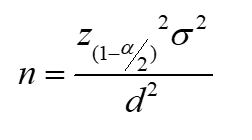
To determine the sample size, considering a type I error of 0.05, a statistical accuracy of 0.151, and a variance of 1.33 from previous studies [17], according to the following sample size formula, the required sample size for this study was 290 people, which, considering a 10% dropout rate, resulted in 320 people being included in the study.
A total of 320 students participated selected using a multi-stage sampling method. First, to ensure representation across the university’s diverse academic landscape, students were categorized into three main disciplinary groups based on their field of study: Social Sciences, Engineering, and Basic Sciences. Following this stratification, participants from these groups were recruited from various academic semesters using an availability (convenience) sampling method. This approach facilitated the inclusion of a broad spectrum of students based on their accessibility and willingness to participate. Inclusion criteria were enrollment as a student and willingness to participate. Participants who refused to continue while completing the questionnaire or who withdrew from the study were excluded.
Instrument
A five-part questionnaire was developed. The first part collected demographic information, including age, sex, field of study, faculty (place of study), semester, educational level, and parents’ educational level. The second part consisted of 9 questions assessing students’ knowledge about the organ donation and transplantation process. This section evaluated concepts such as brain death, who can donate organs, consent conditions for donation from deceased individuals, which organs can be donated by living donors, signs of brain death, the possibility of donating whole organs or parts of organs, which organs cannot be donated by living individuals, and national laws related to organ donation and transplantation. Responses were categorized as true, false, or I don’t know, with one point assigned for each correct answer and zero points for incorrect or I don’t know responses. The third part examined students’ attitudes toward organ donation and transplantation, emphasizing their understanding of its role in saving lives within the community. It broadly assessed individuals’ attitudes in the areas of the act of donation, the value and importance of donation in society, their views on donating to all individuals or only to family members and relatives, their opinions and beliefs regarding posthumous donation, and their opinions and beliefs regarding donation from living individuals. This section comprised seven items measured using a five-point Likert scale ranging from strongly disagree (1) to strongly agree (5). Responses were scored from one to five, with higher scores indicating a more positive attitude. According to Bloom’s taxonomy, knowledge and attitude levels were classified into three categories: Good (80-100% of the total score), moderate (60-79%), and poor (below 60%).
The fourth section assessed the personal and social experiences of participants regarding organ donation and transplantation processes. It consisted of 6 dichotomous items (yes/no) addressing: taking any action to obtain a donor card; membership in organ donation and transplantation associations; personal experience with organ donation; having a family member who has undergone transplantation or donated an organ; personally knowing someone who has received a transplant; and being acquainted with an individual who has registered for a posthumous organ donation card. Each item was scored as 1 for “yes” and 0 for “no”.
Part Five evaluated students’ willingness to donate organs after brain death, determined by whether they had obtained an organ donation card.
The reliability of the questionnaire was assessed using Cronbach’s alpha to evaluate internal consistency. The scales for knowledge and attitude demonstrated acceptable reliability, with values of 0.71 and 0.70, respectively. Content validity was evaluated using the content validity ratio (CVR) and the content validity index (CVI). All questions were retained, as each achieved a CVI of at least 0.8 and a CVR above the critical value of 0.62 (based on Lawshe’s table for the number of experts).
Procedure
The study was conducted after ethical approval was obtained, coordination with the university was completed, participants were selected using defined sampling and inclusion criteria, and questionnaires were administered with informed consent in a controlled environment. Written informed consent was obtained from the participants, and they were assured that their information would remain confidential and that they could withdraw from the study at any time. Numerical codes were used to keep the samples anonymous. All methods were carried out in accordance with the relevant guidelines and regulations in the Declaration.
Data analysis
Associations between sociodemographic characteristics and participants’ knowledge and attitudes towards organ donation were examined using the Chi-square test. Parameters that were significant in bivariate analyses were included in multivariate logistic regression models to identify independent predictors. A p-value ≤0.05 was regarded as statistically significant.
Findings
A total of 320 students (mean age: 22.49±2.11 years) participated in the study. There was a significant disparity between positive attitudes toward organ donation and actual commitment. Only a small minority of participants (11.9%, n=38) were registered as posthumous organ donors. However, these registered individuals demonstrated significantly higher mean scores in knowledge (6.68±1.41 vs. 5.78±1.31, p<0.001), attitude (28.31±3.69 vs. 26.54±3.78, p<0.001), and experiences (9.42±1.42 vs. 7.08±1.10, p<0.001) compared to non-registered participants (Table 1).
Table 1. Comparison of the frequency of knowledge, attitude, and organ donation experience levels among the students stratified by posthumous organ donation card registration (n=320)

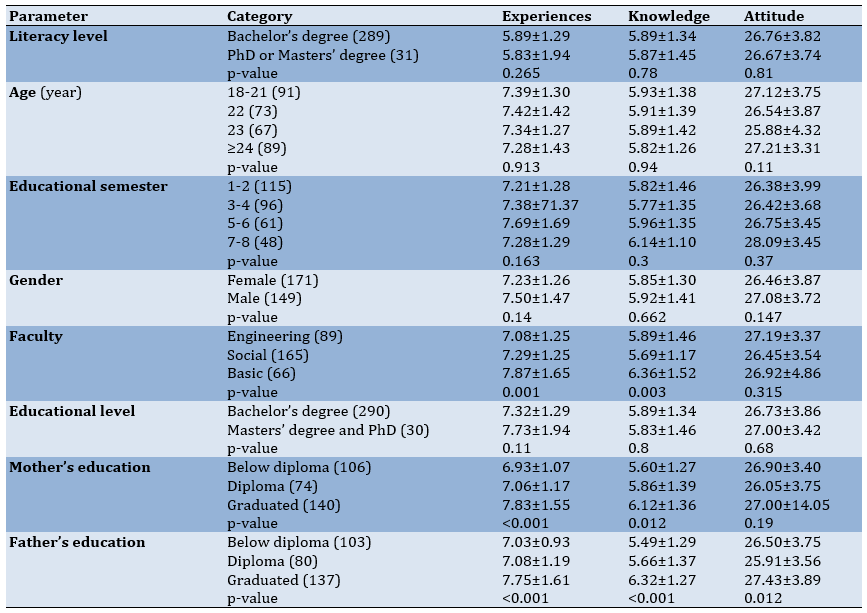
Sociodemographic factors showed limited influence. Faculty of study and parental education were significant factors. Students from the Basic Sciences Faculty had significantly higher knowledge (p=0.003) and experience (p=0.001) scores. Higher parental education, particularly of the father, was significantly associated with higher scores in knowledge (p<0.001), experiences (p<0.001), and attitude (p=0.005). Other parameters, including age, gender, and the student’s own education level, showed no statistically significant association with knowledge or attitude scores (Table 2).
Table 2. Mean sociodemographic characteristics of the participants and comparison of knowledge and attitude scores (n=320)
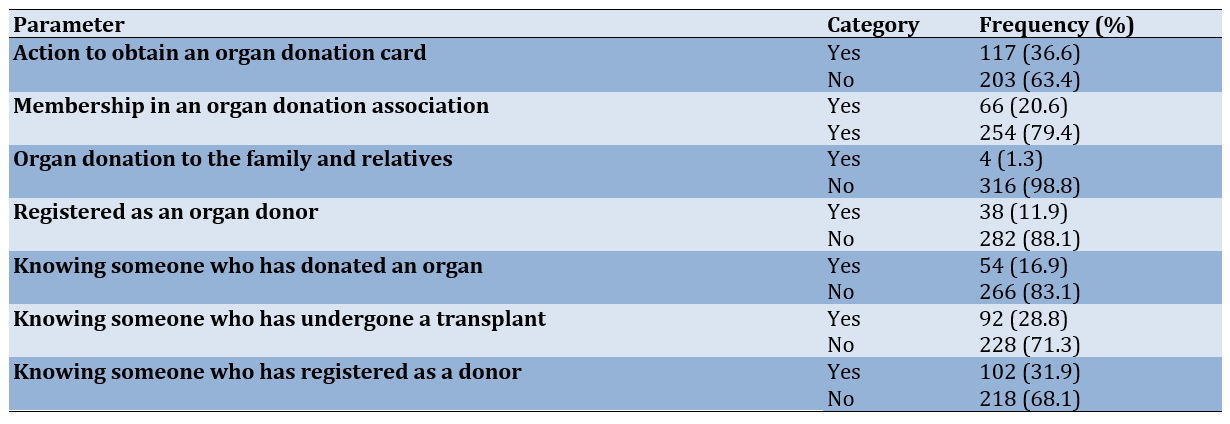
Of the participants, 11.9% were registered as organ donors, 36.6% had taken action to obtain a donation card, 1.3% reported donating to family and relatives, 16.9% knew someone who had donated, 28.8% knew someone who had undergone a transplant, 31.9% knew someone who had registered as a donor, and 20.6% were members of an organ donation association (79.4% were not) (Table 3).
Table 3. Frequency of personal experiences and actions regarding organ donation and transplantation (n=320)
Bivariate correlations indicated that organ donation experiences were significantly and positively correlated with both knowledge (r=0.279, p<0.01) and attitude (r=0.317, p<0.01). Attitude was also weakly correlated with the educational semester (r=0.181, p<0.01; Table 4).
Table 4. Bivariate correlations among organ donation experiences, knowledge, attitude, and selected demographic factors

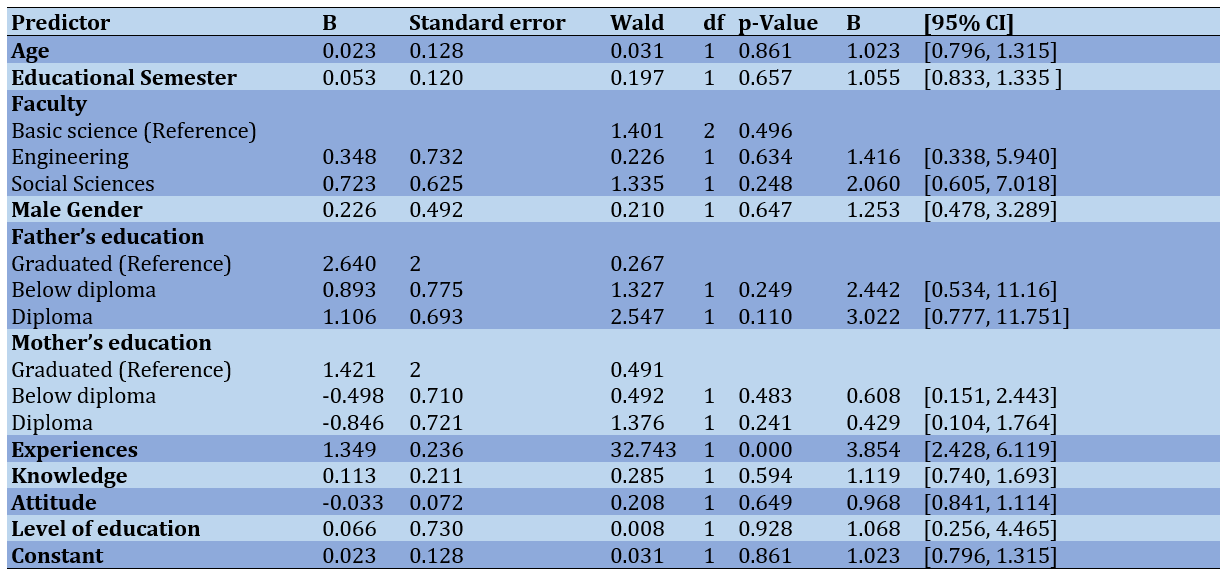
The logistic regression model (Nagelkerke R²=0.52) identified that, among all parameters analyzed, only the level of personal experiences was a significant independent predictor of organ donation card registration (OR: 3.863, 95% CI: 2.434-6.132, p<0.001). Knowledge, attitude, and all sociodemographic parameters were not significant predictors in the multivariate model (Table 5). The model correctly classified 92.8% of cases overall. For those who actually had a donation card (Yes), 98.2% were predicted as Yes, with 5 predicted as No, giving an 86.6% correct rate for this outcome; for those who did not have a card (No), 52.6% were predicted as Yes and 20 were predicted as No, yielding a 50% correct rate for this outcome.
Table 5. Logistic regression analysis for participation in obtaining a posthumous organ donation card among non-medical students
Discussion
The primary objective of the present study was to determine the percentage of individuals who had registered for a posthumous organ donation card. The finding that only 11.9% of participants possessed a donor card aligns with the range of results observed in other Iranian studies, though it remains lower than rates reported in many developed nations.
There was a significant positive correlation between organ donation experiences and participants’ knowledge and attitudes. This indicates that individuals with greater exposure to organ donation issues tend to exhibit higher awareness, more favorable attitudes, and a greater likelihood of registering as donors. These results underscore the significance of cognitive and psychosocial factors in influencing donation decisions, which aligns with prior studies conducted both in Iran and internationally [1, 2]. Participation in organ donation is a complex process involving individuals and their families, where knowledge, attitude, and personal experiences are central to shaping willingness [2, 17]. Therefore, government and non-governmental organizations should actively develop programs that improve public understanding, foster positive attitudes, and provide meaningful exposure to organ donation to support informed decision-making [3, 16, 18].
Similar to our results, a study among students at Qom University of Medical Sciences reports a card possession rate of 12.83% [17], while research with medical students at Golestan University reports that 9.6% had taken steps to obtain one [2]. A study reporting a 19.5% possession rate among students is somewhat higher than our finding [19]. A national figure from the Iranian Organ Donation Association indicates that approximately 6% of Iran’s population holds an organ donor card, confirming the generally low rate within the country [20]. Globally, this rate stands in stark contrast to substantially higher figures from countries such as Australia (61%), the United States, the United Kingdom, and Canada (ranging from 25% to 75%) [21, 22]. This disparity is further highlighted by the high donation rates in leading European nations, such as Spain (46.9 donors per million population) and Portugal (34.0), as well as in the United States (32.0), which underscores the significant gap between developed and developing countries, the latter often hampered by cultural barriers, lack of public awareness, and less developed healthcare infrastructure [22-24]. However, the rate from our study is higher than some regional reports, such as one from Jeddah, Saudi Arabia, where only 5.4% of the urban population possessed a donor card [1, 25].
Participants’ knowledge and attitudes were crucial factors. Only 10.3% of students had good knowledge, while 44.4% demonstrated a good attitude, indicating an overall profile of moderate knowledge paired with moderately positive attitudes. Similar to our results, a study on Iraqi students reports an improper attitude toward organ donation [6]. Other studies corroborate our findings, showing that most students have adequate knowledge regarding organ donation and its explanation [6–8]. In contrast, a study among Omani students found that 70.2% have unfavorable attitudes [1, 8]. The challenges of organ donation—the most effective treatment for acute organ failure—are exacerbated by factors, such as cultural barriers, religious beliefs, lack of public awareness, and ethical concerns. Overcoming these requires a comprehensive strategy involving educational programs, equitable allocation policies, increased consent rates, and investment in research [22].
Most students (53.1%) possessed only moderate knowledge about organ donation, with a mean score of 5.8±1.35, corresponding to 65.48% of the total possible score. This reveals that despite knowledge levels being slightly above the mid-range, substantial gaps remain. Regarding attitudes, the findings were more favorable, suggesting that although students’ knowledge was moderate, their attitudes were generally positive. Contrary to our findings, Darlington et al. [26] report poor knowledge among Indian medical students, while studies from Ethiopia indicate that health science students have good knowledge and positive attitudes [12, 13]. Differences in attitudes were also observed across studies. Ahmed et al. [6] and Alwahaibi et al. [1] report that only 24.39% and 25.66% of participants have favorable attitudes, respectively. In contrast, Naidoo et al. and Abdo et al. report results similar to ours, noting that most medical students support organ donation [13, 27]. This clear discrepancy between predominantly positive attitudes and only moderate knowledge indicates a need for targeted educational interventions to deepen understanding and translate favorable attitudes into informed decisions and actual behaviors [2].
The logistic regression analysis provided critical insights, with the overall model explaining approximately 52% of the variance in card possession. The most salient finding was that personal experience with organ donation emerged as the sole statistically significant predictor. Individuals with prior experiences had 3.86 times higher odds of having a donation card. In contrast, knowledge, attitude, and all demographic and educational parameters, including age, gender, academic semester, and parental education, were not significant predictors.
In conclusion, while the model effectively predicts card possession, the results distinctly highlight that tangible experience is a far more potent catalyst for action than knowledge or positive attitudes alone. This suggests that public awareness campaigns should evolve beyond mere knowledge dissemination and incorporate strategies that foster personal connection and experiential engagement with the concept of organ donation.
This study provides valuable insights by focusing on the under-researched population of non-medical students. The use of multivariate logistic regression allowed for the identification of the most robust predictor, personal experience, while controlling for other parameters. The simultaneous assessment of knowledge, attitude, and experience added methodological comprehensiveness.
The cross-sectional design limits causal inference. Sampling from a single university reduces the generalizability of the findings to other cultural or educational contexts. Furthermore, the reliance on self-reported data may be susceptible to social desirability bias.
The present study revealed a critical disconnect among university students: while attitudes toward organ donation are generally positive, knowledge remains only moderate, and crucially, this positive disposition fails to translate into concrete action, as evidenced by low card registration rates. The analysis unequivocally identified prior exposure or personal experience with organ donation as the most significant predictor of registration, far outweighing the influence of knowledge, attitudes, or any demographic and academic parameters. These findings compellingly argue that future interventions must move beyond traditional, knowledge-based awareness campaigns. To effectively bridge the intention–behavior gap, public health strategies and educational programs should be designed to provide meaningful and engaging experiences. This can be achieved by facilitating direct exposure through partnerships with donor associations and transplant centers, integrating personal narratives from organ recipients, donor families, and registered donors into university curricula and awareness campaigns, and promoting student membership in relevant organ donation organizations to foster a sense of community and active participation.
Conclusion
Personal experience with organ donation is the main predictor of registering for a posthumous organ donation card among non-medical students, while knowledge and attitudes do not predict behavior, highlighting an intention–behavior gap.
Acknowledgments: The authors would like to express their sincere gratitude to all the students from the University of Sistan and Baluchestan who participated in this study. We also extend our thanks to the Research and Technology Department of Zahedan University of Medical Sciences for their administrative support and to the members of the Ethics Committee for their valuable guidance. We appreciate the efforts of our colleagues who assisted in the data collection process.
Ethical Permissions: Ethical approval was obtained from the Ethics Committee of Zahedan University of Medical Sciences (IR.ZAUMS.REC.1398.369).
Conflicts of Interests: The authors declared no conflicts of interests.
Authors' Contribution: Masoudy Gh (First Author), Main Researcher (35%); Saeidinejad F (Second Author), Assistant Researcher (15%); Ansari H (Third Author), Statistical Analyst (15%); Izadirad H (Fourth Author), Introduction Writer (35%)
Funding/Support: This research did not receive any specific grant from funding agencies in the public, commercial, or not-for-profit sectors. The study was conducted as part of academic research at the University of Sistan and Baluchestan.
Donation after brain death (DBD) is considered the most efficient source of transplantable organs, as a single donor can provide multiple organs for different recipients [1-3]. Despite this, substantial international disparities in postmortem donation rates persist [2, 4]. For instance, in 2017, Spain, Portugal, and Belgium achieved 46.9, 34, and 33.6 deceased donors per million population (pmp), respectively, while the United States recorded 32 pmp, a figure that remains significantly higher than those in many other countries, including Iran, which ranked 38th globally [2, 3, 5]. These gaps have severe consequences: it is estimated that globally up to 20 patients die each day while awaiting an organ transplant, resulting in substantial mortality each year worldwide [3, 6-8].
Although Iran has more than four decades of experience in organ transplantation and considerable potential for DBD, the conversion rate of brain-dead cases to actual donations remains lower than anticipated. Annually, 2500 to 4000 brain-death cases are reported in Iran; however, only about 10% result in organ donation [9]. National statistics reveal that approximately 26,000 patients are currently on the transplant waiting list; one patient is added every 10 minutes, and one patient dies every two hours due to organ shortage. Meanwhile, a single brain-dead donor has the potential to save up to eight lives and improve the quality of life for 53 patients [2, 10]. In 2017, out of around 3,000 eligible brain-death cases, only 926 resulted in actual donation [9, 11, 12]. These data emphasize the persistent impact of cultural, legal, organizational, and beliefs in reducing donation rates in Iran and the world [13].
Multiple personal, familial, cultural, and systemic factors contribute to the decision-making process regarding organ donation [13-15]. Barriers such as religious or cultural beliefs, misconceptions about bodily integrity after death, uncertainty regarding the concept of brain death, and demographic characteristics (e.g., age, sex, education level, income) have been reported [2, 6, 14, 16]. In addition to these commonly assessed factors, individual and social experiences such as knowing a transplant recipient or donor in the family, having acquaintances who possess an organ donor card, or participating in donation-related community or student associations have emerged as key motivators that may reinforce positive attitudes and willingness to participate in donation initiatives [13]. Such real-life encounters can help normalize the concept of donation, reduce fear and misperceptions, and strengthen emotional acceptance of postmortem organ donation.
University students form a vital group for educational interventions because of their relatively high literacy, broad social influence, and role in shaping cultural norms. However, most research has mainly focused on medical students. Evidence remains limited for non-medical students, despite their widespread representation and potential to influence societal behavior. Recent findings indicate that structured approaches assessing knowledge, attitudes, behavioral intention, and personal social experiences can better predict the likelihood of registering as an organ donor. Therefore, evaluating these psychosocial and experience-based factors in non-medical populations is essential for developing more targeted and effective interventions.
In addition to cultural and educational barriers, national policy frameworks can significantly influence donation rates. For example, Italy’s opt-out (presumed consent) system has improved deceased donation rates; however, the refusal rate remained at 28.6% in 2021, resulting in the loss of 730 potential donors [5]. Globally, significant regional differences are observed: In 2018, the Americas and Europe reported 55.0 and 42.7 transplants pmp, respectively, while countries such as India had much lower donation rates (0.34pmp), reflecting sociocultural challenges [5, 11]. These discrepancies indicate that improvements in medical infrastructure alone are insufficient; public acceptance and awareness are critical.
Previous studies examining families’ decision-making regarding donation have identified psychological, cultural, and informational factors, including religious perceptions, death-related anxieties, and a lack of accurate knowledge regarding organ donation procedures [5, 7]. Although emerging innovations—such as blockchain-based donation management systems or xenotransplantation—offer new scientific and ethical possibilities, improving public knowledge and fostering supportive attitudes remain indispensable for increasing donation rates [4, 8].
Given the substantial gap between the need for transplantable organs and their availability, and considering the significant roles of knowledge, attitudes, and direct and indirect personal experiences in shaping individuals’ willingness to obtain an organ donor card, it is essential to investigate these determinants in influential social groups. Non-medical university students represent a critical yet understudied population in this regard. Therefore, the present study aimed to assess the knowledge, attitudes, personal and social experiences, and predictors of organ donor card obtaining among non-medical students in relation to brain death, to identify key determinants affecting registration behavior. Findings from this research are expected to provide evidence-based guidance for educational strategies, policymaking, and national initiatives to increase organ donation and improve health outcomes.
Instruments and Methods
Study design and participants
This cross-sectional study was conducted between June 2002 and June 2003 among students at the University of Sistan and Baluchestan, southeastern Iran.
To determine the sample size, considering a type I error of 0.05, a statistical accuracy of 0.151, and a variance of 1.33 from previous studies [17], according to the following sample size formula, the required sample size for this study was 290 people, which, considering a 10% dropout rate, resulted in 320 people being included in the study.
A total of 320 students participated selected using a multi-stage sampling method. First, to ensure representation across the university’s diverse academic landscape, students were categorized into three main disciplinary groups based on their field of study: Social Sciences, Engineering, and Basic Sciences. Following this stratification, participants from these groups were recruited from various academic semesters using an availability (convenience) sampling method. This approach facilitated the inclusion of a broad spectrum of students based on their accessibility and willingness to participate. Inclusion criteria were enrollment as a student and willingness to participate. Participants who refused to continue while completing the questionnaire or who withdrew from the study were excluded.
Instrument
A five-part questionnaire was developed. The first part collected demographic information, including age, sex, field of study, faculty (place of study), semester, educational level, and parents’ educational level. The second part consisted of 9 questions assessing students’ knowledge about the organ donation and transplantation process. This section evaluated concepts such as brain death, who can donate organs, consent conditions for donation from deceased individuals, which organs can be donated by living donors, signs of brain death, the possibility of donating whole organs or parts of organs, which organs cannot be donated by living individuals, and national laws related to organ donation and transplantation. Responses were categorized as true, false, or I don’t know, with one point assigned for each correct answer and zero points for incorrect or I don’t know responses. The third part examined students’ attitudes toward organ donation and transplantation, emphasizing their understanding of its role in saving lives within the community. It broadly assessed individuals’ attitudes in the areas of the act of donation, the value and importance of donation in society, their views on donating to all individuals or only to family members and relatives, their opinions and beliefs regarding posthumous donation, and their opinions and beliefs regarding donation from living individuals. This section comprised seven items measured using a five-point Likert scale ranging from strongly disagree (1) to strongly agree (5). Responses were scored from one to five, with higher scores indicating a more positive attitude. According to Bloom’s taxonomy, knowledge and attitude levels were classified into three categories: Good (80-100% of the total score), moderate (60-79%), and poor (below 60%).
The fourth section assessed the personal and social experiences of participants regarding organ donation and transplantation processes. It consisted of 6 dichotomous items (yes/no) addressing: taking any action to obtain a donor card; membership in organ donation and transplantation associations; personal experience with organ donation; having a family member who has undergone transplantation or donated an organ; personally knowing someone who has received a transplant; and being acquainted with an individual who has registered for a posthumous organ donation card. Each item was scored as 1 for “yes” and 0 for “no”.
Part Five evaluated students’ willingness to donate organs after brain death, determined by whether they had obtained an organ donation card.
The reliability of the questionnaire was assessed using Cronbach’s alpha to evaluate internal consistency. The scales for knowledge and attitude demonstrated acceptable reliability, with values of 0.71 and 0.70, respectively. Content validity was evaluated using the content validity ratio (CVR) and the content validity index (CVI). All questions were retained, as each achieved a CVI of at least 0.8 and a CVR above the critical value of 0.62 (based on Lawshe’s table for the number of experts).
Procedure
The study was conducted after ethical approval was obtained, coordination with the university was completed, participants were selected using defined sampling and inclusion criteria, and questionnaires were administered with informed consent in a controlled environment. Written informed consent was obtained from the participants, and they were assured that their information would remain confidential and that they could withdraw from the study at any time. Numerical codes were used to keep the samples anonymous. All methods were carried out in accordance with the relevant guidelines and regulations in the Declaration.
Data analysis
Associations between sociodemographic characteristics and participants’ knowledge and attitudes towards organ donation were examined using the Chi-square test. Parameters that were significant in bivariate analyses were included in multivariate logistic regression models to identify independent predictors. A p-value ≤0.05 was regarded as statistically significant.
Findings
A total of 320 students (mean age: 22.49±2.11 years) participated in the study. There was a significant disparity between positive attitudes toward organ donation and actual commitment. Only a small minority of participants (11.9%, n=38) were registered as posthumous organ donors. However, these registered individuals demonstrated significantly higher mean scores in knowledge (6.68±1.41 vs. 5.78±1.31, p<0.001), attitude (28.31±3.69 vs. 26.54±3.78, p<0.001), and experiences (9.42±1.42 vs. 7.08±1.10, p<0.001) compared to non-registered participants (Table 1).
Table 1. Comparison of the frequency of knowledge, attitude, and organ donation experience levels among the students stratified by posthumous organ donation card registration (n=320)
Sociodemographic factors showed limited influence. Faculty of study and parental education were significant factors. Students from the Basic Sciences Faculty had significantly higher knowledge (p=0.003) and experience (p=0.001) scores. Higher parental education, particularly of the father, was significantly associated with higher scores in knowledge (p<0.001), experiences (p<0.001), and attitude (p=0.005). Other parameters, including age, gender, and the student’s own education level, showed no statistically significant association with knowledge or attitude scores (Table 2).
Table 2. Mean sociodemographic characteristics of the participants and comparison of knowledge and attitude scores (n=320)
Of the participants, 11.9% were registered as organ donors, 36.6% had taken action to obtain a donation card, 1.3% reported donating to family and relatives, 16.9% knew someone who had donated, 28.8% knew someone who had undergone a transplant, 31.9% knew someone who had registered as a donor, and 20.6% were members of an organ donation association (79.4% were not) (Table 3).
Table 3. Frequency of personal experiences and actions regarding organ donation and transplantation (n=320)
Bivariate correlations indicated that organ donation experiences were significantly and positively correlated with both knowledge (r=0.279, p<0.01) and attitude (r=0.317, p<0.01). Attitude was also weakly correlated with the educational semester (r=0.181, p<0.01; Table 4).
Table 4. Bivariate correlations among organ donation experiences, knowledge, attitude, and selected demographic factors
The logistic regression model (Nagelkerke R²=0.52) identified that, among all parameters analyzed, only the level of personal experiences was a significant independent predictor of organ donation card registration (OR: 3.863, 95% CI: 2.434-6.132, p<0.001). Knowledge, attitude, and all sociodemographic parameters were not significant predictors in the multivariate model (Table 5). The model correctly classified 92.8% of cases overall. For those who actually had a donation card (Yes), 98.2% were predicted as Yes, with 5 predicted as No, giving an 86.6% correct rate for this outcome; for those who did not have a card (No), 52.6% were predicted as Yes and 20 were predicted as No, yielding a 50% correct rate for this outcome.
Table 5. Logistic regression analysis for participation in obtaining a posthumous organ donation card among non-medical students
Discussion
The primary objective of the present study was to determine the percentage of individuals who had registered for a posthumous organ donation card. The finding that only 11.9% of participants possessed a donor card aligns with the range of results observed in other Iranian studies, though it remains lower than rates reported in many developed nations.
There was a significant positive correlation between organ donation experiences and participants’ knowledge and attitudes. This indicates that individuals with greater exposure to organ donation issues tend to exhibit higher awareness, more favorable attitudes, and a greater likelihood of registering as donors. These results underscore the significance of cognitive and psychosocial factors in influencing donation decisions, which aligns with prior studies conducted both in Iran and internationally [1, 2]. Participation in organ donation is a complex process involving individuals and their families, where knowledge, attitude, and personal experiences are central to shaping willingness [2, 17]. Therefore, government and non-governmental organizations should actively develop programs that improve public understanding, foster positive attitudes, and provide meaningful exposure to organ donation to support informed decision-making [3, 16, 18].
Similar to our results, a study among students at Qom University of Medical Sciences reports a card possession rate of 12.83% [17], while research with medical students at Golestan University reports that 9.6% had taken steps to obtain one [2]. A study reporting a 19.5% possession rate among students is somewhat higher than our finding [19]. A national figure from the Iranian Organ Donation Association indicates that approximately 6% of Iran’s population holds an organ donor card, confirming the generally low rate within the country [20]. Globally, this rate stands in stark contrast to substantially higher figures from countries such as Australia (61%), the United States, the United Kingdom, and Canada (ranging from 25% to 75%) [21, 22]. This disparity is further highlighted by the high donation rates in leading European nations, such as Spain (46.9 donors per million population) and Portugal (34.0), as well as in the United States (32.0), which underscores the significant gap between developed and developing countries, the latter often hampered by cultural barriers, lack of public awareness, and less developed healthcare infrastructure [22-24]. However, the rate from our study is higher than some regional reports, such as one from Jeddah, Saudi Arabia, where only 5.4% of the urban population possessed a donor card [1, 25].
Participants’ knowledge and attitudes were crucial factors. Only 10.3% of students had good knowledge, while 44.4% demonstrated a good attitude, indicating an overall profile of moderate knowledge paired with moderately positive attitudes. Similar to our results, a study on Iraqi students reports an improper attitude toward organ donation [6]. Other studies corroborate our findings, showing that most students have adequate knowledge regarding organ donation and its explanation [6–8]. In contrast, a study among Omani students found that 70.2% have unfavorable attitudes [1, 8]. The challenges of organ donation—the most effective treatment for acute organ failure—are exacerbated by factors, such as cultural barriers, religious beliefs, lack of public awareness, and ethical concerns. Overcoming these requires a comprehensive strategy involving educational programs, equitable allocation policies, increased consent rates, and investment in research [22].
Most students (53.1%) possessed only moderate knowledge about organ donation, with a mean score of 5.8±1.35, corresponding to 65.48% of the total possible score. This reveals that despite knowledge levels being slightly above the mid-range, substantial gaps remain. Regarding attitudes, the findings were more favorable, suggesting that although students’ knowledge was moderate, their attitudes were generally positive. Contrary to our findings, Darlington et al. [26] report poor knowledge among Indian medical students, while studies from Ethiopia indicate that health science students have good knowledge and positive attitudes [12, 13]. Differences in attitudes were also observed across studies. Ahmed et al. [6] and Alwahaibi et al. [1] report that only 24.39% and 25.66% of participants have favorable attitudes, respectively. In contrast, Naidoo et al. and Abdo et al. report results similar to ours, noting that most medical students support organ donation [13, 27]. This clear discrepancy between predominantly positive attitudes and only moderate knowledge indicates a need for targeted educational interventions to deepen understanding and translate favorable attitudes into informed decisions and actual behaviors [2].
The logistic regression analysis provided critical insights, with the overall model explaining approximately 52% of the variance in card possession. The most salient finding was that personal experience with organ donation emerged as the sole statistically significant predictor. Individuals with prior experiences had 3.86 times higher odds of having a donation card. In contrast, knowledge, attitude, and all demographic and educational parameters, including age, gender, academic semester, and parental education, were not significant predictors.
In conclusion, while the model effectively predicts card possession, the results distinctly highlight that tangible experience is a far more potent catalyst for action than knowledge or positive attitudes alone. This suggests that public awareness campaigns should evolve beyond mere knowledge dissemination and incorporate strategies that foster personal connection and experiential engagement with the concept of organ donation.
This study provides valuable insights by focusing on the under-researched population of non-medical students. The use of multivariate logistic regression allowed for the identification of the most robust predictor, personal experience, while controlling for other parameters. The simultaneous assessment of knowledge, attitude, and experience added methodological comprehensiveness.
The cross-sectional design limits causal inference. Sampling from a single university reduces the generalizability of the findings to other cultural or educational contexts. Furthermore, the reliance on self-reported data may be susceptible to social desirability bias.
The present study revealed a critical disconnect among university students: while attitudes toward organ donation are generally positive, knowledge remains only moderate, and crucially, this positive disposition fails to translate into concrete action, as evidenced by low card registration rates. The analysis unequivocally identified prior exposure or personal experience with organ donation as the most significant predictor of registration, far outweighing the influence of knowledge, attitudes, or any demographic and academic parameters. These findings compellingly argue that future interventions must move beyond traditional, knowledge-based awareness campaigns. To effectively bridge the intention–behavior gap, public health strategies and educational programs should be designed to provide meaningful and engaging experiences. This can be achieved by facilitating direct exposure through partnerships with donor associations and transplant centers, integrating personal narratives from organ recipients, donor families, and registered donors into university curricula and awareness campaigns, and promoting student membership in relevant organ donation organizations to foster a sense of community and active participation.
Conclusion
Personal experience with organ donation is the main predictor of registering for a posthumous organ donation card among non-medical students, while knowledge and attitudes do not predict behavior, highlighting an intention–behavior gap.
Acknowledgments: The authors would like to express their sincere gratitude to all the students from the University of Sistan and Baluchestan who participated in this study. We also extend our thanks to the Research and Technology Department of Zahedan University of Medical Sciences for their administrative support and to the members of the Ethics Committee for their valuable guidance. We appreciate the efforts of our colleagues who assisted in the data collection process.
Ethical Permissions: Ethical approval was obtained from the Ethics Committee of Zahedan University of Medical Sciences (IR.ZAUMS.REC.1398.369).
Conflicts of Interests: The authors declared no conflicts of interests.
Authors' Contribution: Masoudy Gh (First Author), Main Researcher (35%); Saeidinejad F (Second Author), Assistant Researcher (15%); Ansari H (Third Author), Statistical Analyst (15%); Izadirad H (Fourth Author), Introduction Writer (35%)
Funding/Support: This research did not receive any specific grant from funding agencies in the public, commercial, or not-for-profit sectors. The study was conducted as part of academic research at the University of Sistan and Baluchestan.
Article Type: Descriptive & Survey |
| Rights and permissions | |
 |
This work is licensed under a Creative Commons Attribution-NonCommercial 4.0 International License. |