


Volume -
3 , - : 125-132 |
Back to browse issues page


Download citation:
BibTeX | RIS | EndNote | Medlars | ProCite | Reference Manager | RefWorks
Send citation to:


BibTeX | RIS | EndNote | Medlars | ProCite | Reference Manager | RefWorks
Send citation to:
Faculty Members’ Perspectives on Using Artificial Intelligence Chatbots in Medical Education and Research. 3 https://doi.org/10.58209/hehp.14.1.125
URL: http://daneshafarand.org/article-1-83093-en.html
URL: http://daneshafarand.org/article-1-83093-en.html
| Abstract (HTML) (503 Views)
Full-Text: (44 Views)
Introduction
Artificial intelligence (AI) refers to systems capable of performing behaviors that emulate human intelligence. These behaviors encompass the ability to comprehend complex situations, simulate thought processes, engage in human reasoning, and acquire knowledge to address problems [1]. Currently, intelligent conversational agents, such as chatbots, are employed in various domains, and most are web-based and readily accessible to users. While many adults engage with chatbots regularly—particularly when seeking assistance from mobile or internet service providers—choosing more sophisticated conversational agents like ChatGPT or Bard is typically a conscious, intentional decision [2].
AI and related technologies have significantly impacted educational and research approaches. In this context, medical education must evolve beyond basic biomedical and clinical sciences by focusing on coordinating professional efforts among healthcare providers and leveraging AI-driven information tools, while ensuring mastery of compassionate care [3]. Therefore, given the increasing pace of advancements in medical knowledge, technologies like AI are emerging as essential tools for healthcare professionals to leverage this knowledge effectively in clinical practice. Medical professionals must be adequately trained in these novel technologies, their benefits for improving the cost, quality, and accessibility of healthcare services, and the challenges of transparency and accountability [4]. One of the key benefits of utilizing AI in education is the strengthening of traditional teaching methods, the introduction of innovative approaches, and the improvement of assessment and clinical reasoning [5]. The successful integration of AI into educational practices has the potential to enhance both teaching and learning [6]. In this way, AI can help improve students’ clinical skills, facilitate their learning process, and play an effective role in medical decision-making.
Nonetheless, the application of AI in medical education also presents certain challenges. Given the expanding applications of this technology, immediate attention to ethical guidelines and an examination of its potential risks are necessary [5]. Furthermore, faculty members face various concerns and challenges in educational and research fields. As the results of the Gayed study indicate, despite faculty members’ strong background in educational technology and their positive outlook toward using AI tools in the classroom, they still do not feel adequately prepared for them [7].
Views on the use of AI are generally positive, though they are accompanied by significant concerns about ethics and privacy. This study emphasizes the need to adopt a balanced approach that maximizes the benefits of AI while protecting the rights and interests of all stakeholders [8]. Furthermore, the medical organization warns of the risks that students may face when using these technologies to complete their assignments [9].
Regarding the role of AI in research, academics believe that ChatGPT can serve as an assistive tool in scientific research and educational processes, and as a source of inspiration for new research topics and areas. However, academics have expressed concerns about ethical issues, including plagiarism and the dissemination of misinformation [10]. Although AI can improve students’ writing skills, self-efficacy, and academic understanding, some students have raised concerns about its possible effects on creativity, critical thinking, and ethical writing practices [11]. Finally, a study revealed that more than half of the students are inclined to cheat and may utilize ChatGPT to produce content for their essays, which could jeopardize research integrity [12].
A key factor in the successful application of AI in medical education and research is faculty members' perspective as the primary users of this technology and their acceptance of the need to prepare for and become knowledgeable about AI and its use. The success of AI depends on considering stakeholders’ viewpoints, and awareness of these perspectives can help identify the strengths, weaknesses, and challenges in this field. Furthermore, faculty perspectives should be considered in the development of future AI tools. Qualitative studies, by explaining deep, individual concepts, help us understand human phenomena. To the best of our knowledge, no research has been conducted in Iran to investigate faculty members’ perspectives on the use of AI tools, particularly chatbots, in education and research. The results of this research can assist medical universities in planning the application of AI and open new horizons for explaining its use across various fields, including education, research, treatment, management, and administration.
This research aimed to elucidate the perspectives of faculty members regarding the use of AI chatbots in medical education and research.
Participants and Methods
The qualitative study was conducted from March 12 to November 26, 2025, on 18 faculty members from Alborz University of Medical Sciences. Snowball sampling was initiated by asking the first participant to recommend colleagues with experience using AI chatbots in medical education or research. Consequently, participants who were medical student instructors and had experience using chatbots in medical education and research were purposively selected. Maximum variation was ensured regarding sex, work experience, academic rank, and specialty. The sampling process continued until data saturation was achieved, at which point no new codes were identified.
An information sheet containing the study's title, objective, and main questions, along with a consent form, was provided to the participants. Permission was obtained from the participants to audio-record, and they were assured that their information would be kept confidential. Data were collected through semi-structured interviews, with some general questions pre-designed to align with the study’s objectives. Interviews were conducted after initial telephone contact, with the location and time arranged according to participants' preferences at Alborz University of Medical Sciences. On the day of the interview, participants provided written informed consent before the session began, confirming their willingness to participate and authorizing the recording of their responses. The interview began with the general question: “Please describe your experience using AI chatbots in the education of medical students.” It then continued using probing questions, such as: “Please provide an example in this regard.” Subsequently, a general question was posed regarding their experience using AI chatbots in research. The average interview duration was 45-55 minutes, and interviews were collected, analyzed, and interpreted from March 2025 to September 2025. An additional two months were dedicated to report preparation and manuscript writing. All interviews were conducted by one of the authors (L.S).
The research questions and the starting point determine which type of content analysis a researcher will use. Inductive content analysis is performed to create concepts, categories, and themes from the data [13, 14]. Given our lack of prior knowledge about faculty members’ perspectives on the use of chatbots in medical students' education and research, the data were analyzed using inductive content analysis following the Graneheim & Lundman approach. The analysis of the interviews began after the first interview was collected. The verbatim transcription of each recorded interview was carried out on paper by one of the authors, Z.N.kh. Subsequently, two of the authors, Z.N.kh and R.A, independently read through the interview text multiple times to gain a deep understanding of it. Meaning units were then identified, and each meaning unit was assigned one or two codes. Similar codes were then grouped into subcategories, and main categories were formed by combining these subcategories [15].
To assess scientific rigor, Lincoln & Guba’s four criteria were used [16]. Accordingly, credibility was ensured by having a third researcher review the codes extracted from the interviews. Transferability was achieved by providing complete explanations regarding the methodology and code extraction process. Dependability was ensured, as all details pertaining to how the interviews were conducted and the analyses performed during the research process were meticulously recorded and maintained, and confirmability was ensured, as the second researcher extracted the codes after the first researcher, and all stages were reviewed and monitored from the beginning by the third researcher.
Findings
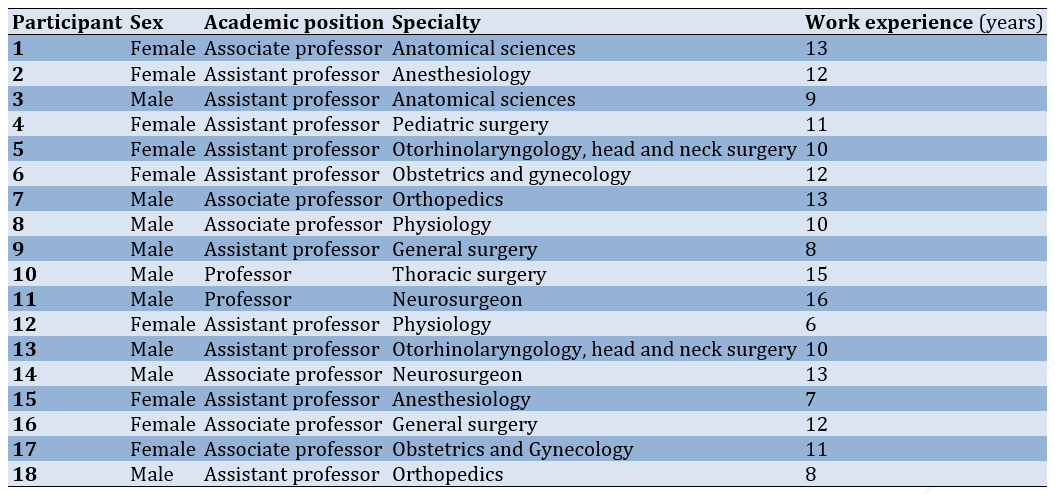
A total of 18 faculty members from Alborz University of Medical Sciences participated in the study (Table 1). The chatbots most frequently mentioned by participants during interviews were ChatGPT, Copilot, Gemini, and Perplexity. Although our objective was to investigate the use of AI chatbots, participants also referred to other AI tools, such as Gamma and PaperPad.
Table 1. Demographic information of participants
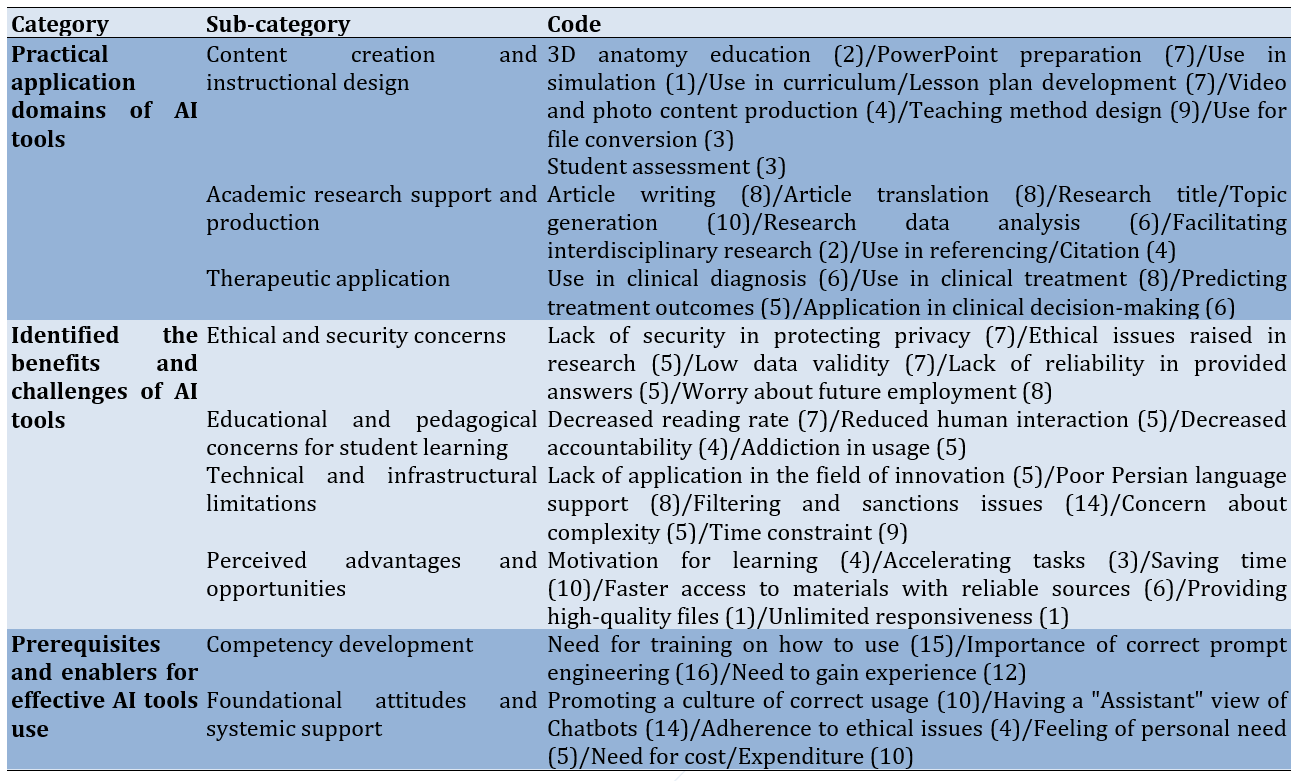
Content analysis identified 301 primary codes, which were subsequently organized into nine subcategories and three main categories: practical application domains of AI tools, identified benefits and challenges of AI tools, and prerequisites and enablers for effective use of AI tools (Table 2).
Table 2. Participants’ interview results
Practical application domains of AI tools
Content creation and instructional design
Participants stated that they use AI and chatbots for student education, PowerPoint preparation, lesson plan writing, teaching method design, and designing assessment questions for learners; “In my field, which is anatomy, it's very useful because it relies heavily on 3D and spatial understanding of body organs... especially when you want to simulate the 3D state of body organs or in surgical models where we have the proximity of different organs to each other” (p. 1); “For example, we can use AI for slide creation and even writing lesson plans” (p. 5); “In education, it can help with designing standardized questions, provided you give it the content and tell it to create questions” (p. 10); “It also helps us in choosing teaching methods and gamification” (p. 12).
Academic research support and production
Article writing and article translation were the most frequently mentioned applications of AI by professors, although some also mentioned using AI for referencing, research data analysis, and research title selection; “There's a huge variety of AIs, and the number is growing every day. We can use them to translate our articles and even find research topics” (p. 9); “Some professors are using AI for qualitative content analysis” (p. 3).
Therapeutic application
Professors stated that they can use AI to diagnose diseases, make clinical decisions, and even assess disease prognosis; “We use artificial intelligence to help students learn how to diagnose diseases and identify risk factors, so they can be useful in patient treatment” (p. 16); “We and students together can use AI in clinical decision-making or even in treatments based on genetic and demographic differences” (p. 10); “AI can sometimes help predict treatment outcomes and the course of a disease” (p. 17).
Identified benefits and challenges for AI tools
Ethical and security concerns
Despite its applications in education, research, and student treatment, AI raises certain concerns. One of the most significant concerns is ethics and security, particularly in research. One participant noted that: “AI is frequently used for writing articles, but authors often fail to transparently report the extent of its use upon submission” (p. 1). Participants also expressed ethical concerns regarding the unreliability and lack of validity of AI-generated data. As one participant noted: “Often, it suggests articles to you, and then you find out that the article doesn't even exist... Even though it also nicely provides valid findings relevant to your question, there's actually no such article, and you definitely need to check these things” (p. 9). Similarly, another participant pointed out that: “One problem with AI is that if you ask it the same question today, it might give you one answer, and then if you ask it again in a day or two, it might give you a slightly different answer. Basically, AI search results aren't consistent from day to day. I think that's a problem” (p. 4).
Educational and pedagogical concerns for student learning
One of the educational concerns expressed by the participant was a decrease in students’ study rate. They believed that since AI chatbots provide answers in the shortest possible time, many students no longer refer to their primary course materials. Another major issue they highlighted was addiction to using AI. They stated that this addiction leads to irresponsibility in learning the material and completing their assignments.
Regarding this, one of the professors said: "One of our concerns as instructors is the loss of deep thinking among the new generation of students because of their dependence on this technology" (p. 10). Another professor said: "When you have a tool that quickly does your assignments, what responsibility do you want to have for your own learning?" (p. 6).
Technical and infrastructural limitations
Some of the challenges concerned technical and infrastructural limitations. Many participants stated that popular AI chatbots have time limits on their higher-tier versions and can only be used for a limited time each day. Another infrastructural limitation that most referred to was the filtering of many chatbots and some of their functions in Iran. Regarding this, one professor said: “I was on a research trip to Spain, and while I was there, access was much easier. I created an account and had easy access to ChatGPT-4 with a SIM card I had there. Since I've returned to Iran... it seems access to the higher versions of ChatGPT isn't possible in our country. It needs a circumvention tool... I haven't been able to use that account anymore either” (p. 8).
Perceived advantages and opportunities
Despite the concerns and challenges posed by AI, participants cited numerous benefits, including faster task completion, time savings, greater responsiveness, and increased motivation to learn; “Since the world is moving in this direction, and it's become such that a while ago, if a student had a question, or even when I was a student and wanted to ask something... it would occur to me that first I should Google it, and if I didn't find the answer to my question, then ask my professor. And now, AI is exactly the same way... meaning, when a student has a question or something unclear, they can easily use AI... to reach the answer much faster and more time-efficiently” (p. 15); “Artificial intelligence is really useful in student education… because it's a new topic… and at the same time, students can use various resources simultaneously… This makes us have a desire and passion for learning in students” (p. 6).
Prerequisites and enablers for effective AI tools use
Competency development
Faculty members stated that, to use AI tools in student education and research, experience alone is insufficient; there is also a need to attend training workshops on using these tools, especially on proper prompt engineering. Regarding this, two professors said: “The way you ask questions from them (artificial intelligence) is very important, and we should ask those questions very clearly” (p. 5); “If we want to use it without training and recklessly... it can give us a lot of incorrect information” (p. 2).
Foundational attitudes and systemic support
In addition to empowering faculty to use AI, having a positive attitude and organizational support in terms of culture and funding for the use of these tools is important. Many professors viewed AI tools as assistants and believed that ethical issues, especially in research, must be observed when using these tools, and that a culture for their use should be fostered within universities. One of the professors stated: “When something comes along, and there isn't a culture of using it, it can be very damaging... So, a lack of education and sufficient culture in the use of artificial intelligence can be harmful” (p. 1).
Discussion
This study aimed to elucidate faculty perspectives regarding the use of artificial intelligence chatbots in medical education and research. Given the practical dimensions of AI in education, faculty members stated that they utilize AI and chatbots to educate students, prepare PowerPoint presentations, write lesson plans, design teaching methods, and evaluate learners. In this regard, Garg also states that AI can be employed at various levels of medical education, including curriculum development and analysis, the learning process, and evaluation. This can reduce the time required to evaluate multiple curricula, solve multidimensional problems, increase classification accuracy, identify relationships among parameters, assess curriculum effectiveness, and provide students with adaptive, personalized learning content [17]. Furthermore, by participating in educational discussions, evaluating students, and providing immediate feedback, these tools support medical students' learning and make the evaluation process more objective, faster, and more cost-effective [17, 18], thereby confirming the results of the present study.
In the study by Tlili et al., one participant noted that ChatGPT can serve as a valuable resource for professors by identifying the knowledge and skills to incorporate into their curriculum, thereby assisting in curriculum design. Participants also utilized AI for simulation and gamification in education [19]. Another study, focusing on developing AI to improve the training of radiology assistants, suggests that AI-enhanced radiology may lead to greater accuracy and efficiency in medical education [20]. While professors in this study primarily leveraged AI capabilities for teaching anatomy and surgery courses, it is necessary to examine its application in each medical science course separately. Furthermore, some chatbots are developed using a social constructivist approach and can act as interactive tutors by providing quizzes, assessments, and access to previous lectures [21], which benefits the learning of all students across various disciplines.
Article writing and article translation were the most common applications of AI in research. However, some also mentioned using AI for referencing, analyzing research data, and selecting research titles. The AI revolution in scientific publication encompasses various research aspects, including the transformation of the peer-review process, plagiarism detection, intelligent data validation systems, the automated generation of meta-analyses from existing data, alert systems for unusual findings, continuous post-publication monitoring with automatic citation and related results tracking, intelligent content management, article recommendation systems, and translation [22].
In the field of treatment, some professors stated that students can use AI in disease diagnosis, clinical decision-making, and even in determining disease prognosis. On the other hand, AI also has the potential to create positive transformations in the healthcare system and empower patients. This includes providing personalized health information, such as health recommendations and warnings tailored to each individual’s condition, analyzing personal health data to predict disease risks, and offering virtual consultation services that provide access to remote medical advice. In some cases, this may occur through continuous remote monitoring of patients’ vital signs and timely alerts upon the observation of medical anomalies, as well as improved management of chronic diseases, which can help physicians [22]. Considering that the professors did not mention this issue, it seems that there is a need to provide the groundwork for the use of telemedicine so that professors, while using this technology, can also provide the necessary training in this field to their students.
Despite professors pointing to the applications of AI in education, research, and treatment, they also expressed challenges in its use. One of the biggest challenges was the filtering and usage limitations, which made it difficult for professors to employ these tools. Other issues included the low credibility of data generated by AI, the unreliability of the answers provided, and a lack of privacy and security. In this context, Milana et al. indicate that all aspects of AI technologies are either predetermined or derived from a restricted set of data and information that humans have previously expressed and documented [2]. This can occasionally result in inaccuracies and diminished credibility of the information provided, particularly when AI technology has adopted an incorrect pattern due to incomplete or biased training data [23].
Conversely, interactions with ChatGPT do not incorporate recognition of emotions and other typical cues found in human-to-human communication, and at times, it may provide contradictory responses to questions on the same subject. These are among the ethical concerns cited by participants in the study by Tlili et al.: encouraging plagiarism and cheating, promoting laziness, and susceptibility to errors, such as presenting biased or fabricated information and sometimes providing inaccurate and vague information. Some participants consider ChatGPT’s output data to be more like an opinion without references [19]. We also referred to related codes, including reduced human interaction, low-quality communication with humans, reduced student accountability, and low data credibility.
In another study, a small number of participants expressed concerns regarding the potential for learners to misuse ChatGPT, viewing it as a cause for reduced innovative capacity and critical thinking. They stated that when students lack motivation, they are more likely to seek easily accessible solutions [19]. In this context, even professors participating in the study admitted that chatbots could lead to frustration with learners’ personal performance and a decrease in study engagement. Another study, surveying 367 Ethiopian students from various educational levels and regions, focuses on concerns regarding privacy and data security [24]. Therefore, ethical issues have always been a central public concern, and there is a fear of privacy breaches. These concerns stem mainly from the lack of unified standards and norms in AI technology, leading to public skepticism. It is suggested that standards be established for further AI regulation and privacy protection [25-27]. Consequently, individuals at various academic levels, both professors and students, are concerned about the lack of security in preserving privacy. In conclusion, while the integration of AI in medicine holds great promise, health policies must be developed to address the ethical and financial concerns associated with its use [28].
Alongside the challenges AI presents, participants cited numerous benefits, including accelerated task completion, time savings, unrestricted responsiveness, and increased motivation to learn. Most users hold a positive outlook on integrating AI-powered chatbots, such as ChatGPT, into educational systems [19], and instructors appreciate chatbots as time-saving assistants that help with planning, organizing, and enhancing their teaching [29].
Professors outlined the prerequisites for the proper and beneficial use of AI and chatbots. The most important among these were training on how to use them, proper prompt engineering, fostering a culture of acceptance, adhering to ethical considerations, and viewing AI as an assistant. According to Ejaz et al., in the context of AI and medical education, there is support for including AI education in core curricula worldwide, as few students, particularly in low- and middle-income countries, have received AI training. Incorporating this training into the curriculum is essential for developing students’ skills and knowledge and preparing them for a future in medicine that is increasingly digitally driven [30]. Therefore, there is a broad consensus on the need for AI ethics education and AI in medical education, and there is an immediate need to integrate AI and AI ethics education into medical curricula to adequately prepare future medical professionals [31]. Considering our findings indicating the necessity of incorporating AI education into student curricula, the need for comprehensive training of professors and for improving their proficiency in using AI is increasingly felt.
The research by Omar et al. on faculty members at Palestinian universities emphasizes the need for comprehensive training programs to improve their skills in using AI applications in higher education. Additionally, it discusses the concerns and risks that may impede the adoption of these programs [32]. Conducting workshops, seminars, and training courses for professors and students can deepen understanding of AI's role in medicine. Its success requires careful planning, faculty training, and intelligent integration with existing curricula, which can help nurture a new generation of physicians with comprehensive skills [33]. Furthermore, the field of integrating AI with medicine/medical education is continually expanding, and the most pressing need is for collaboration among policymakers, medical professionals, AI specialists, educators, and other disciplines to reach consensus on ethical issues and develop regulatory standards [26]. Our professors mentioned the preliminary codes for cultivating the correct use of AI and observing ethical issues as prerequisites for using AI.
One limitation of this study is its focus on a single university and its faculty, which may limit the generalizability of the findings to other universities and fields within medical science. Furthermore, the technical and ethical challenges related to the use of AI in education and research necessitate further exploration across other universities and countries globally.
It is recommended to focus on developing training courses for faculty members and students regarding the use of AI and chatbots. Furthermore, creating suitable platforms for accessing these tools and addressing technical and ethical challenges can help improve the quality of education and research. Finally, examining successful experiences at other universities and in other countries can help optimize the use of these technologies.
Conclusion
Faculty members at Alborz University of Medical Sciences widely utilize chatbots for content creation, article writing, and disease diagnosis.
Acknowledgments: The authors are grateful to all faculty members of Alborz University of Medical Sciences who collaborated with us on this study, as well as to the university's research department for its material and spiritual support for this project.
Ethical Permissions: The research project was approved by the ethical committee of Alborz University of Medical Sciences (ethics code: IR.ABZUMS.REC.1403.237).
Conflicts of Interest: The authors reported no conflicts of interest.
Authors' Contribution: Abjar R (First Author), Introduction Writer/Methodologist/Main Researcher/Statistical Analyst (40%); Nouri Khaneghah Z (Second Author), Methodologist/Discussion Writer/Statistical Analyst (30%); Sadati L (Third Author), Introduction Writer/Methodologist (10%); Hosseini SM (Fourth Author), Assistant Researcher/Statistical Analyst (10%); Ramezani Gh (Fifth Author), Introduction Writer/Assistant Researcher (10%)
Funding/Support: This study was supported by Alborz University of Medical Sciences, Iran.
Artificial intelligence (AI) refers to systems capable of performing behaviors that emulate human intelligence. These behaviors encompass the ability to comprehend complex situations, simulate thought processes, engage in human reasoning, and acquire knowledge to address problems [1]. Currently, intelligent conversational agents, such as chatbots, are employed in various domains, and most are web-based and readily accessible to users. While many adults engage with chatbots regularly—particularly when seeking assistance from mobile or internet service providers—choosing more sophisticated conversational agents like ChatGPT or Bard is typically a conscious, intentional decision [2].
AI and related technologies have significantly impacted educational and research approaches. In this context, medical education must evolve beyond basic biomedical and clinical sciences by focusing on coordinating professional efforts among healthcare providers and leveraging AI-driven information tools, while ensuring mastery of compassionate care [3]. Therefore, given the increasing pace of advancements in medical knowledge, technologies like AI are emerging as essential tools for healthcare professionals to leverage this knowledge effectively in clinical practice. Medical professionals must be adequately trained in these novel technologies, their benefits for improving the cost, quality, and accessibility of healthcare services, and the challenges of transparency and accountability [4]. One of the key benefits of utilizing AI in education is the strengthening of traditional teaching methods, the introduction of innovative approaches, and the improvement of assessment and clinical reasoning [5]. The successful integration of AI into educational practices has the potential to enhance both teaching and learning [6]. In this way, AI can help improve students’ clinical skills, facilitate their learning process, and play an effective role in medical decision-making.
Nonetheless, the application of AI in medical education also presents certain challenges. Given the expanding applications of this technology, immediate attention to ethical guidelines and an examination of its potential risks are necessary [5]. Furthermore, faculty members face various concerns and challenges in educational and research fields. As the results of the Gayed study indicate, despite faculty members’ strong background in educational technology and their positive outlook toward using AI tools in the classroom, they still do not feel adequately prepared for them [7].
Views on the use of AI are generally positive, though they are accompanied by significant concerns about ethics and privacy. This study emphasizes the need to adopt a balanced approach that maximizes the benefits of AI while protecting the rights and interests of all stakeholders [8]. Furthermore, the medical organization warns of the risks that students may face when using these technologies to complete their assignments [9].
Regarding the role of AI in research, academics believe that ChatGPT can serve as an assistive tool in scientific research and educational processes, and as a source of inspiration for new research topics and areas. However, academics have expressed concerns about ethical issues, including plagiarism and the dissemination of misinformation [10]. Although AI can improve students’ writing skills, self-efficacy, and academic understanding, some students have raised concerns about its possible effects on creativity, critical thinking, and ethical writing practices [11]. Finally, a study revealed that more than half of the students are inclined to cheat and may utilize ChatGPT to produce content for their essays, which could jeopardize research integrity [12].
A key factor in the successful application of AI in medical education and research is faculty members' perspective as the primary users of this technology and their acceptance of the need to prepare for and become knowledgeable about AI and its use. The success of AI depends on considering stakeholders’ viewpoints, and awareness of these perspectives can help identify the strengths, weaknesses, and challenges in this field. Furthermore, faculty perspectives should be considered in the development of future AI tools. Qualitative studies, by explaining deep, individual concepts, help us understand human phenomena. To the best of our knowledge, no research has been conducted in Iran to investigate faculty members’ perspectives on the use of AI tools, particularly chatbots, in education and research. The results of this research can assist medical universities in planning the application of AI and open new horizons for explaining its use across various fields, including education, research, treatment, management, and administration.
This research aimed to elucidate the perspectives of faculty members regarding the use of AI chatbots in medical education and research.
Participants and Methods
The qualitative study was conducted from March 12 to November 26, 2025, on 18 faculty members from Alborz University of Medical Sciences. Snowball sampling was initiated by asking the first participant to recommend colleagues with experience using AI chatbots in medical education or research. Consequently, participants who were medical student instructors and had experience using chatbots in medical education and research were purposively selected. Maximum variation was ensured regarding sex, work experience, academic rank, and specialty. The sampling process continued until data saturation was achieved, at which point no new codes were identified.
An information sheet containing the study's title, objective, and main questions, along with a consent form, was provided to the participants. Permission was obtained from the participants to audio-record, and they were assured that their information would be kept confidential. Data were collected through semi-structured interviews, with some general questions pre-designed to align with the study’s objectives. Interviews were conducted after initial telephone contact, with the location and time arranged according to participants' preferences at Alborz University of Medical Sciences. On the day of the interview, participants provided written informed consent before the session began, confirming their willingness to participate and authorizing the recording of their responses. The interview began with the general question: “Please describe your experience using AI chatbots in the education of medical students.” It then continued using probing questions, such as: “Please provide an example in this regard.” Subsequently, a general question was posed regarding their experience using AI chatbots in research. The average interview duration was 45-55 minutes, and interviews were collected, analyzed, and interpreted from March 2025 to September 2025. An additional two months were dedicated to report preparation and manuscript writing. All interviews were conducted by one of the authors (L.S).
The research questions and the starting point determine which type of content analysis a researcher will use. Inductive content analysis is performed to create concepts, categories, and themes from the data [13, 14]. Given our lack of prior knowledge about faculty members’ perspectives on the use of chatbots in medical students' education and research, the data were analyzed using inductive content analysis following the Graneheim & Lundman approach. The analysis of the interviews began after the first interview was collected. The verbatim transcription of each recorded interview was carried out on paper by one of the authors, Z.N.kh. Subsequently, two of the authors, Z.N.kh and R.A, independently read through the interview text multiple times to gain a deep understanding of it. Meaning units were then identified, and each meaning unit was assigned one or two codes. Similar codes were then grouped into subcategories, and main categories were formed by combining these subcategories [15].
To assess scientific rigor, Lincoln & Guba’s four criteria were used [16]. Accordingly, credibility was ensured by having a third researcher review the codes extracted from the interviews. Transferability was achieved by providing complete explanations regarding the methodology and code extraction process. Dependability was ensured, as all details pertaining to how the interviews were conducted and the analyses performed during the research process were meticulously recorded and maintained, and confirmability was ensured, as the second researcher extracted the codes after the first researcher, and all stages were reviewed and monitored from the beginning by the third researcher.
Findings
A total of 18 faculty members from Alborz University of Medical Sciences participated in the study (Table 1). The chatbots most frequently mentioned by participants during interviews were ChatGPT, Copilot, Gemini, and Perplexity. Although our objective was to investigate the use of AI chatbots, participants also referred to other AI tools, such as Gamma and PaperPad.
Table 1. Demographic information of participants
Content analysis identified 301 primary codes, which were subsequently organized into nine subcategories and three main categories: practical application domains of AI tools, identified benefits and challenges of AI tools, and prerequisites and enablers for effective use of AI tools (Table 2).
Table 2. Participants’ interview results
Practical application domains of AI tools
Content creation and instructional design
Participants stated that they use AI and chatbots for student education, PowerPoint preparation, lesson plan writing, teaching method design, and designing assessment questions for learners; “In my field, which is anatomy, it's very useful because it relies heavily on 3D and spatial understanding of body organs... especially when you want to simulate the 3D state of body organs or in surgical models where we have the proximity of different organs to each other” (p. 1); “For example, we can use AI for slide creation and even writing lesson plans” (p. 5); “In education, it can help with designing standardized questions, provided you give it the content and tell it to create questions” (p. 10); “It also helps us in choosing teaching methods and gamification” (p. 12).
Academic research support and production
Article writing and article translation were the most frequently mentioned applications of AI by professors, although some also mentioned using AI for referencing, research data analysis, and research title selection; “There's a huge variety of AIs, and the number is growing every day. We can use them to translate our articles and even find research topics” (p. 9); “Some professors are using AI for qualitative content analysis” (p. 3).
Therapeutic application
Professors stated that they can use AI to diagnose diseases, make clinical decisions, and even assess disease prognosis; “We use artificial intelligence to help students learn how to diagnose diseases and identify risk factors, so they can be useful in patient treatment” (p. 16); “We and students together can use AI in clinical decision-making or even in treatments based on genetic and demographic differences” (p. 10); “AI can sometimes help predict treatment outcomes and the course of a disease” (p. 17).
Identified benefits and challenges for AI tools
Ethical and security concerns
Despite its applications in education, research, and student treatment, AI raises certain concerns. One of the most significant concerns is ethics and security, particularly in research. One participant noted that: “AI is frequently used for writing articles, but authors often fail to transparently report the extent of its use upon submission” (p. 1). Participants also expressed ethical concerns regarding the unreliability and lack of validity of AI-generated data. As one participant noted: “Often, it suggests articles to you, and then you find out that the article doesn't even exist... Even though it also nicely provides valid findings relevant to your question, there's actually no such article, and you definitely need to check these things” (p. 9). Similarly, another participant pointed out that: “One problem with AI is that if you ask it the same question today, it might give you one answer, and then if you ask it again in a day or two, it might give you a slightly different answer. Basically, AI search results aren't consistent from day to day. I think that's a problem” (p. 4).
Educational and pedagogical concerns for student learning
One of the educational concerns expressed by the participant was a decrease in students’ study rate. They believed that since AI chatbots provide answers in the shortest possible time, many students no longer refer to their primary course materials. Another major issue they highlighted was addiction to using AI. They stated that this addiction leads to irresponsibility in learning the material and completing their assignments.
Regarding this, one of the professors said: "One of our concerns as instructors is the loss of deep thinking among the new generation of students because of their dependence on this technology" (p. 10). Another professor said: "When you have a tool that quickly does your assignments, what responsibility do you want to have for your own learning?" (p. 6).
Technical and infrastructural limitations
Some of the challenges concerned technical and infrastructural limitations. Many participants stated that popular AI chatbots have time limits on their higher-tier versions and can only be used for a limited time each day. Another infrastructural limitation that most referred to was the filtering of many chatbots and some of their functions in Iran. Regarding this, one professor said: “I was on a research trip to Spain, and while I was there, access was much easier. I created an account and had easy access to ChatGPT-4 with a SIM card I had there. Since I've returned to Iran... it seems access to the higher versions of ChatGPT isn't possible in our country. It needs a circumvention tool... I haven't been able to use that account anymore either” (p. 8).
Perceived advantages and opportunities
Despite the concerns and challenges posed by AI, participants cited numerous benefits, including faster task completion, time savings, greater responsiveness, and increased motivation to learn; “Since the world is moving in this direction, and it's become such that a while ago, if a student had a question, or even when I was a student and wanted to ask something... it would occur to me that first I should Google it, and if I didn't find the answer to my question, then ask my professor. And now, AI is exactly the same way... meaning, when a student has a question or something unclear, they can easily use AI... to reach the answer much faster and more time-efficiently” (p. 15); “Artificial intelligence is really useful in student education… because it's a new topic… and at the same time, students can use various resources simultaneously… This makes us have a desire and passion for learning in students” (p. 6).
Prerequisites and enablers for effective AI tools use
Competency development
Faculty members stated that, to use AI tools in student education and research, experience alone is insufficient; there is also a need to attend training workshops on using these tools, especially on proper prompt engineering. Regarding this, two professors said: “The way you ask questions from them (artificial intelligence) is very important, and we should ask those questions very clearly” (p. 5); “If we want to use it without training and recklessly... it can give us a lot of incorrect information” (p. 2).
Foundational attitudes and systemic support
In addition to empowering faculty to use AI, having a positive attitude and organizational support in terms of culture and funding for the use of these tools is important. Many professors viewed AI tools as assistants and believed that ethical issues, especially in research, must be observed when using these tools, and that a culture for their use should be fostered within universities. One of the professors stated: “When something comes along, and there isn't a culture of using it, it can be very damaging... So, a lack of education and sufficient culture in the use of artificial intelligence can be harmful” (p. 1).
Discussion
This study aimed to elucidate faculty perspectives regarding the use of artificial intelligence chatbots in medical education and research. Given the practical dimensions of AI in education, faculty members stated that they utilize AI and chatbots to educate students, prepare PowerPoint presentations, write lesson plans, design teaching methods, and evaluate learners. In this regard, Garg also states that AI can be employed at various levels of medical education, including curriculum development and analysis, the learning process, and evaluation. This can reduce the time required to evaluate multiple curricula, solve multidimensional problems, increase classification accuracy, identify relationships among parameters, assess curriculum effectiveness, and provide students with adaptive, personalized learning content [17]. Furthermore, by participating in educational discussions, evaluating students, and providing immediate feedback, these tools support medical students' learning and make the evaluation process more objective, faster, and more cost-effective [17, 18], thereby confirming the results of the present study.
In the study by Tlili et al., one participant noted that ChatGPT can serve as a valuable resource for professors by identifying the knowledge and skills to incorporate into their curriculum, thereby assisting in curriculum design. Participants also utilized AI for simulation and gamification in education [19]. Another study, focusing on developing AI to improve the training of radiology assistants, suggests that AI-enhanced radiology may lead to greater accuracy and efficiency in medical education [20]. While professors in this study primarily leveraged AI capabilities for teaching anatomy and surgery courses, it is necessary to examine its application in each medical science course separately. Furthermore, some chatbots are developed using a social constructivist approach and can act as interactive tutors by providing quizzes, assessments, and access to previous lectures [21], which benefits the learning of all students across various disciplines.
Article writing and article translation were the most common applications of AI in research. However, some also mentioned using AI for referencing, analyzing research data, and selecting research titles. The AI revolution in scientific publication encompasses various research aspects, including the transformation of the peer-review process, plagiarism detection, intelligent data validation systems, the automated generation of meta-analyses from existing data, alert systems for unusual findings, continuous post-publication monitoring with automatic citation and related results tracking, intelligent content management, article recommendation systems, and translation [22].
In the field of treatment, some professors stated that students can use AI in disease diagnosis, clinical decision-making, and even in determining disease prognosis. On the other hand, AI also has the potential to create positive transformations in the healthcare system and empower patients. This includes providing personalized health information, such as health recommendations and warnings tailored to each individual’s condition, analyzing personal health data to predict disease risks, and offering virtual consultation services that provide access to remote medical advice. In some cases, this may occur through continuous remote monitoring of patients’ vital signs and timely alerts upon the observation of medical anomalies, as well as improved management of chronic diseases, which can help physicians [22]. Considering that the professors did not mention this issue, it seems that there is a need to provide the groundwork for the use of telemedicine so that professors, while using this technology, can also provide the necessary training in this field to their students.
Despite professors pointing to the applications of AI in education, research, and treatment, they also expressed challenges in its use. One of the biggest challenges was the filtering and usage limitations, which made it difficult for professors to employ these tools. Other issues included the low credibility of data generated by AI, the unreliability of the answers provided, and a lack of privacy and security. In this context, Milana et al. indicate that all aspects of AI technologies are either predetermined or derived from a restricted set of data and information that humans have previously expressed and documented [2]. This can occasionally result in inaccuracies and diminished credibility of the information provided, particularly when AI technology has adopted an incorrect pattern due to incomplete or biased training data [23].
Conversely, interactions with ChatGPT do not incorporate recognition of emotions and other typical cues found in human-to-human communication, and at times, it may provide contradictory responses to questions on the same subject. These are among the ethical concerns cited by participants in the study by Tlili et al.: encouraging plagiarism and cheating, promoting laziness, and susceptibility to errors, such as presenting biased or fabricated information and sometimes providing inaccurate and vague information. Some participants consider ChatGPT’s output data to be more like an opinion without references [19]. We also referred to related codes, including reduced human interaction, low-quality communication with humans, reduced student accountability, and low data credibility.
In another study, a small number of participants expressed concerns regarding the potential for learners to misuse ChatGPT, viewing it as a cause for reduced innovative capacity and critical thinking. They stated that when students lack motivation, they are more likely to seek easily accessible solutions [19]. In this context, even professors participating in the study admitted that chatbots could lead to frustration with learners’ personal performance and a decrease in study engagement. Another study, surveying 367 Ethiopian students from various educational levels and regions, focuses on concerns regarding privacy and data security [24]. Therefore, ethical issues have always been a central public concern, and there is a fear of privacy breaches. These concerns stem mainly from the lack of unified standards and norms in AI technology, leading to public skepticism. It is suggested that standards be established for further AI regulation and privacy protection [25-27]. Consequently, individuals at various academic levels, both professors and students, are concerned about the lack of security in preserving privacy. In conclusion, while the integration of AI in medicine holds great promise, health policies must be developed to address the ethical and financial concerns associated with its use [28].
Alongside the challenges AI presents, participants cited numerous benefits, including accelerated task completion, time savings, unrestricted responsiveness, and increased motivation to learn. Most users hold a positive outlook on integrating AI-powered chatbots, such as ChatGPT, into educational systems [19], and instructors appreciate chatbots as time-saving assistants that help with planning, organizing, and enhancing their teaching [29].
Professors outlined the prerequisites for the proper and beneficial use of AI and chatbots. The most important among these were training on how to use them, proper prompt engineering, fostering a culture of acceptance, adhering to ethical considerations, and viewing AI as an assistant. According to Ejaz et al., in the context of AI and medical education, there is support for including AI education in core curricula worldwide, as few students, particularly in low- and middle-income countries, have received AI training. Incorporating this training into the curriculum is essential for developing students’ skills and knowledge and preparing them for a future in medicine that is increasingly digitally driven [30]. Therefore, there is a broad consensus on the need for AI ethics education and AI in medical education, and there is an immediate need to integrate AI and AI ethics education into medical curricula to adequately prepare future medical professionals [31]. Considering our findings indicating the necessity of incorporating AI education into student curricula, the need for comprehensive training of professors and for improving their proficiency in using AI is increasingly felt.
The research by Omar et al. on faculty members at Palestinian universities emphasizes the need for comprehensive training programs to improve their skills in using AI applications in higher education. Additionally, it discusses the concerns and risks that may impede the adoption of these programs [32]. Conducting workshops, seminars, and training courses for professors and students can deepen understanding of AI's role in medicine. Its success requires careful planning, faculty training, and intelligent integration with existing curricula, which can help nurture a new generation of physicians with comprehensive skills [33]. Furthermore, the field of integrating AI with medicine/medical education is continually expanding, and the most pressing need is for collaboration among policymakers, medical professionals, AI specialists, educators, and other disciplines to reach consensus on ethical issues and develop regulatory standards [26]. Our professors mentioned the preliminary codes for cultivating the correct use of AI and observing ethical issues as prerequisites for using AI.
One limitation of this study is its focus on a single university and its faculty, which may limit the generalizability of the findings to other universities and fields within medical science. Furthermore, the technical and ethical challenges related to the use of AI in education and research necessitate further exploration across other universities and countries globally.
It is recommended to focus on developing training courses for faculty members and students regarding the use of AI and chatbots. Furthermore, creating suitable platforms for accessing these tools and addressing technical and ethical challenges can help improve the quality of education and research. Finally, examining successful experiences at other universities and in other countries can help optimize the use of these technologies.
Conclusion
Faculty members at Alborz University of Medical Sciences widely utilize chatbots for content creation, article writing, and disease diagnosis.
Acknowledgments: The authors are grateful to all faculty members of Alborz University of Medical Sciences who collaborated with us on this study, as well as to the university's research department for its material and spiritual support for this project.
Ethical Permissions: The research project was approved by the ethical committee of Alborz University of Medical Sciences (ethics code: IR.ABZUMS.REC.1403.237).
Conflicts of Interest: The authors reported no conflicts of interest.
Authors' Contribution: Abjar R (First Author), Introduction Writer/Methodologist/Main Researcher/Statistical Analyst (40%); Nouri Khaneghah Z (Second Author), Methodologist/Discussion Writer/Statistical Analyst (30%); Sadati L (Third Author), Introduction Writer/Methodologist (10%); Hosseini SM (Fourth Author), Assistant Researcher/Statistical Analyst (10%); Ramezani Gh (Fifth Author), Introduction Writer/Assistant Researcher (10%)
Funding/Support: This study was supported by Alborz University of Medical Sciences, Iran.
Article Type: Qualitative Study |
| Rights and permissions | |
 |
This work is licensed under a Creative Commons Attribution-NonCommercial 4.0 International License. |