


Volume -
3 , - : 139-145 |
Back to browse issues page



Download citation:
BibTeX | RIS | EndNote | Medlars | ProCite | Reference Manager | RefWorks
Send citation to:


BibTeX | RIS | EndNote | Medlars | ProCite | Reference Manager | RefWorks
Send citation to:
Selective Mediating Role of Quality of Work Life on Health Worker Performance in Decentralized Systems. 3 https://doi.org/10.58209/hehp.14.1.139
URL: http://daneshafarand.org/article-1-85678-en.html
URL: http://daneshafarand.org/article-1-85678-en.html
| Abstract (HTML) (724 Views)
Full-Text: (92 Views)
Introduction
Health worker performance affects decentralized care. Central governments have transferred human resource administration to local governments. Decentralization is promoted to improve efficiency, accountability, and service responsiveness, but research indicates that it complicates labor management. Inconsistent employment legislation, managerial skills, and career progression prospects may demotivate health professionals [1]. Understanding the organizational determinants of health professional effectiveness is crucial. Research shows that organizational circumstances, psychological traits, professional competence, and technical skills influence job effectiveness. Regional employment patterns and governance frameworks affect health professionals’ work, organizational support, and career prospects in decentralized settings.
Various events can impact work and mood. The way organizational environments affect employee functioning beyond job requirements is known as quality of work life (QWL). By humanizing work, QWL promotes employee respect and growth [2]. QWL reflects workers’ perceptions of justice, well-being, involvement, and organizational success—not just favorable working conditions. Higher QWL improves mental health, job satisfaction, and performance in demanding industries such as health care [3]. Beyond work, QWL also influences familial, social, and overall life satisfaction [4]. Higher QWL may help health organizations recruit, motivate, and retain skilled workers, thereby enhancing long-term performance and system sustainability [5, 6]. Studies emphasize QWL as an important organizational factor in employee success
However, there is disagreement regarding QWL’s mediating role. Some empirical evidence shows that organizational settings improve performance through QWL, while other studies indicate that certain factors directly affect performance without influencing QWL. Public-sector and decentralized health systems may hinder the relationship between organizational conditions and workers’ subjective job evaluations due to structural limitations, fragmented authority, and restricted career mobility [7, 8].
According to the human resource management and health systems literature, individual, organizational, and systemic factors affect health professionals’ job performance. Organizational, psychological, emotional [9], and institutional factors influence health care job performance, as reported in a study [10]. Frameworks emphasize psychological and social work skills, recognizing that health care is emotionally demanding [11, 12]. QWL, which includes job security, salary, career growth opportunities, and working conditions, is a key factor influencing the retention of healthcare professionals. A study in Serbia found that healthcare workers with better QWL have greater job satisfaction and organizational commitment, thereby reducing the likelihood of professional turnover [13]. Similarly, studies in Indonesia report that improving QWL increases job satisfaction and organizational commitment, both of which are important in reducing healthcare worker turnover [14]. In contrast, other studies report that perceived organizational support (POS) mitigates the negative impact of job stress and work overload. Research conducted in Malaysia, the Philippines, and Indonesia has highlighted the importance of supportive leadership, competitive salaries, and an inclusive organizational culture in retaining academic personnel [15]. Compared with other studies on QWL and work experience, POS simultaneously reduces staff turnover and strengthens institutions by mediating the relationship between QWL and the intention to quit [16].
This research aimed to analyze whether QWL consistently mediates the relationship between organizational characteristics and health worker job performance in decentralized health systems, thereby enhancing context-sensitive understanding of worker performance.
Instrument and Methods
Design
This explanatory quantitative research was conducted on 320 local government primary healthcare workers in Aceh, Indonesia, in 2025. The explanatory design examined both direct and mediated relationships among organizational features, quality of work life (QWL), and health worker performance, exploring causal links between latent parameters and performance outcomes in decentralized health systems [17].
Regarding sample size, structural equation modeling (SEM) generally requires a minimum of five to ten times the number of estimated parameters. The parameters estimated included health worker characteristics (6 parameters), organizational commitment (4 parameters), healthy work environment (5 parameters), motivational climate (2 parameters), career development (4 parameters), QWL (8 parameters), job performance (4 parameters), and 9 arrow directions or correlations, totaling 36 parameters multiplied by 9. Therefore, the maximum required sample size was 324, and the fixed sample size used was 320. The purposive sampling was used. Respondents who had worked for at least one year in primary healthcare facilities and completed the questionnaire fully were selected from primary healthcare workers employed in decentralized health service facilities in Aceh, Indonesia, based on their relevance to the study's objectives.
Instrument
Approved empirical research tools were used to develop a structured, self-administered questionnaire comprising multiple items, each scored on a five-point scale ranging from 1 (strongly disagree) to 5 (strongly agree). The questionnaire measured six key constructs: organizational commitment, QWL, health worker performance, motivating atmosphere, career progression, and healthy work environment. Contextual adaptations ensured the instrument’s relevance to decentralized health systems while maintaining construct validity. The validated status was demonstrated by discriminant validity assessment using the Fornell-Larcker criterion, with values as follows: motivating climate (0.895), job performance (0.849), organizational commitment (0.799), QWL (0.897), healthy work environment (0.769), and career development (0.847). Structural validity was confirmed by a single-factor unidimensional model with a factor score of 0.983. Internal consistency was excellent, with Cronbach’s alpha=0.877 and Guttman split-half coefficient=0.939.
Data collection
A web-based questionnaire created using Google Forms was distributed to mothers among 320 health workers in Aceh, Indonesia. It included closed-ended Likert-scale questions, multiple-choice questions, and open-ended questions. Before releasing the survey, validity and reliability tests were conducted to ensure that the measurement tool was both accurate and consistent. Reliability was assessed using Cronbach’s alpha, while validity was determined through factor analysis and construct validity. The instrument had previously undergone an initial evaluation to assess its accuracy and appropriateness for this research context. These standards included identifying public health institutions by type, location, and patient population.
Data analysis
The SEMpls program was used to assess the correlations and to construct the model. Smart-PLS version 4 was used to perform partial least squares structural equation modeling (PLS-SEM). PLS-SEM was employed for theory development, predictive analysis, and handling complex models with many latent parameters and mediation effects [18]. The measurement and structural models were assessed. Bootstrapping with 5,000 samples and resampling techniques was used to evaluate the path coefficients and indirect effects. T-values above 1.96 and p-values below 0.05 were considered statistically significant at the 95% confidence level [19].
Findings
A high proportion of health workers were aged between 20 and 40 years, accounting for 210 individuals (65.6%), a productive age range. The remaining 110 individuals (34.4%) were aged between 41 and 60 years. Regarding gender distribution, most health workers were female (212, 66.3%), while males accounted for 108 (33.8%). The health workers represented 10 different professional specialties, each comprising approximately 10% of the total sample. Specifically, there were 32 individuals (10.0%) in each of the following professions: medical doctor, dentist, nurse, midwife, health promotion officer, epidemiologist, environmental health officer, medical laboratory technologist, pharmacist, and nutritionist.
Analysis of construct reliability using Cronbach’s alpha, composite reliability, and average variance extracted (AVE) showed that all constructs demonstrated high internal consistency and reliability. Cronbach’s Alpha and composite reliability values were above recommended thresholds, indicating that the items reliably measured their respective constructs. AVE values exceeded 0.50 for all constructs, confirming adequate convergent validity. These results validate the measurement model used in the PLS-SEM analysis for assessing organizational determinants of health worker performance in a decentralized health system (Table 1).
Table 1. Results of construct reliability and convergent validity

Discriminant validity was evaluated using the Fornell-Larcker criterion, which requires that the square root of the AVE for each latent construct be greater than its correlations with other constructs. For all constructs, the square root of the AVE exceeded the inter-construct correlations, providing strong evidence of discriminant validity. Thus, each construct was distinct and measured a unique concept within the model (Table 2).
Table 2. Discriminant validity assessment based on the Fornell-Larcker criterion

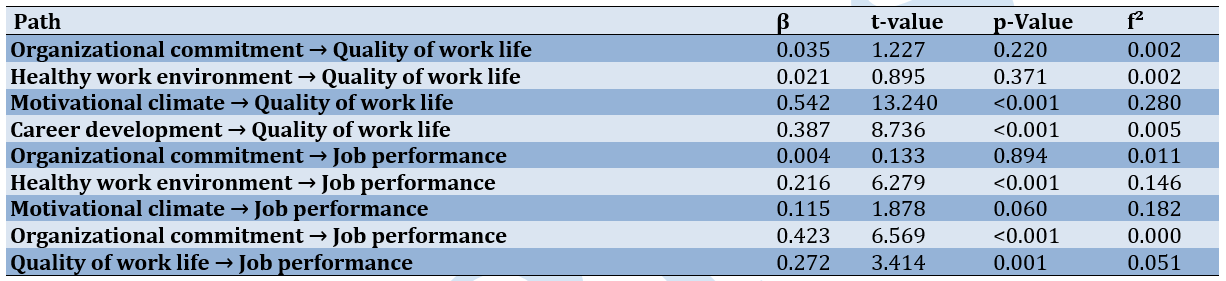
A stimulating atmosphere positively impacted QWL, followed by professional progress. Organizational commitment and a healthy workplace did not significantly affect QWL. Career growth and a positive work environment improved job performance. QWL significantly affected job performance, underscoring its importance as a key factor in health workers' success. The motivational climate and organizational commitment did not affect work performance. Motivational climate had a significant effect on QWL, whereas other relationships exhibited small to moderate effect sizes (Table 3).
Table 3. Structural model results (direct effects)
QWL significantly influenced the relationship between job performance and career advancement, as well as the motivating environment. QWL did not mediate the indirect effects of organizational commitment or a healthy work environment on job performance. Through motivation and career development, QWL selectively and context-dependently enhanced health professionals’ work performance (Table 4).
Table 4. Mediation analysis results (specific indirect effects)

The model tested the relationships among organizational commitment, healthy work environment, motivational climate, career development, QWL, and job performance. Career development and a healthy work environment positively influenced QWL, while organizational commitment and motivational climate did not. Career development, a healthy work environment, and QWL positively affected job performance, whereas organizational commitment and motivational climate had no significant effect. Additionally, QWL partially mediated the effects on motivational climate, career development, and job performance (Figure 1).
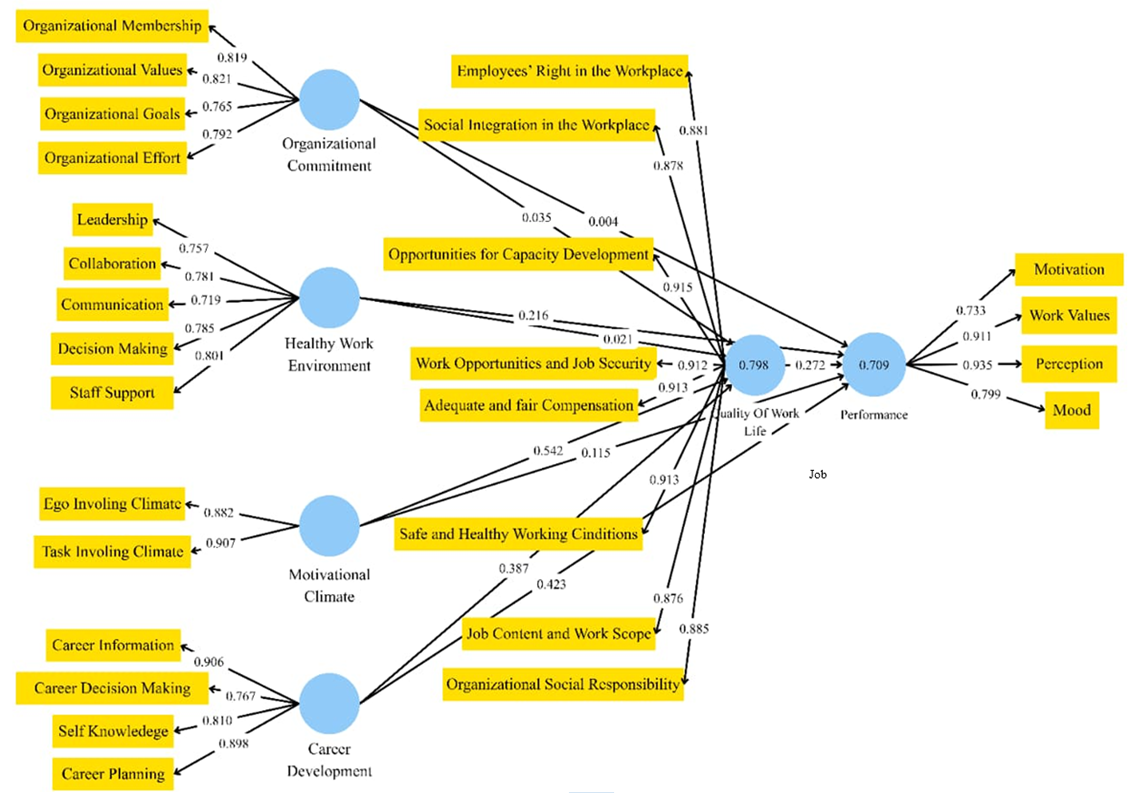
Figure 1. Organizational determinants of health worker performance in a decentralized health system, indicating the selective mediating role of quality of work life.
Discussion
This research aimed to analyze whether QWL consistently mediates the relationship between organizational characteristics and health worker job performance in decentralized health systems. QWL did not automatically moderate health professionals’ work performance. Instead, QWL selectively impacted health professionals within specific organizations and institutions. This study challenged the linear assumptions about QWL and emphasized the need for contextualized explanations in decentralized health systems. Notably, organizational commitment, QWL, and job success were found to be unrelated. In private and centralized organizations, organizational commitment influences employee well-being and performance [20, 21]. Employee commitment motivates individuals to work harder and support organizational goals. However, as with other research, this study suggests that this approach may not be effective in decentralized public health systems [22].
Human-AI collaboration positively impacts employment participation by addressing employees’ fundamental and evolving demands for quality of life at work [23]. This finding differs from other studies that have identified significant relationships among personal life disruption at work, improved work-life balance, and job satisfaction. Furthermore, the findings revealed a substantial, potentially undesirable relationship between work-life balance and the intention to leave one’s position. A study also found that job satisfaction is partially and fully mediated by the intention to quit with respect to both work-life balance parameters [24].
Research in Croatia suggests that the chaos caused by decentralization may explain these results. Health professionals in decentralized systems may face overlapping administrative authorities, inconsistent employment laws, and poor organizational coherence [25]. This contrasts with studies from Germany and France, which report significant relationships among personal life disruption at work, improved work-life balance, and job satisfaction. Additionally, those studies report an adverse relationship between work-life balance and plans to leave the organization. A survey further demonstrates that job satisfaction is partially and fully mediated by the intention to quit, with respect to both work-life balance parameters [26].
As emotional attachment to an organization fades, organizational commitment may lose its appeal. Dedication may not necessarily improve productivity or well-being. This suggests that commitment-based models, which presume stable organizational environments, may not accurately describe performance patterns in decentralized public-sector health systems. This is consistent with other research indicating that decentralized administrative authority affects the political framework and policy implementation, with governance emphasizing both benefits and challenges and highlighting the importance of local attention. Post-crisis restructuring efforts may suggest that an organization has lost credibility due to government interference, increased responsibilities, and performance gaps [27].
Healthy workplaces boosted performance without compromising QWL. This finding contradicts the substantial link often reported between supportive work environments and employee well-being. In decentralized health systems, the work atmosphere may prioritize operations over quality [28]. This is reinforced by a systematic review of several European countries, which found that decentralized management structures, community health worker programs, and mobile health units aim to improve service delivery in challenging conditions. However, ongoing challenges, such as infrastructure damage, resource constraints, and security risks, remain significant barriers to the availability of health services [29].
Work settings with a high psychosocial safety climate are associated with more job resources, including psychological resilience, improved performance, and lower job demands. Conversely, work environments with a low psychosocial safety climate are associated with increased job demands, poorer psychological health, and poorer work performance [30]. Importantly, the psychosocial safety climate acts as a preventative measure, reducing the harmful effects of occupational demands on overall psychological well-being while maintaining positive relationships among job resources, supports, and achievement qualities for healthcare workers [31].
Improvements in the work environment enhanced performance, but not necessarily QWL. A motivating environment and professional success impacted QWL. Internal motivation, recognition, and career opportunities had the strongest effect on health professionals’ work-life satisfaction. Compared with findings in Jordan, nurses sometimes experience frequent work-related stress, moderate QWL, and excellent effectiveness during nursing disease management. The quality of nursing care is positively related to QWL [32]. Stress can exacerbate psychological problems if the burden becomes excessive [33]. Career trajectories and recognition improve employee mental health and engagement. These findings support research on motivational support and healthcare professional development. Such risks may affect QWL in decentralized organizations with uneven, regionally based career ladders. QWL is more influenced by individual motivation and professional advancement than by organizational factors [34].
Our results emphasize the conditionality of QWL. Motivation, career progression, and work performance were mediated by QWL, but organizational commitment and health were not. QWL may emerge when organizational characteristics actively engage workers’ ambitions and long-term professional goals. Research in Pakistan indicates that healthcare providers can be prepared to offer compassionate, patient-centered care by completing extensive medical education and continuing professional development. Integrating humanistic values into healthcare policy and organizational practice is essential for building a balanced approach that recognizes both technological advances and the irreplaceable human touch [35].
Motivation and development determined QWL, whereas structural and environmental factors affected performance. In decentralized health systems, structural constraints may impair emotional or attitudinal processes [36]. We redefine QWL as a conditional rather than a complete mediator to enhance QWL theory. The findings explain why empirical research on QWL’s mediating role has produced varied outcomes by considering the organizational context [36]. This differs from research on Gen Z, which finds that work flexibility is the most important work incentive [37]. Compared to research results in India, where organizations focus on certainty, shared objectives, and collaboration among employees in independently operating small businesses, institutional and organizational concerns, rather than technique, may explain such differences [38].
Decentralized health systems require independent personnel management. A motivating atmosphere and career growth may increase QWL and job performance. Workplace and organizational improvements may boost performance without compromising workers’ well-being [39]. Health managers and policymakers should employ integrated psychological and structural performance interventions instead of solely QWL-centered ones [40]. These results reveal that health professionals require multiple factors to succeed. Organizational and governance factors affect QWL, which is a crucial yet selective process in decentralized health systems. The conditional perspective improves the assessment of worker performance and supports institutionally responsive, evidence-based interventions.
Conclusion
Quality of work life improves health professionals’ performance in decentralized health systems by selectively mediating the effects of motivational climate and career development, while organizational commitment and health environment influence performance through other direct pathways.
Acknowledgments: The authors would like to thank Universitas Sumatera Utara, Faculty of Public Health, Medan, Indonesia, and the health workers in Aceh for allowing the authors to analyze the data presented in this article.
Ethical Permissions: This research received ethical approval from Universitas Sumatera Utara, with approval number 931/KEPK/USU/2025.
Conflicts of Interest: There are no conflicts of interest to declare.
Authors' Contribution: Yuda Pratama M (First Author), Assistant Researcher/Discussion Writer/Statistical Analyst (20%); Yustina I (Second Author), Statistical Analyst (15%); Nurmaini N (Third Author), Introduction Writer/Methodologist/Main Researcher (15%); Zulkarnain Z (Fourth Author), Discussion Writer (10%); Silaban G (Fifth Author), Assistant Researcher (10%); Mutiara E (Sixth Author), Assistant Researcher (10%); Lubis NL (Seventh Author), Assistant Researcher (10%); Sumardiyono S (Eighth Author), Assistant Researcher (10%)
Funding/Support: No funding was received for this study.
Health worker performance affects decentralized care. Central governments have transferred human resource administration to local governments. Decentralization is promoted to improve efficiency, accountability, and service responsiveness, but research indicates that it complicates labor management. Inconsistent employment legislation, managerial skills, and career progression prospects may demotivate health professionals [1]. Understanding the organizational determinants of health professional effectiveness is crucial. Research shows that organizational circumstances, psychological traits, professional competence, and technical skills influence job effectiveness. Regional employment patterns and governance frameworks affect health professionals’ work, organizational support, and career prospects in decentralized settings.
Various events can impact work and mood. The way organizational environments affect employee functioning beyond job requirements is known as quality of work life (QWL). By humanizing work, QWL promotes employee respect and growth [2]. QWL reflects workers’ perceptions of justice, well-being, involvement, and organizational success—not just favorable working conditions. Higher QWL improves mental health, job satisfaction, and performance in demanding industries such as health care [3]. Beyond work, QWL also influences familial, social, and overall life satisfaction [4]. Higher QWL may help health organizations recruit, motivate, and retain skilled workers, thereby enhancing long-term performance and system sustainability [5, 6]. Studies emphasize QWL as an important organizational factor in employee success
However, there is disagreement regarding QWL’s mediating role. Some empirical evidence shows that organizational settings improve performance through QWL, while other studies indicate that certain factors directly affect performance without influencing QWL. Public-sector and decentralized health systems may hinder the relationship between organizational conditions and workers’ subjective job evaluations due to structural limitations, fragmented authority, and restricted career mobility [7, 8].
According to the human resource management and health systems literature, individual, organizational, and systemic factors affect health professionals’ job performance. Organizational, psychological, emotional [9], and institutional factors influence health care job performance, as reported in a study [10]. Frameworks emphasize psychological and social work skills, recognizing that health care is emotionally demanding [11, 12]. QWL, which includes job security, salary, career growth opportunities, and working conditions, is a key factor influencing the retention of healthcare professionals. A study in Serbia found that healthcare workers with better QWL have greater job satisfaction and organizational commitment, thereby reducing the likelihood of professional turnover [13]. Similarly, studies in Indonesia report that improving QWL increases job satisfaction and organizational commitment, both of which are important in reducing healthcare worker turnover [14]. In contrast, other studies report that perceived organizational support (POS) mitigates the negative impact of job stress and work overload. Research conducted in Malaysia, the Philippines, and Indonesia has highlighted the importance of supportive leadership, competitive salaries, and an inclusive organizational culture in retaining academic personnel [15]. Compared with other studies on QWL and work experience, POS simultaneously reduces staff turnover and strengthens institutions by mediating the relationship between QWL and the intention to quit [16].
This research aimed to analyze whether QWL consistently mediates the relationship between organizational characteristics and health worker job performance in decentralized health systems, thereby enhancing context-sensitive understanding of worker performance.
Instrument and Methods
Design
This explanatory quantitative research was conducted on 320 local government primary healthcare workers in Aceh, Indonesia, in 2025. The explanatory design examined both direct and mediated relationships among organizational features, quality of work life (QWL), and health worker performance, exploring causal links between latent parameters and performance outcomes in decentralized health systems [17].
Regarding sample size, structural equation modeling (SEM) generally requires a minimum of five to ten times the number of estimated parameters. The parameters estimated included health worker characteristics (6 parameters), organizational commitment (4 parameters), healthy work environment (5 parameters), motivational climate (2 parameters), career development (4 parameters), QWL (8 parameters), job performance (4 parameters), and 9 arrow directions or correlations, totaling 36 parameters multiplied by 9. Therefore, the maximum required sample size was 324, and the fixed sample size used was 320. The purposive sampling was used. Respondents who had worked for at least one year in primary healthcare facilities and completed the questionnaire fully were selected from primary healthcare workers employed in decentralized health service facilities in Aceh, Indonesia, based on their relevance to the study's objectives.
Instrument
Approved empirical research tools were used to develop a structured, self-administered questionnaire comprising multiple items, each scored on a five-point scale ranging from 1 (strongly disagree) to 5 (strongly agree). The questionnaire measured six key constructs: organizational commitment, QWL, health worker performance, motivating atmosphere, career progression, and healthy work environment. Contextual adaptations ensured the instrument’s relevance to decentralized health systems while maintaining construct validity. The validated status was demonstrated by discriminant validity assessment using the Fornell-Larcker criterion, with values as follows: motivating climate (0.895), job performance (0.849), organizational commitment (0.799), QWL (0.897), healthy work environment (0.769), and career development (0.847). Structural validity was confirmed by a single-factor unidimensional model with a factor score of 0.983. Internal consistency was excellent, with Cronbach’s alpha=0.877 and Guttman split-half coefficient=0.939.
Data collection
A web-based questionnaire created using Google Forms was distributed to mothers among 320 health workers in Aceh, Indonesia. It included closed-ended Likert-scale questions, multiple-choice questions, and open-ended questions. Before releasing the survey, validity and reliability tests were conducted to ensure that the measurement tool was both accurate and consistent. Reliability was assessed using Cronbach’s alpha, while validity was determined through factor analysis and construct validity. The instrument had previously undergone an initial evaluation to assess its accuracy and appropriateness for this research context. These standards included identifying public health institutions by type, location, and patient population.
Data analysis
The SEMpls program was used to assess the correlations and to construct the model. Smart-PLS version 4 was used to perform partial least squares structural equation modeling (PLS-SEM). PLS-SEM was employed for theory development, predictive analysis, and handling complex models with many latent parameters and mediation effects [18]. The measurement and structural models were assessed. Bootstrapping with 5,000 samples and resampling techniques was used to evaluate the path coefficients and indirect effects. T-values above 1.96 and p-values below 0.05 were considered statistically significant at the 95% confidence level [19].
Findings
A high proportion of health workers were aged between 20 and 40 years, accounting for 210 individuals (65.6%), a productive age range. The remaining 110 individuals (34.4%) were aged between 41 and 60 years. Regarding gender distribution, most health workers were female (212, 66.3%), while males accounted for 108 (33.8%). The health workers represented 10 different professional specialties, each comprising approximately 10% of the total sample. Specifically, there were 32 individuals (10.0%) in each of the following professions: medical doctor, dentist, nurse, midwife, health promotion officer, epidemiologist, environmental health officer, medical laboratory technologist, pharmacist, and nutritionist.
Analysis of construct reliability using Cronbach’s alpha, composite reliability, and average variance extracted (AVE) showed that all constructs demonstrated high internal consistency and reliability. Cronbach’s Alpha and composite reliability values were above recommended thresholds, indicating that the items reliably measured their respective constructs. AVE values exceeded 0.50 for all constructs, confirming adequate convergent validity. These results validate the measurement model used in the PLS-SEM analysis for assessing organizational determinants of health worker performance in a decentralized health system (Table 1).
Table 1. Results of construct reliability and convergent validity
Discriminant validity was evaluated using the Fornell-Larcker criterion, which requires that the square root of the AVE for each latent construct be greater than its correlations with other constructs. For all constructs, the square root of the AVE exceeded the inter-construct correlations, providing strong evidence of discriminant validity. Thus, each construct was distinct and measured a unique concept within the model (Table 2).
Table 2. Discriminant validity assessment based on the Fornell-Larcker criterion
A stimulating atmosphere positively impacted QWL, followed by professional progress. Organizational commitment and a healthy workplace did not significantly affect QWL. Career growth and a positive work environment improved job performance. QWL significantly affected job performance, underscoring its importance as a key factor in health workers' success. The motivational climate and organizational commitment did not affect work performance. Motivational climate had a significant effect on QWL, whereas other relationships exhibited small to moderate effect sizes (Table 3).
Table 3. Structural model results (direct effects)
QWL significantly influenced the relationship between job performance and career advancement, as well as the motivating environment. QWL did not mediate the indirect effects of organizational commitment or a healthy work environment on job performance. Through motivation and career development, QWL selectively and context-dependently enhanced health professionals’ work performance (Table 4).
Table 4. Mediation analysis results (specific indirect effects)
The model tested the relationships among organizational commitment, healthy work environment, motivational climate, career development, QWL, and job performance. Career development and a healthy work environment positively influenced QWL, while organizational commitment and motivational climate did not. Career development, a healthy work environment, and QWL positively affected job performance, whereas organizational commitment and motivational climate had no significant effect. Additionally, QWL partially mediated the effects on motivational climate, career development, and job performance (Figure 1).
Figure 1. Organizational determinants of health worker performance in a decentralized health system, indicating the selective mediating role of quality of work life.
Discussion
This research aimed to analyze whether QWL consistently mediates the relationship between organizational characteristics and health worker job performance in decentralized health systems. QWL did not automatically moderate health professionals’ work performance. Instead, QWL selectively impacted health professionals within specific organizations and institutions. This study challenged the linear assumptions about QWL and emphasized the need for contextualized explanations in decentralized health systems. Notably, organizational commitment, QWL, and job success were found to be unrelated. In private and centralized organizations, organizational commitment influences employee well-being and performance [20, 21]. Employee commitment motivates individuals to work harder and support organizational goals. However, as with other research, this study suggests that this approach may not be effective in decentralized public health systems [22].
Human-AI collaboration positively impacts employment participation by addressing employees’ fundamental and evolving demands for quality of life at work [23]. This finding differs from other studies that have identified significant relationships among personal life disruption at work, improved work-life balance, and job satisfaction. Furthermore, the findings revealed a substantial, potentially undesirable relationship between work-life balance and the intention to leave one’s position. A study also found that job satisfaction is partially and fully mediated by the intention to quit with respect to both work-life balance parameters [24].
Research in Croatia suggests that the chaos caused by decentralization may explain these results. Health professionals in decentralized systems may face overlapping administrative authorities, inconsistent employment laws, and poor organizational coherence [25]. This contrasts with studies from Germany and France, which report significant relationships among personal life disruption at work, improved work-life balance, and job satisfaction. Additionally, those studies report an adverse relationship between work-life balance and plans to leave the organization. A survey further demonstrates that job satisfaction is partially and fully mediated by the intention to quit, with respect to both work-life balance parameters [26].
As emotional attachment to an organization fades, organizational commitment may lose its appeal. Dedication may not necessarily improve productivity or well-being. This suggests that commitment-based models, which presume stable organizational environments, may not accurately describe performance patterns in decentralized public-sector health systems. This is consistent with other research indicating that decentralized administrative authority affects the political framework and policy implementation, with governance emphasizing both benefits and challenges and highlighting the importance of local attention. Post-crisis restructuring efforts may suggest that an organization has lost credibility due to government interference, increased responsibilities, and performance gaps [27].
Healthy workplaces boosted performance without compromising QWL. This finding contradicts the substantial link often reported between supportive work environments and employee well-being. In decentralized health systems, the work atmosphere may prioritize operations over quality [28]. This is reinforced by a systematic review of several European countries, which found that decentralized management structures, community health worker programs, and mobile health units aim to improve service delivery in challenging conditions. However, ongoing challenges, such as infrastructure damage, resource constraints, and security risks, remain significant barriers to the availability of health services [29].
Work settings with a high psychosocial safety climate are associated with more job resources, including psychological resilience, improved performance, and lower job demands. Conversely, work environments with a low psychosocial safety climate are associated with increased job demands, poorer psychological health, and poorer work performance [30]. Importantly, the psychosocial safety climate acts as a preventative measure, reducing the harmful effects of occupational demands on overall psychological well-being while maintaining positive relationships among job resources, supports, and achievement qualities for healthcare workers [31].
Improvements in the work environment enhanced performance, but not necessarily QWL. A motivating environment and professional success impacted QWL. Internal motivation, recognition, and career opportunities had the strongest effect on health professionals’ work-life satisfaction. Compared with findings in Jordan, nurses sometimes experience frequent work-related stress, moderate QWL, and excellent effectiveness during nursing disease management. The quality of nursing care is positively related to QWL [32]. Stress can exacerbate psychological problems if the burden becomes excessive [33]. Career trajectories and recognition improve employee mental health and engagement. These findings support research on motivational support and healthcare professional development. Such risks may affect QWL in decentralized organizations with uneven, regionally based career ladders. QWL is more influenced by individual motivation and professional advancement than by organizational factors [34].
Our results emphasize the conditionality of QWL. Motivation, career progression, and work performance were mediated by QWL, but organizational commitment and health were not. QWL may emerge when organizational characteristics actively engage workers’ ambitions and long-term professional goals. Research in Pakistan indicates that healthcare providers can be prepared to offer compassionate, patient-centered care by completing extensive medical education and continuing professional development. Integrating humanistic values into healthcare policy and organizational practice is essential for building a balanced approach that recognizes both technological advances and the irreplaceable human touch [35].
Motivation and development determined QWL, whereas structural and environmental factors affected performance. In decentralized health systems, structural constraints may impair emotional or attitudinal processes [36]. We redefine QWL as a conditional rather than a complete mediator to enhance QWL theory. The findings explain why empirical research on QWL’s mediating role has produced varied outcomes by considering the organizational context [36]. This differs from research on Gen Z, which finds that work flexibility is the most important work incentive [37]. Compared to research results in India, where organizations focus on certainty, shared objectives, and collaboration among employees in independently operating small businesses, institutional and organizational concerns, rather than technique, may explain such differences [38].
Decentralized health systems require independent personnel management. A motivating atmosphere and career growth may increase QWL and job performance. Workplace and organizational improvements may boost performance without compromising workers’ well-being [39]. Health managers and policymakers should employ integrated psychological and structural performance interventions instead of solely QWL-centered ones [40]. These results reveal that health professionals require multiple factors to succeed. Organizational and governance factors affect QWL, which is a crucial yet selective process in decentralized health systems. The conditional perspective improves the assessment of worker performance and supports institutionally responsive, evidence-based interventions.
Conclusion
Quality of work life improves health professionals’ performance in decentralized health systems by selectively mediating the effects of motivational climate and career development, while organizational commitment and health environment influence performance through other direct pathways.
Acknowledgments: The authors would like to thank Universitas Sumatera Utara, Faculty of Public Health, Medan, Indonesia, and the health workers in Aceh for allowing the authors to analyze the data presented in this article.
Ethical Permissions: This research received ethical approval from Universitas Sumatera Utara, with approval number 931/KEPK/USU/2025.
Conflicts of Interest: There are no conflicts of interest to declare.
Authors' Contribution: Yuda Pratama M (First Author), Assistant Researcher/Discussion Writer/Statistical Analyst (20%); Yustina I (Second Author), Statistical Analyst (15%); Nurmaini N (Third Author), Introduction Writer/Methodologist/Main Researcher (15%); Zulkarnain Z (Fourth Author), Discussion Writer (10%); Silaban G (Fifth Author), Assistant Researcher (10%); Mutiara E (Sixth Author), Assistant Researcher (10%); Lubis NL (Seventh Author), Assistant Researcher (10%); Sumardiyono S (Eighth Author), Assistant Researcher (10%)
Funding/Support: No funding was received for this study.
Article Type: Descriptive & Survey |
| Rights and permissions | |
 |
This work is licensed under a Creative Commons Attribution-NonCommercial 4.0 International License. |